Species / Tamaricaceae
Tamarix arceuthoides
Tamaricaceae · Shrub · Uzbek: archakabi yulg‘un; Russian: Гребенщик можжевелловый
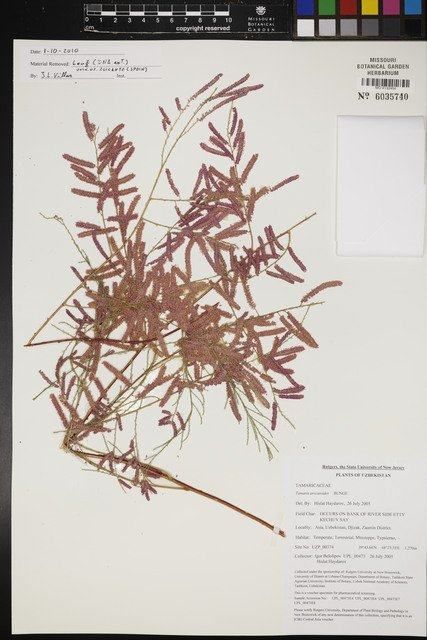
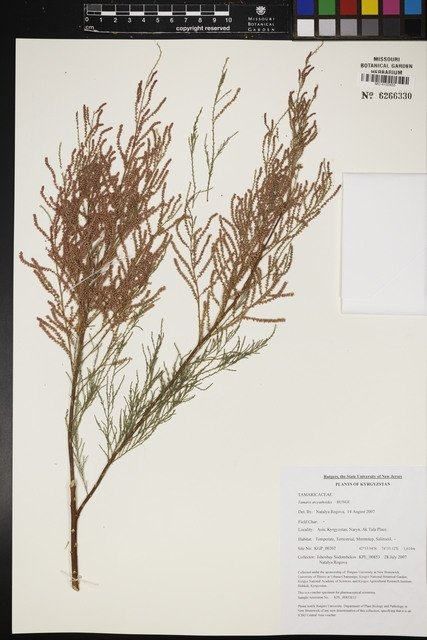
Restoration use by landscape
Kugitangtau Immediate score 79 · rank 16 of 100 shortlisted · rank 18 of 1 208 scored
- Succession role
- Pioneer (riparian stabiliser)
- Suited to
- Gullies & drainage lines; Riparian / sai (other)
- Establishment
- hardwood cuttings / poles
- Why this category
- Strong: erosion control potential, climate resilience, nursery propagation feasibility, restoration cost-effectiveness; Weak: drought tolerance, grazing tolerance; -> routine propagation and available material: use now
- Cautions
- needs moist sites; protect from grazing for 3-5 yrs
- Local habitat
- Forest, Wetlands (inland) · Frequent
Criteria scores
Propagation
hardwood cuttings / poles
Where it fits in the degradation matrix
- Kugitangtau: Gullies & drainage lines (pioneer)
- Kugitangtau: Riparian / sai (other) (pioneer)
Planting material and suppliers
Cuttings or seed to be collected from local stands. No supplier found Action: Collect cuttings in winter 2026–2027 on the same river system
Description
- Morphology
- Shrub or tree, to 2–3 m high, with rufous or brownish-purple or sometimes gray bark and spreading, often dense branches; leaves ovate or sub-deltoid, 1–2 mm mm long, 0.5 broad, acute, decurrent at base; racemes subsessile, erect or often spreading, rather dense, 3–6(9) cm long, 2.4–3.5 mm broad, forming a loose or sometimes fairly dense contracted panicle; bracts ovate -subulate or lance-subulate, 1–1.5 mm long, shorter than to exceeding calyx (including pedicel); pedicels 0.5–0.7 mm long; flowers 5-merous; calyx 0.5–0.7 mm long, about half as long as petals; sepals ovate to oblong-ovate, obtusish, 0.4–0. 5 mm mm long, 0.3 broad, mostly scarlet or reddish-lilac, broadly scarious-margined; petals pink or violet, obovate or elliptical, 1–1.7 mm mm long, 0. [Flora of the USSR (Tree of Life)]
- Habitat
- Valley of river, pebble beds
- Altitudinal belts
- Plain, foothills, low mountains, mid-mountains
- Phenology
- Flowering May–Aug, fruiting Jun–Sep
- Distribution
- Alakol depression, Balkhash deserts, Aral deserts, valley of river Syr Darya, valley of river Amu Darya, Fergana valley, valley of river Zeravshan, Surkhan-Sherabad valley, Dzungarian Alatau, Tian Shan (ranges Trans-Ili Alatau, Kyrgyz Alatau, Talas Alatau, mountains in basin of river Naryn, Terskey Alatau, range Chatkal, Mogotau, range Kurama, Ugam, Pskem, Karatau), Pamir-Alai (Nuratau, ranges Alai, Turkestan, Zarafshan, Hissar, Karategin, Peter the Great, Darvaz, Babatag, western Pamir, foothills of southern Tajikistan), Kopet Dag, Badkhyz
- Uses
- forest amelioration / agroforestry, melliferous, ornamental
- Conservation
- IUCN LC