Species / Tamaricaceae
Tamarix elongata
Tamaricaceae · Shrub · Uzbek: cho‘zilgan yulg‘un; Russian: Гребенщик вытянутый
Restoration use by landscape
Kugitangtau Pilot score 72 · rank 80 of 100 shortlisted · rank 92 of 1 208 scored
- Succession role
- Pioneer (riparian stabiliser)
- Suited to
- Gullies & drainage lines; Riparian / sai (other)
- Establishment
- hardwood cuttings / poles
- Why this category
- Strong: erosion control potential, nursery propagation feasibility, restoration cost-effectiveness; Weak: drought tolerance, grazing tolerance; -> promising but propagation/supply or field performance not proven at scale: pilot plots
- Cautions
- needs moist sites; protect from grazing for 3-5 yrs
- Local habitat
- Desert, Grassland, Wetlands (inland) · Occasional
Criteria scores
Propagation
hardwood cuttings / poles
Planting material and suppliers
No commercial offer found in November 2026: material has to come from wild seed collection or contracted propagation. See Nurseries & supply.
Description
- Morphology
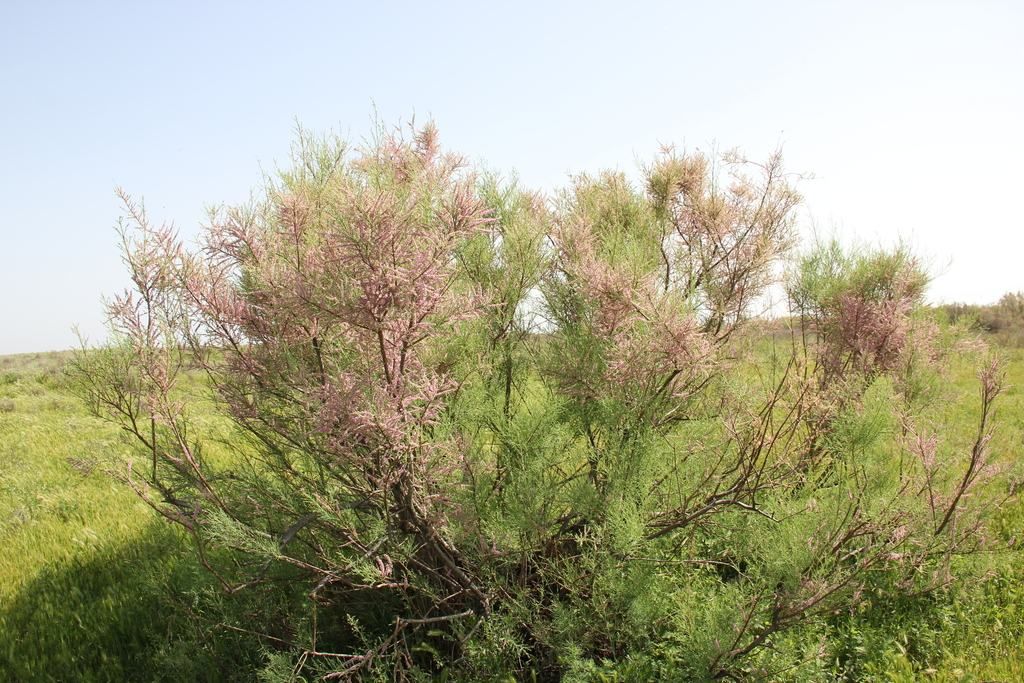
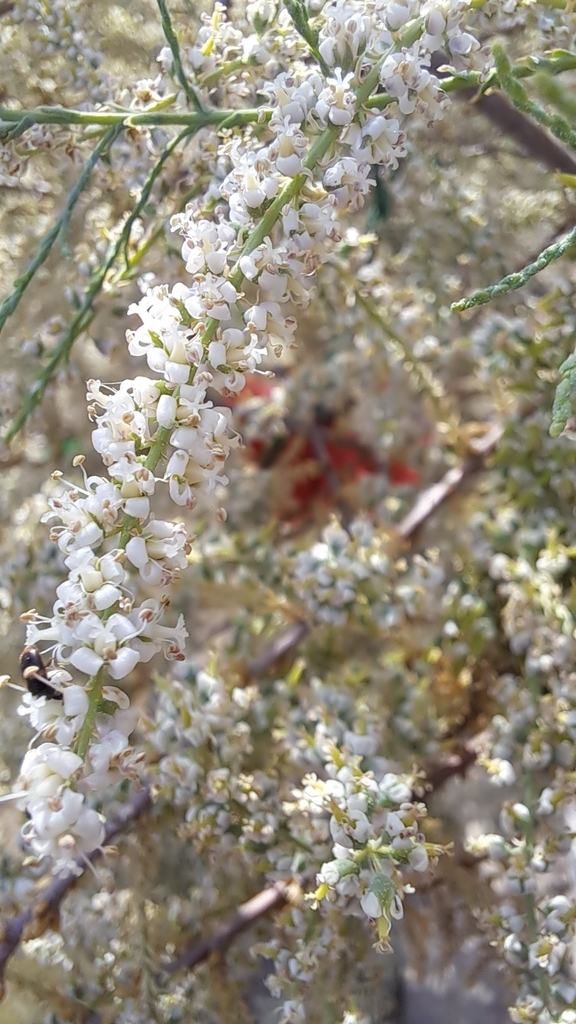
- Shrub or small tree, with yellowish -gray or brownish-gray bark, to 1–3(5) m high; leaves broad-linear, lanceolate or oblong-lanceolate, 1–9 mm long, 0.3–3 mm broad, acute, broadly cordate at base, auriculate, semi-amplexicaul; racemes lateral, simple, 6–15(20) cm long, 0.4–0.8 cm broad, dense; peduncles 1–2 cm long, covered with oblong obtuse scales; bracts linear, 3–6 mm mm long, 0.3–0.7 broad, acuminate, at first somewhat spreading, at length recurved, equaling or exceeding corolla (including pedicel); flowers 4(5)-merous; calyx 1.5 mm long, shorter than petals by ^li or more; sepals broad-ovate, 1mm mm long, 0.3–0.7 broad, acutish, narrowly scarious -margined; petals pale or bright pink or pinkish-violet mm (occasionally white), oblong-oval or elliptical, 2–2.5 mm long, 1–1.3 broad, oblique, obtuse, recurved, partly caducous; stamens 4 (rarely 6 or 7); disk 4(6–7) -angled, gradually dilated at base, equaling or slightly exceeding corolla; ovary ovoid-oblong, 1.3–2 mm long, styles 3, very short, 5–6 times shorter than ovary; capsule 4–6 mm mm long, 2 broad, 2V2~4 times as long as . [Flora of the USSR (Tree of Life)]
- Habitat
- Valley of river, bank of water bodies, solonchaks, takyrs, saline place
- Altitudinal belts
- Plain, low mountains
- Phenology
- Flowering Apr–May, fruiting May–Jun
- Distribution
- Zaisan basin, Turgai depression, Balkhash deserts, Betpakdala, Aral deserts, Emba plateau, Pre-Caspian lowland, Muyunkum, lower reaches of river Chu and Sarysu, valley of river Syrdari, Ustyurt, Mangyshlak, Prikaratav foothill plain, Kyzylkum, valley of river Amudari, Mirzachul, Surkhan-Sherabad valley, Karakum, Tian Shan (Karatau), Pamir-Alai (range Kugitang, Babatag), Kopet Dag
- Uses
- forest amelioration / agroforestry, dye, melliferous, ornamental
- Conservation
- IUCN NE