Species / Solanaceae
Lycium depressum
Solanaceae · Shrub · Uzbek: qisilgan qorachingil; Russian: Дереза прижатая
Restoration use by landscape
Kugitangtau Immediate score 81 · rank 10 of 100 shortlisted · rank 10 of 1 208 scored
- Succession role
- Nurse / intermediate shrub
- Suited to
- Eroded slopes; Rocky slopes; Landslide-prone areas; Gullies & drainage lines; Riparian / sai (other); Degraded pistachio–almond woodland
- Establishment
- seed, cuttings or root suckers
- Why this category
- Strong: erosion control potential; -> routine propagation and available material: use now
- Local habitat
- Rocky areas, Grassland, Desert, Wetlands (inland), Artificial terrestrial · Frequent
Criteria scores
Propagation
seed, cuttings or root suckers
Where it fits in the degradation matrix
- Kugitangtau: Eroded slopes (nurse)
- Kugitangtau: Rocky slopes (nurse)
- Kugitangtau: Landslide-prone areas (nurse)
- Kugitangtau: Gullies & drainage lines (nurse)
- Kugitangtau: Degraded pistachio–almond woodland (nurse)
- Kugitangtau: Riparian / sai (other) (nurse)
Planting combinations
- Kugitangtau: Gullies, sai and Sherabad river margins (Phase 2)
Planting material and suppliers
Cuttings or seed to be collected from local stands. No supplier found Action: Collect cuttings in winter 2026–2027 on the same river system
Description
- Morphology
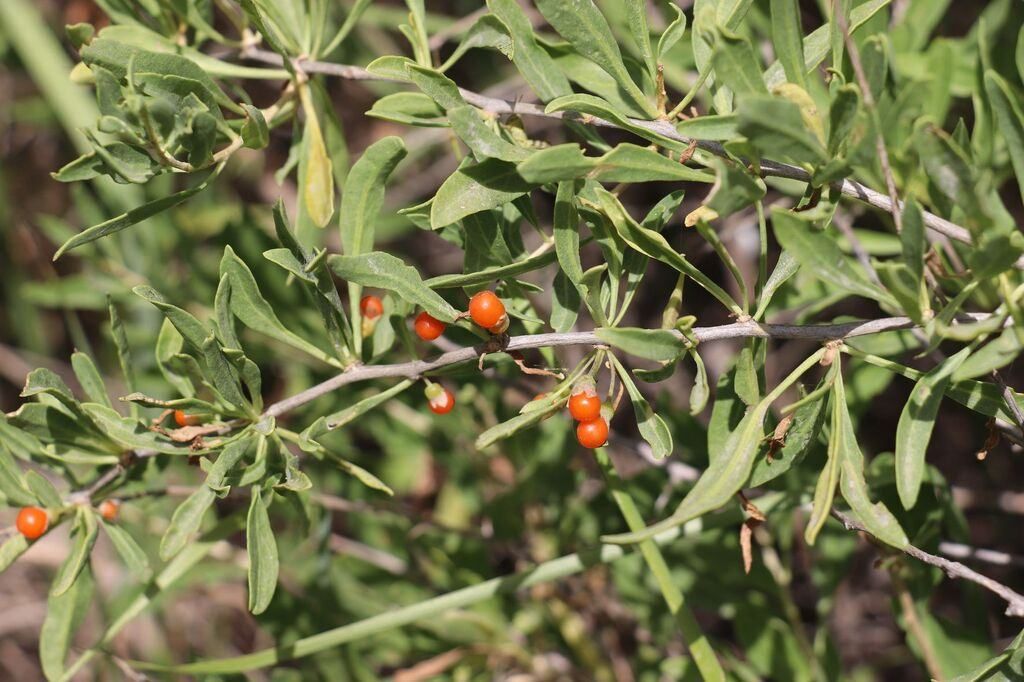
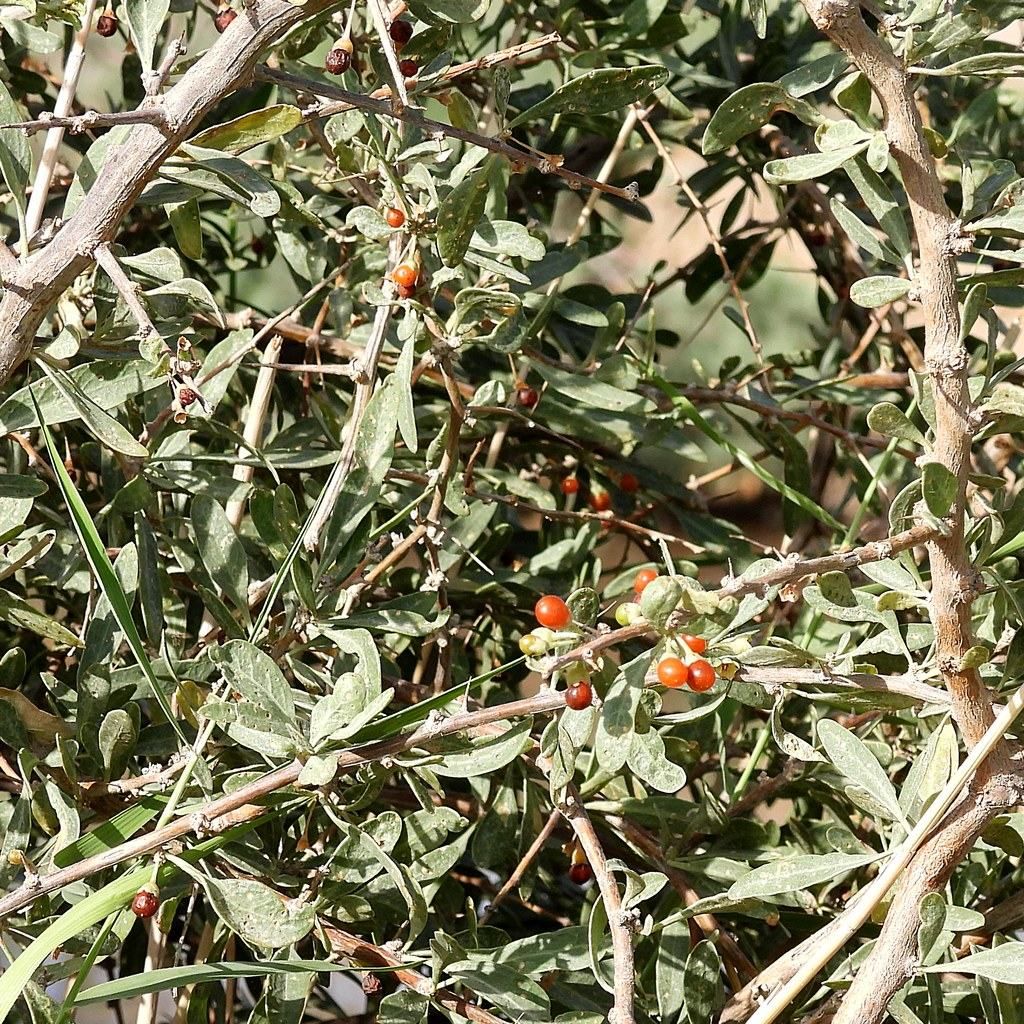
- Spiny glabrous shrub up to 1.5–2.5 m tall with knotty strong spreading branches, clothed grey, along cracking bark, and 1–2-summer rod-like, often изгибистыми shoots, clothed whitish bark and set with frequent strong spines, leafless or bearing buds, from which develop flowers and leaves. Leaves light-glaucous, thick, fleshy, almost cylindrical, with indistinct conspicuous middle vein, oblong-oblanceolate, obtuse or, more rarely, acute, gradually narrowed towards the base, 2–5(6) cm long, 0.2–1(1.5) cm wide, on petioles 2–6 times shorter than the blade, developing from buds of lateral extra-axillary shortened shoots, whereby approximate in fascicles. Flowers together with leaves arranged fascicles along 3–5 on pedicels 4–12 mm long. Calyx broad-campanulate, unequal 5 (4–6) -toothed or cut on 2–3 lobes. Corolla light-violet, (9)10–13 mm long, with funnel-shaped, widening gradually upward tube and limb, in 1.5–2 times more short, than tube, cut on 5 (more rarely 4–6) ovate or oblong-ovate lobes, along the margin with sparse short cilia. Stamens almost identical along length, with filaments, attached higher than the middle of tube, glabrous. Berries red, globose or ovate-globose, 4–8 mm long, with (2)5–9 (– 15) seeds. Seed reniform, 2–3 mm long. [Flora of Uzbekistan (Tree of Life)]
- Habitat
- Outcrops of variegated rocks, gravelly slopes, screes, sandy deserts, solonchaks, dry watercourse bed, tugais
- Altitudinal belts
- Plain, foothills
- Phenology
- Flowering May–Aug, fruiting Jun–Sep
- Distribution
- Valley of river Amu Darya (middle course), southeastern Karakum, Zauzboy, Pamir-Alai (southwestern spurs of Hissar range, foothills of southern Tajikistan, Babatag, Sherabad valley, Kugitang), Kopet Dag, Kyurendag, large and Lesser Balkhan, Karabil-badkhyz
- Uses
- forest amelioration / agroforestry, medicinal, melliferous, oil
- Conservation
- IUCN NE