Restoration use by landscape
West Tian Shan Pilot score 75 · rank 32 of 79 shortlisted · rank 41 of 1 194 scored
- Succession role
- Nurse / intermediate shrub
- Suited to
- Gullies & drainage lines; Riparian / sai (other); Degraded walnut–fruit and broadleaf woodland (other); Degraded juniper woodland; Degraded pistachio–almond woodland
- Establishment
- stratified seed, root suckers, cuttings; nursery
- Why this category
- Strong: erosion control potential; Weak: drought tolerance; -> promising but propagation/supply or field performance not proven at scale: pilot plots
- Cautions
- needs moist sites
- Local habitat
- Rocky areas, Shrubland, Forest, Grassland, Wetlands (inland), Artificial terrestrial · Occasional
Criteria scores
Propagation
stratified seed, root suckers, cuttings; nursery
Where it fits in the degradation matrix
- West Tian Shan: Riparian / sai (other) (nurse)
Planting material and suppliers
No commercial offer found in November 2026: material has to come from wild seed collection or contracted propagation. See Nurseries & supply.
Description
- Morphology
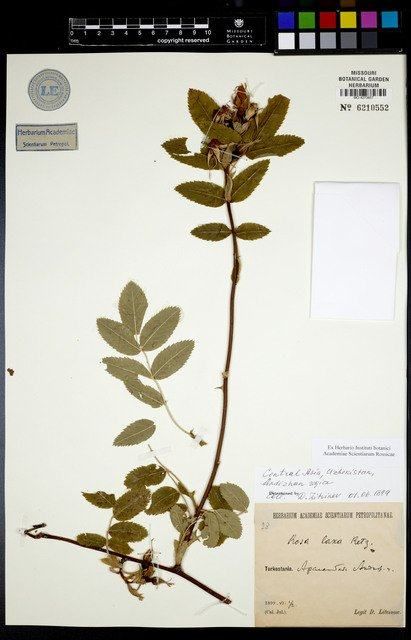
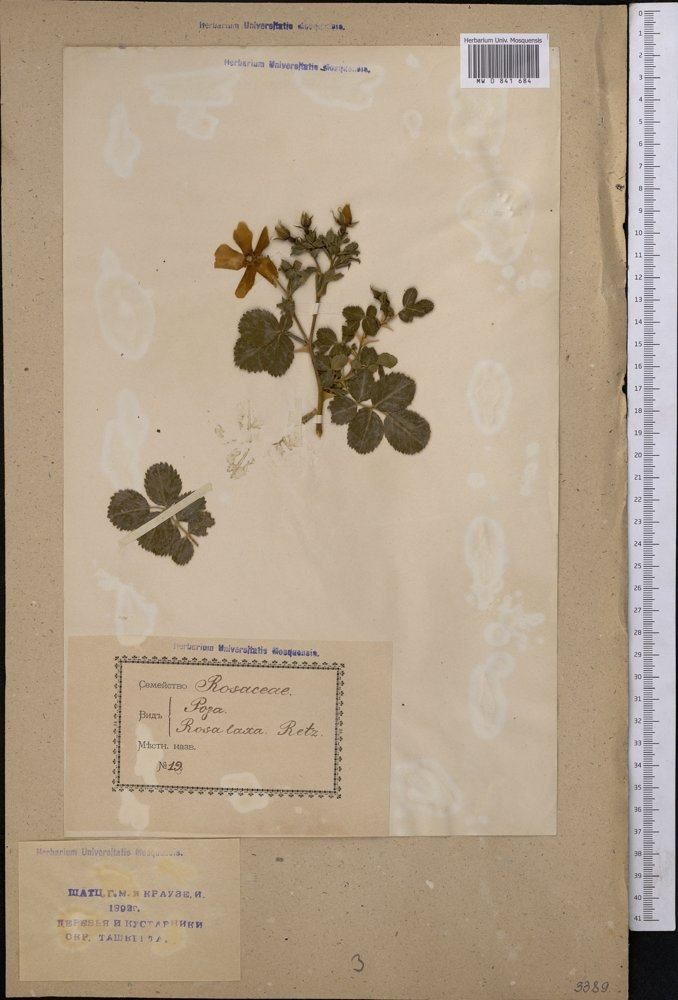
- Shrub, to 2m high, stem arcuate, with strong branches; bark nearly always green, glaucescent (at least when young); prickles sparse, rather large, strongly arcuately downcurved, flattened, with distinctly broadened base, normally in pairs at base of leaves, mainly at base of stem with mixture of medium-sized heterogeneous prickles, prickles on very thin shoots (nearly) erect, often very thin; stipules rather broad, sometimes with glandular margin, with small, ovate divergent auricles, not increased in upper leaves; petioles short, slightly downy, sometimes glandular, with weak prickles; leaves 3–10cm long, leaflets 5–9, ovate, obovate, elliptic or oblong, the largest 1.5–4.5cm long, 8-25 mm wide, obtuse, serrate-dentate, with simple teeth, grayish green, glabrous on both sides or slightly downy beneath, rather compact. [Flora of the USSR (Tree of Life)]
- Habitat
- Fine-earth, stony slopes, deciduous forest and shrubs, juniper woodlands, bank of river and lake
- Altitudinal belts
- Plain, foothills, low mountains, mid-mountains
- Phenology
- Flowering May–Jun, fruiting Jul–Sep
- Distribution
- Zaisan basin, Kazakhstan small hills, Ustyurt (chink (escarpment)), range Monrak, Tarbagatai, Dzungarian Alatau, Tian Shan (Ketmentau, Trans-Ili Alatau, Kungey Alatau, Terskey Alatau, Kyrgyz Alatau, Karatau, Talas Alatau, Tashkent Alatau, Chatkal and Fergana ranges), Pamir-Alai (Turkestan and Zarafshan ranges)
- Uses
- forest amelioration / agroforestry, medicinal, melliferous, ornamental
- Conservation
- IUCN NE