Species / Rosaceae
Rosa fedtschenkoana
Rosaceae · Shrub · Uzbek: Korjinskiy namatagi; Russian: Шиповник Коржинского
Restoration use by landscape
West Tian Shan Immediate score 81 · rank 5 of 79 shortlisted · rank 7 of 1 194 scored
- Succession role
- Nurse / intermediate shrub
- Suited to
- Eroded slopes; Rocky slopes; Landslide-prone areas; Gullies & drainage lines; Degraded walnut–fruit and broadleaf woodland (other); Degraded juniper woodland; Degraded pistachio–almond woodland
- Establishment
- stratified seed, root suckers, cuttings; nursery
- Why this category
- Strong: erosion control potential; -> routine propagation and available material: use now
- Local habitat
- Rocky areas, Grassland · Frequent
Criteria scores
Propagation
stratified seed, root suckers, cuttings; nursery
Where it fits in the degradation matrix
- West Tian Shan: Eroded slopes (nurse)
- West Tian Shan: Rocky slopes (nurse)
- West Tian Shan: Landslide-prone areas (nurse)
- West Tian Shan: Gullies & drainage lines (nurse)
- West Tian Shan: Degraded juniper woodland (nurse)
- West Tian Shan: Degraded pistachio–almond woodland (nurse)
- West Tian Shan: Degraded walnut–fruit and broadleaf woodland (other) (nurse)
Planting material and suppliers
Seed collection and nursery propagation needed. Not named in any offer; the Burchmulla nurseries grow other species to order on an advance agreement Action: Collect seed in autumn 2027; planting stock from 2028
Description
- Morphology
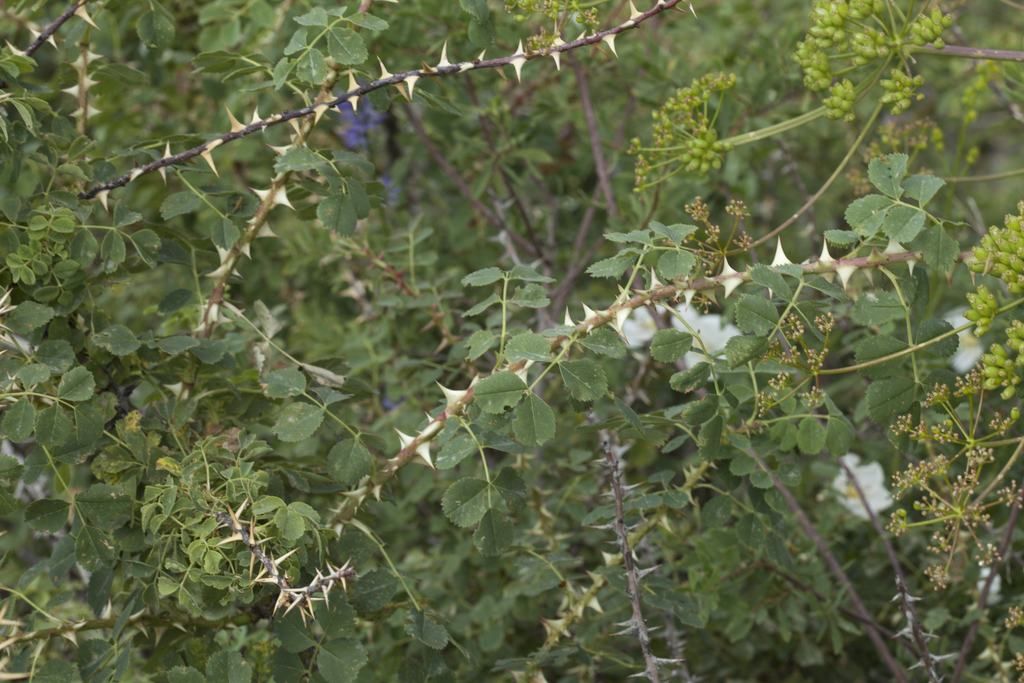
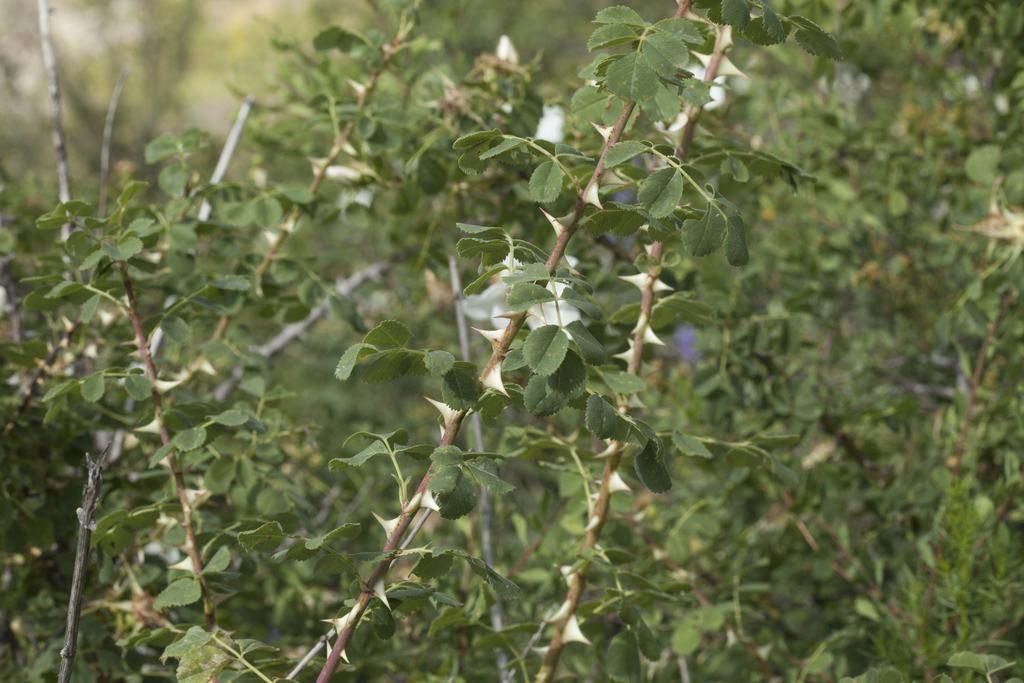
- Shrub, 1 m high; prickles often erect, sometimes slightly directed upward, remote or in pairs, in part very robust, gradually broadened at base, others rather thin, abruptly and strongly broadened at base, usually shorter than (very rarely as long as) the larger leaflets, whitish or straw yellow; (with the exception of turions) acicular prickles absent; leaves 2–10 cm long; leaflets generally 7–9, orbicular, obovate or elliptic, orbicular or slightly tapering at base, obtuse, orbicular or acute at apex, 1–3 cm long, glabrous above or barely pubescent, frequently lightly appressed -hairy, eglandulose or with glands only along midrib;beneath; teeth often sinnple, 8–2 at each side; stipules mostly broad with triangular, more or less glandular divergent auricles. [Flora of the USSR (Tree of Life)]
- Habitat
- Fine-earth, gravelly, stony slopes, rocks, gorge, deciduous forest and shrubs, juniper woodlands
- Altitudinal belts
- Low mountains, mid-mountains, high mountains
- Phenology
- Flowering Jun–Jul, fruiting Aug–Sep
- Distribution
- Dzungarian Alatau, Tian Shan (ranges Trans-Ili, Kungey, Terskey, Kyrgyz Alatau, Karatau, Talas Alatau, Uzun-akhmat, Ugam, Chatkal, Fergana and Kurama), Pamir-Alai (ranges Alai, Trans-Alai, Turkestan, Zarafshan, Hissar, Darvaz, Vakhan, Shugnan)
- Uses
- forest amelioration / agroforestry, food, medicinal, melliferous, ornamental
- Conservation
- IUCN NE