Restoration use by landscape
Kugitangtau Immediate score 83 · rank 5 of 100 shortlisted · rank 5 of 1 208 scored
- Succession role
- Nurse / intermediate shrub
- Suited to
- Eroded slopes; Rocky slopes; Landslide-prone areas; Degraded juniper woodland; Degraded pistachio–almond woodland
- Establishment
- stratified seed, root suckers, cuttings; nursery
- Why this category
- Strong: drought tolerance, erosion control potential; -> routine propagation and available material: use now
- Local habitat
- Rocky areas, Grassland, Shrubland, Forest, Artificial terrestrial · Frequent
Criteria scores
Propagation
stratified seed, root suckers, cuttings; nursery
Where it fits in the degradation matrix
- Kugitangtau: Eroded slopes (nurse)
- Kugitangtau: Rocky slopes (nurse)
- Kugitangtau: Landslide-prone areas (nurse)
- Kugitangtau: Degraded juniper woodland (nurse)
- Kugitangtau: Degraded pistachio–almond woodland (nurse)
Planting combinations
- Kugitangtau: Degraded pistachio woodland (foothills and low mountains, ~600–1,400 m) (Phase 2)
Planting material and suppliers
Available for procurement now. Boysun SFE: 10,000 rosehip seedlings at 10,000 UZS and 160 kg of seed at 110,000 UZS per kg. Burchmulla private nurseries: 200,000 rosehip seedlings at 15,000 UZS (Table 7.5). Platform price for R. canina: seedling 10,000 UZS, seed 8,000 UZS per kg (Table 7.4) Action: Confirm the species of each lot and the origin of the seed before purchase
| Supplier | Material | Quantity | Price | Source |
|---|---|---|---|---|
| Boysun SFE | Seedling (Rosehip (na'matak)) | 10 000 pcs | 10 000 UZS per piece | Table 7.5 |
| Boysun SFE | Seed (Rosehip seed) | 160 kg | 110 000 UZS per kg | Table 7.5 |
Description
- Morphology
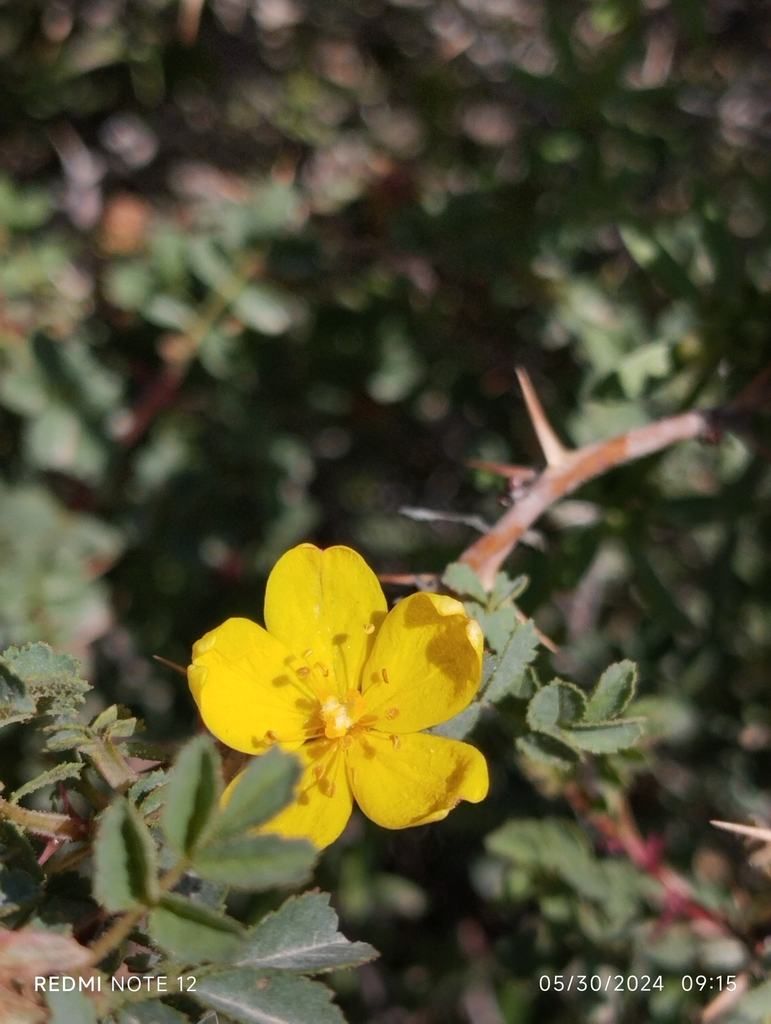
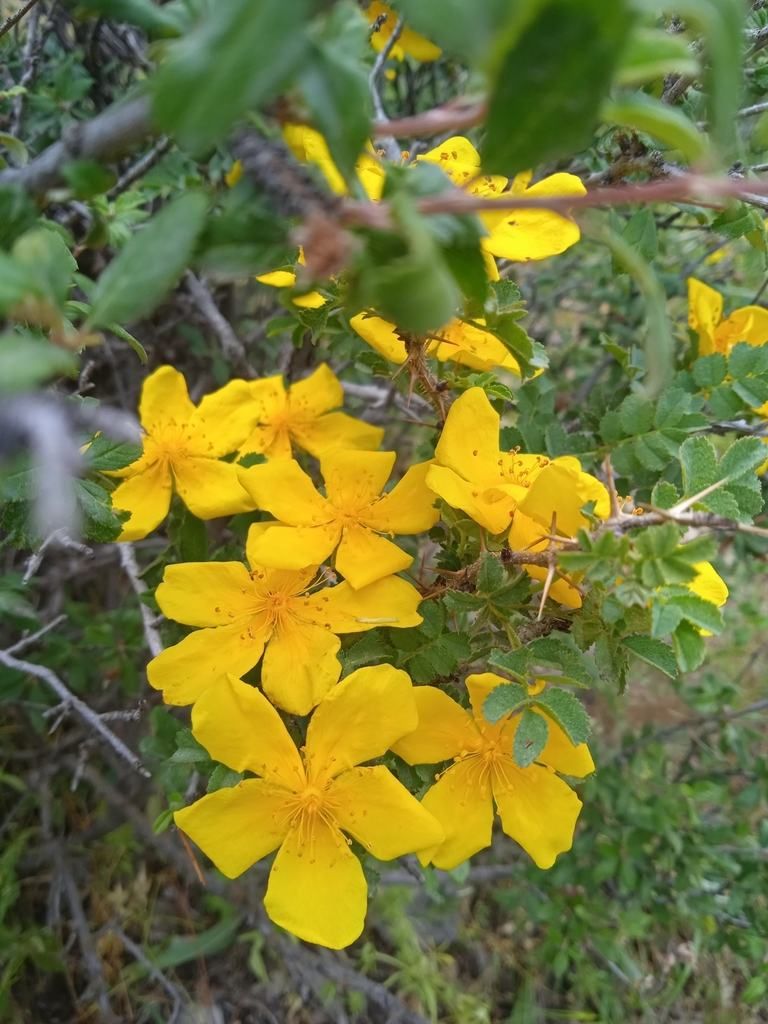
- Plant. XIV (I88I) tab. 1329; Hook. f. in Curtis Bot. Mag. LV (l899) tab. 7666 (sub R, x an t hin a). Shrub, 1 m high, with flexuous shoots and gray bark; prickles of uniform length (pricklets and bristles absent), purple or whitish, erect, often inclined upward, long, thin, flattened, with considerably broadened, decurrent base, often densely crowded and contiguous; petioles and rachis often finely glandular; stipules narrow, with divergent auricles, margin finely glandular; leaflets 5–9(ll), very small, (2)5–7 mm long, glaucescent green, oblong or orbicular, dentate or fairly bidentate, with 4–9 predominantly obtuse teeth on each side, glabrous above, glabrous or pubescent beneath, bearing minute yellowish glands. Flowers solitary, small, usually ca. [Flora of the USSR (Tree of Life)]
- Habitat
- Fine-earth, gravelly, stony slopes, outcrops of variegated rocks, thickets of shrubs, juniper woodlands
- Altitudinal belts
- Low mountains, mid-mountains, high mountains
- Phenology
- Flowering May–Jun, fruiting Jul
- Distribution
- Tian Shan (Susamyrtau, Talas Alatau, Chatkal, Fergana and Kurama ranges, Mogoltau), Pamir-Alai (ranges Alai, Turkestan, Zarafshan, Hissar, Darvaz, Peter the Great, Karategin, Babatag, Kugitang, foothills of southern Tajikistan: mountains Gazimaylik, Aktau and Karatau)
- Uses
- food, medicinal, melliferous, ornamental, weedy
- Conservation
- IUCN NE