Species / Rosaceae
Rosa corymbifera
Rosaceae · Shrub · Uzbek: Qalqonli namatak; Russian: Шиповник щитконосный
Restoration use by landscape
West Tian Shan Pilot score 74 · rank 45 of 79 shortlisted · rank 54 of 1 194 scored
- Succession role
- Nurse / intermediate shrub
- Suited to
- Eroded slopes; Rocky slopes; Landslide-prone areas; Gullies & drainage lines; Degraded walnut–fruit and broadleaf woodland (other); Degraded juniper woodland; Degraded pistachio–almond woodland
- Establishment
- stratified seed, root suckers, cuttings; nursery
- Why this category
- Strong: erosion control potential; -> promising but propagation/supply or field performance not proven at scale: pilot plots
- Local habitat
- Rocky areas, Grassland · Occasional
Criteria scores
Nuratau Pilot score 77 · rank 20 of 80 shortlisted · rank 23 of 640 scored
- Succession role
- Nurse / intermediate shrub
- Suited to
- Eroded slopes; Rocky slopes; Landslide-prone areas; Gullies & drainage lines; Degraded juniper woodland; Degraded pistachio–almond woodland
- Establishment
- stratified seed, root suckers, cuttings; nursery
- Why this category
- Strong: erosion control potential; -> promising but propagation/supply or field performance not proven at scale: pilot plots
- Local habitat
- Forest, Shrubland, Rocky areas · Occasional
Criteria scores
Propagation
stratified seed, root suckers, cuttings; nursery
Where it fits in the degradation matrix
- Nuratau: Eroded slopes (nurse)
- Nuratau: Landslide-prone areas (nurse)
- Nuratau: Gullies & drainage lines (nurse)
- Nuratau: Degraded juniper woodland (nurse)
- Nuratau: Degraded pistachio–almond woodland (nurse)
Planting material and suppliers
No commercial offer found in November 2026: material has to come from wild seed collection or contracted propagation. See Nurseries & supply.
Description
- Morphology
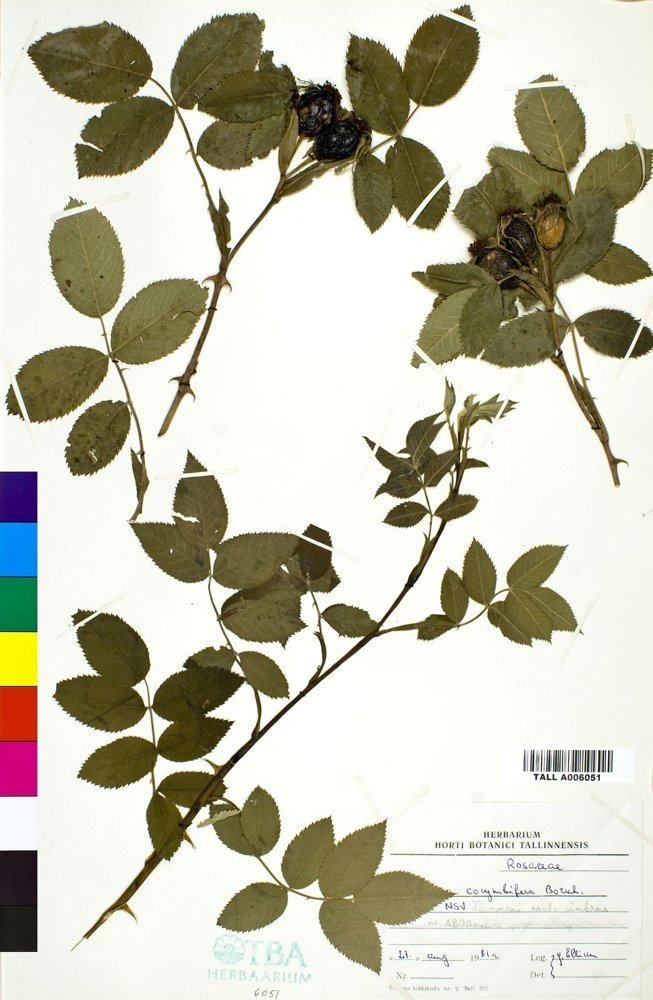
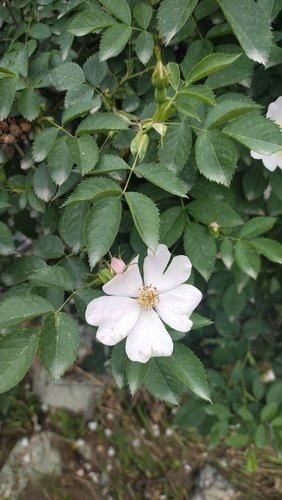
- Shrub; plant similar to preceding species from which it is distinguished only by the pubescence of the leaves; prickles equal, hamate; leaflets 5–7, large, ovate, more or less pubescent on both sides, at least beneath where hairs are sometimes confined to veins, simple -dentate, teeth less prominent than in R. c anina, rarely nearly bidentate, with 1–2 glands; petioles smooth or faintly glandular; stipules broadened. Flowers long-pediceled, mediumsized, white or pale pink, with lanceolate bracts; hypanthia, pedicels and lower side of sepals smooth, rarely with remote stalked glands; sepals recurved below, pinnate, often with foliate appendages; style heads pediceled, pubescent or glabrous; fruit ovoid, sepals persistent. June— July. [Flora of the USSR (Tree of Life)]
- Habitat
- Valley of river, fine-earth, gravelly, stony slopes, deciduous forest and shrubs, juniper woodlands
- Altitudinal belts
- Low mountains, mid-mountains
- Phenology
- Flowering Jun–Jul (Flora of the USSR)
- Distribution
- Western Tian Shan (Kyrgyz Alatau, western part Karatau, Talas Alatau, Uzun-akhmat, Pskem, Ugam, Chatkal, Fergana and Kurama ranges), Pamir-Alai (ranges Alai, Trans-Alai, Turkestan, Zarafshan, Hissar, Karategin, Peter the Great, Darvaz, Kugitang), Kopet Dag (central and western)
- Uses
- forest amelioration / agroforestry, food, medicinal, melliferous, ornamental
- Conservation
- IUCN NE