Restoration use by landscape
West Tian Shan Immediate score 85 · rank 1 of 79 shortlisted · rank 2 of 1 194 scored
- Succession role
- Nurse / intermediate shrub
- Suited to
- Eroded slopes; Rocky slopes; Landslide-prone areas; Gullies & drainage lines; Degraded walnut–fruit and broadleaf woodland (other); Degraded juniper woodland; Degraded pistachio–almond woodland
- Establishment
- stratified seed, root suckers, cuttings; nursery
- Why this category
- Strong: erosion control potential, climate resilience, seed; in documented forestry/nursery use (D1); -> routine propagation and available material: use now
- Local habitat
- Rocky areas, Grassland · Frequent
Criteria scores
Nuratau Immediate score 79 · rank 14 of 80 shortlisted · rank 15 of 640 scored
- Succession role
- Nurse / intermediate shrub
- Suited to
- Eroded slopes; Landslide-prone areas; Gullies & drainage lines; Riparian / sai (other); Degraded juniper woodland; Degraded pistachio–almond woodland
- Establishment
- stratified seed, root suckers, cuttings; nursery
- Why this category
- Strong: erosion control potential, seed; in documented forestry/nursery use (D1); -> routine propagation and available material: use now
- Local habitat
- Forest, Shrubland, Grassland, Rocky areas, Wetlands (inland), Artificial aquatic, Artificial terrestrial · Frequent
Criteria scores
Kugitangtau Immediate score 79 · rank 15 of 100 shortlisted · rank 15 of 1 208 scored
- Succession role
- Nurse / intermediate shrub
- Suited to
- Eroded slopes; Landslide-prone areas; Gullies & drainage lines; Riparian / sai (other); Degraded juniper woodland; Degraded pistachio–almond woodland
- Establishment
- stratified seed, root suckers, cuttings; nursery
- Why this category
- Strong: erosion control potential, seed; in documented forestry/nursery use (D1); -> routine propagation and available material: use now
- Local habitat
- Artificial terrestrial, Forest, Grassland, Rocky areas, Shrubland, Wetlands (inland) · Frequent
Criteria scores
Propagation
stratified seed, root suckers, cuttings; nursery
Where it fits in the degradation matrix
- West Tian Shan: Eroded slopes (nurse)
- West Tian Shan: Rocky slopes (nurse)
- West Tian Shan: Landslide-prone areas (nurse)
- West Tian Shan: Gullies & drainage lines (nurse)
- West Tian Shan: Degraded juniper woodland (nurse)
- West Tian Shan: Degraded pistachio–almond woodland (nurse)
- West Tian Shan: Degraded walnut–fruit and broadleaf woodland (other) (nurse)
- Nuratau: Eroded slopes (nurse)
- Nuratau: Landslide-prone areas (nurse)
- Nuratau: Gullies & drainage lines (nurse)
- Nuratau: Degraded juniper woodland (nurse)
- Nuratau: Degraded pistachio–almond woodland (nurse)
- Nuratau: Riparian / sai (other) (nurse)
- Kugitangtau: Gullies & drainage lines (nurse)
- Kugitangtau: Degraded juniper woodland (nurse)
- Kugitangtau: Riparian / sai (other) (nurse)
Planting combinations
- West Tian Shan: Eroded and landslide-prone slopes (Akhangaran mining and road cuts, steep loess slopes) (Phase 2)
- Nuratau: Gullies, sai and drainage lines (Phase 2)
Description
- Morphology
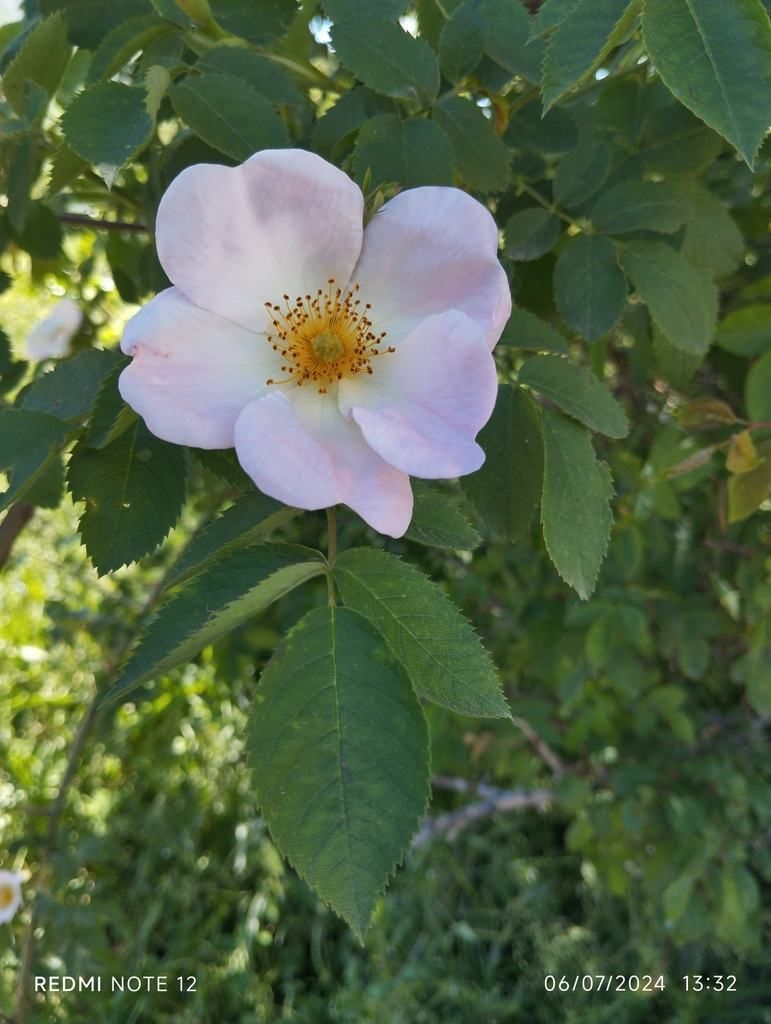
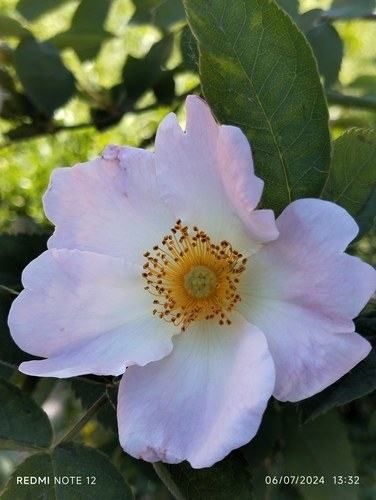
- High, sparse, branching shrub with arcuate branches; bark green or red -brown, usually without glaucous bloomj prickles often sparse or remote, on main shoots, in pairs or whorled, with very broad base, compressed, falcately curved (very rarely suberect), smaller on fertile shoots and usually rather abundant; leaves glabrous or with few hairs on rachis above, green or glaucescent; stipules narrow, only in terminal leaves slightly broadened, with distally divergent auricles, glandular -ciliate; leaflets of different shapes, often elliptic, 1.5–6 cm long, acuminate, acutely serrate, with thin -acuminate teeth curving upward, simple or with 1–2 secondary teeth terminating in a gland, smooth or at times sparsely glandular along veins beneath. [Flora of the USSR (Tree of Life)]
- Habitat
- River valleys, fine-earth, gravelly and stony slopes, deciduous forests and shrublands, juniper woodlands
- Altitudinal belts
- Low mountains, mid-mountains
- Phenology
- Flowering May–Jun, fruiting Jul–Sep
- Distribution
- Tian Shan (Trans-Ili, Kyrgyz and Talas Alatau, Karatau, Karzhantau, Ugam, Chatkal, Fergana and Kurama ranges), Pamir-Alai (Alai, Turkestan, Zeravshan, Hissar, Karategin, Peter the First and Darvaz ranges, low mountains of Southern Tajikistan: Gardani-Ushty, Rengentau and Karatau; Kugitang), Kopet Dag (Central)
- Uses
- forest amelioration / agroforestry, food, medicinal, melliferous, oil, ornamental, tannin
- Conservation
- IUCN NE