Species / Polygonaceae
Polygonum paronychioides
Polygonaceae · Subshrub · Uzbek: tarmag‘ toron; Russian: Горец приноготковидный
Restoration use by landscape
Nuratau Pilot score 72 · rank 65 of 80 shortlisted · rank 74 of 640 scored
- Succession role
- Pioneer (ground cover)
- Suited to
- Eroded slopes; Rocky slopes; Degraded pistachio–almond woodland
- Establishment
- seed (protocol to confirm)
- Why this category
- Strong: climate resilience; Weak: grazing tolerance; -> promising but propagation/supply or field performance not proven at scale: pilot plots
- Cautions
- protect from grazing for 3-5 yrs
- Local habitat
- Rocky areas · Frequent
Criteria scores
Propagation
seed (protocol to confirm)
Planting material and suppliers
No commercial offer found in November 2026: material has to come from wild seed collection or contracted propagation. See Nurseries & supply.
Description
- Morphology
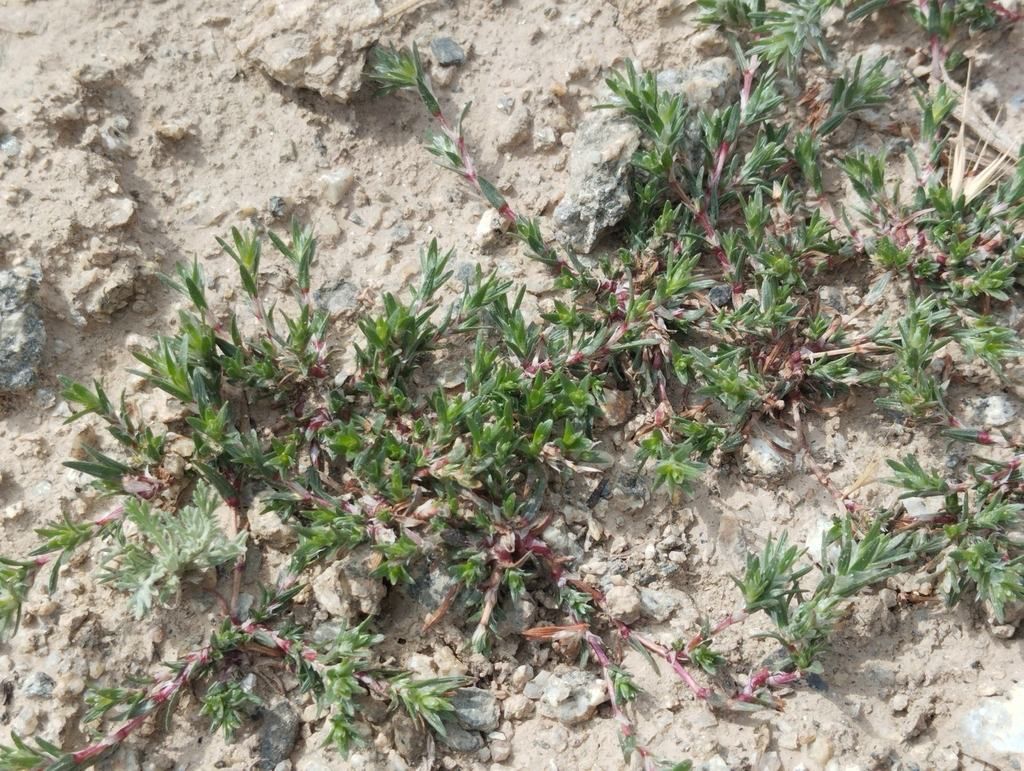
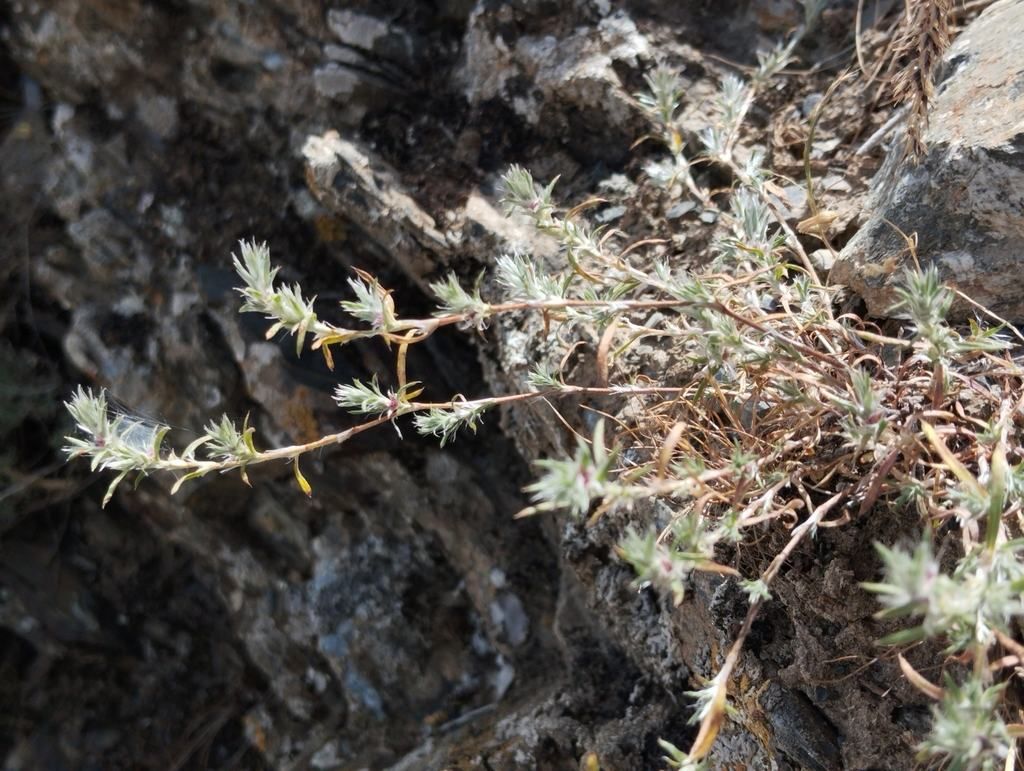
- Shrub; rhizome woody, thickened or slender and multicipital; branches mostly prostrate, very rough, 5–30 cm long, herbaceous or woody and then erect (f. suf f ru t ic o sum Kom.); high-mountain specimens sometimes forming a subspherical top with very dense short branchlets (f. compactum B. Fedtsch. in supplement to the journal "Zemlevedenie" (Geography), 1900, No. 9, 186); ocreae white, lustrous, subpellucid, on young branchlets longer than the internodes and often longer than the leaves, on old branches half as long as the internodes, lanceolate to oval -lanceolate, at the ends of branchlets numerous, approximate, imbricated, finally disintegrating into filiform shreds; leaves narrowly linear, acute, 1 -nerved, 8–15 mm long and 0.7–1.5mm broad, scabrous, often revolute -margined and spinous -tipped; flowers axillary, solitary, enclosed in the ocreae; perianth segments shorter than the tube (in very young flowers longer, roseate); stamens 8, the filaments strongly dilated toward base; achene sharply 3 -angled, oblong, quite smooth, lustrous. May —September. [Flora of the USSR (Tree of Life)]
- Habitat
- Mountain slopes, screes, limestones, pebble beds, outcrops of variegated rocks, thickets of shrubs, juniper woodlands, wormwood steppes, fescue steppes
- Altitudinal belts
- Foothills, low mountains, mid-mountains, high mountains
- Phenology
- Flowering May–Jul, fruiting Jun–Sep
- Distribution
- Fergana valley, western Tian Shan, Pamir-Alai, Badkhyz, Kopet Dag
- Uses
- tannin
- Conservation
- IUCN NE