Species / Rhamnaceae
Rhamnus cathartica
Rhamnaceae · Tree, shrub · Uzbek: yumshatuvchi tog‘jumrut; Russian: Жостер слабительный
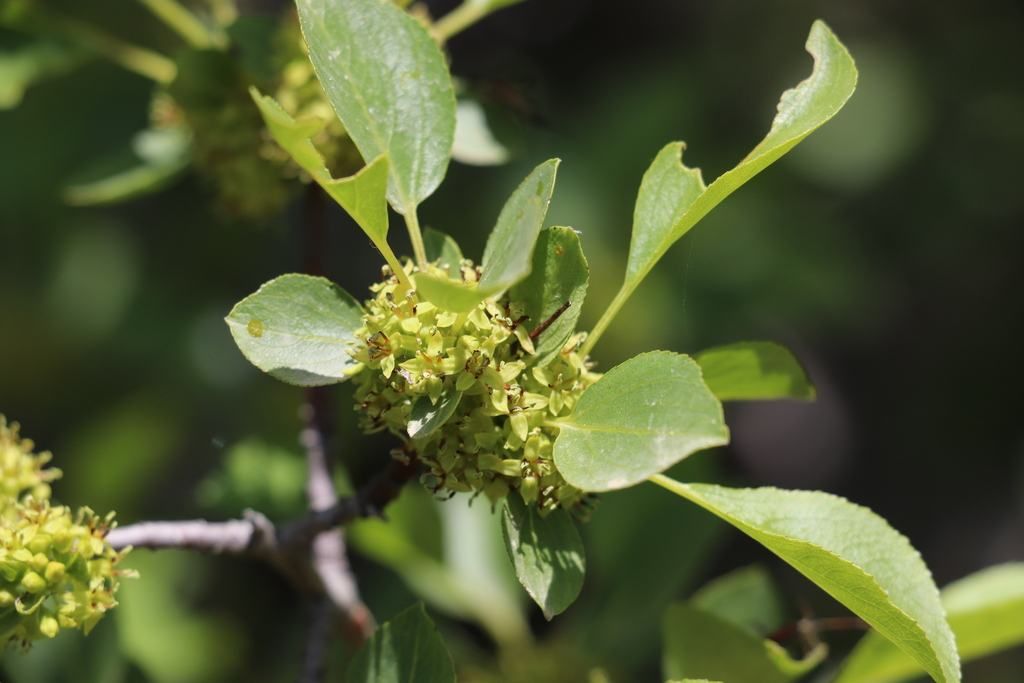
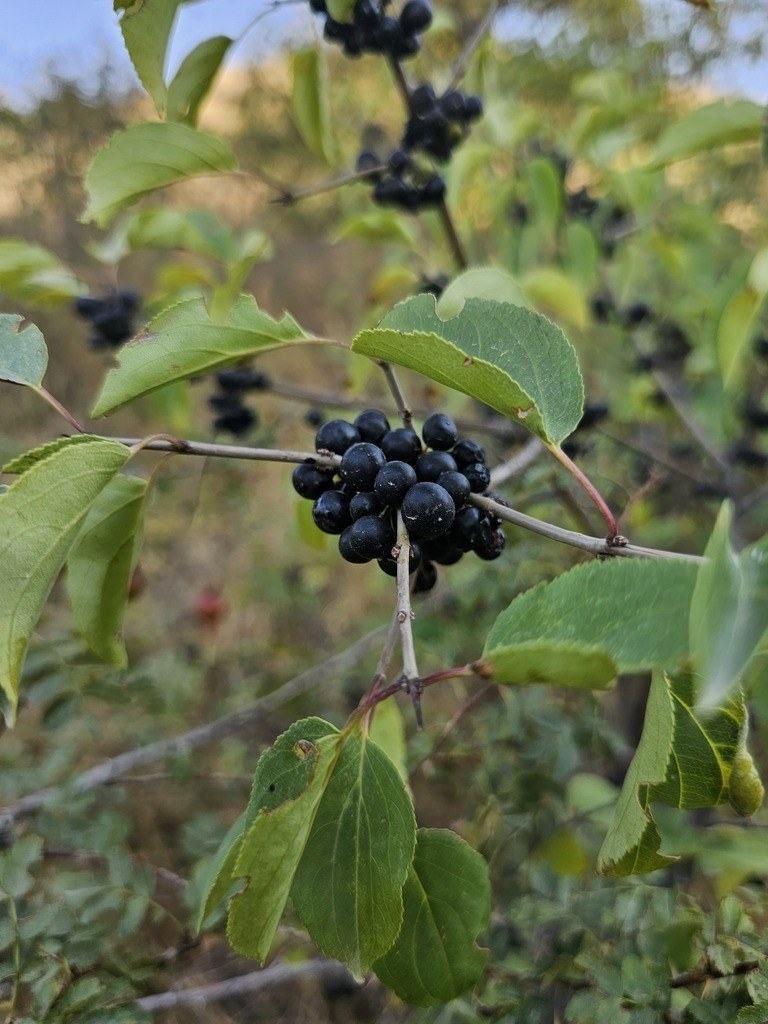
Restoration use by landscape
West Tian Shan Pilot score 73 · rank 54 of 79 shortlisted · rank 68 of 1 194 scored
- Succession role
- Climax / long-term (canopy)
- Suited to
- Eroded slopes; Rocky slopes; Landslide-prone areas; Gullies & drainage lines; Degraded walnut–fruit and broadleaf woodland (other); Degraded pistachio–almond woodland
- Establishment
- seed; nursery (protocol to confirm)
- Why this category
- Strong: erosion control potential; Weak: grazing tolerance; -> promising but propagation/supply or field performance not proven at scale: pilot plots
- Cautions
- protect from grazing for 3-5 yrs
- Local habitat
- Rocky areas, Grassland · Frequent
Criteria scores
Propagation
seed; nursery (protocol to confirm)
Where it fits in the degradation matrix
- West Tian Shan: Eroded slopes (long-term)
- West Tian Shan: Rocky slopes (long-term)
- West Tian Shan: Landslide-prone areas (long-term)
- West Tian Shan: Gullies & drainage lines (long-term)
- West Tian Shan: Degraded pistachio–almond woodland (long-term)
- West Tian Shan: Degraded walnut–fruit and broadleaf woodland (other) (long-term)
Planting combinations
- West Tian Shan: Degraded walnut–fruit and broadleaf woodland (northern slopes, valleys, ~1,000–2,000 m) (Phase 2)
Planting material and suppliers
No commercial offer found in November 2026: material has to come from wild seed collection or contracted propagation. See Nurseries & supply.
Description
- Morphology
- Strongly branching diffuse shrubs or small trees up to 8 m tall, with scabrous splitting and peeling nearly black bark; branches spinose, opposite, with red-brown shiny bark, as in Prunus; buds oblong-ovoid, 3–7 mm long, violet-brown or brown; leaves opposite on juvenile shoots and fascicled on fertile branches, more or less chartaceous, bright green or grayish, dull or slightly glossy above, paler beneath, glabrous or sparingly pubescent at both faces, but more so beneath (f. pubescens Lge.), highly variable in shape, elliptic to orbicular but commonly oval, (2)3–5(6) cm long, (1.2)1.5–3(4) cm wide, short-acuminate, obtuse or mucronulate, broadly cuneate or rounded, rarely broadly cordate at base, generally crenate-serrate, with strong petioles with 3 pairs of nerves much protruding beneath, arcuately converging at apex; petioles 1–2 cm long (2.5–3 cm long — f. longipetiolata Grub.), strong. [Flora of the USSR (Tree of Life)]
- Habitat
- Fine-earth, gravelly, stony slopes, valley of river, pebble beds, juniper woodlands, deciduous forest and shrubs
- Altitudinal belts
- Low mountains, mid-mountains
- Phenology
- Flowering May–Jul, fruiting Jul–Sep
- Distribution
- Zaisan basin, Kazakhstan small hills, Turgai and Alakol depression, Balkhash and Aral deserts, Betpakdala, Tarbagatai, Dzungarian Alatau, Tian Shan (Trans-Ili Alatau, Chu-Ili mountains, Kungey Alatau, Kyrgyz Alatau, Susamyrtau, Karatau, Talas Alatau, Karzhantau, ranges Alai, Pskem, Chatkal, Kurama, Fergana, Uzunakhmat, Atoynok), Pamir-Alai (ranges Alai, Turkestan, Karategin, Peter the Great, foothills of southern Tajikistan)
- Uses
- forest amelioration / agroforestry, dye, medicinal, melliferous, oil, ornamental, technical
- Conservation
- IUCN LC