Species / Polygonaceae
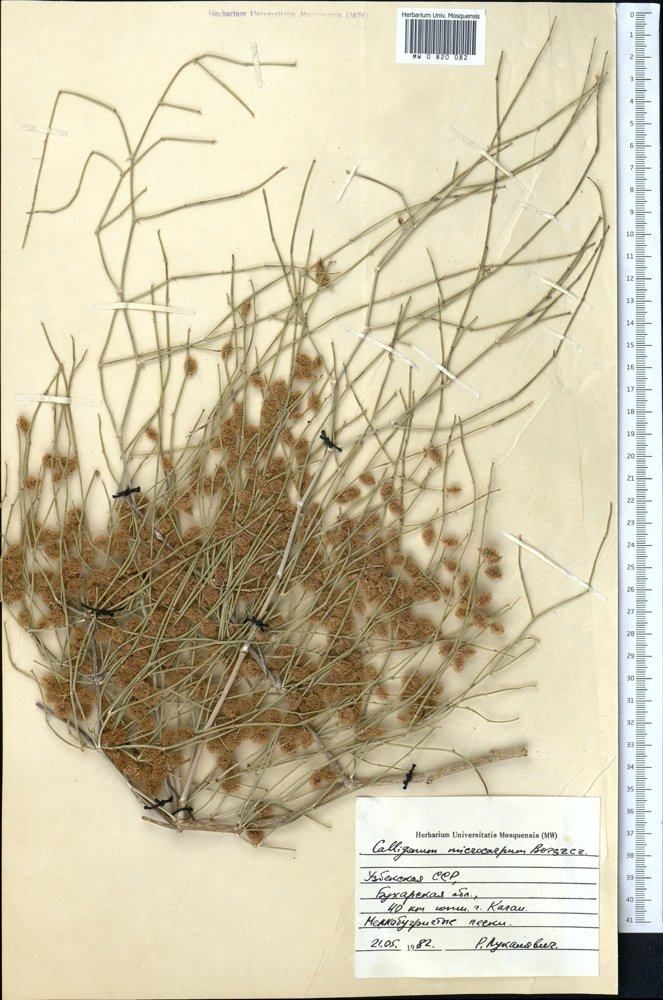
Calligonum microcarpum
Polygonaceae · Shrub · Uzbek: maydamevali qandim; Russian: Кандым мелкоплодный
Restoration use by landscape
Kugitangtau Immediate score 73 · rank 63 of 100 shortlisted · rank 73 of 1 208 scored
- Succession role
- Nurse / intermediate shrub
- Suited to
- Landslide-prone areas; Overgrazed rangelands
- Establishment
- seed or cuttings
- Why this category
- Strong: erosion control potential; Weak: ecological suitability, climate resilience; in documented forestry/nursery use (D1); -> routine propagation and available material: use now
- Local habitat
- Desert · Occasional
Criteria scores
Propagation
seed or cuttings
Where it fits in the degradation matrix
- Kugitangtau: Overgrazed rangelands (nurse)
Planting material and suppliers
Cuttings or seed to be collected from local stands. No supplier found Action: Collect cuttings in winter 2026–2027 on the same river system
Description
- Morphology
- A low shrub, ca. 0.5 m in height, rarely up to 3 m; bark of mature branches grayish or reddish; herbaceous branchlets slender, densely covered with flowers; flowers axillary, mostly in groups of 5; pedicels jointed below the middle, glabrous, as long as or 1.5 times as long as the perianth; perianth segments subequal, broadly obovate, whitish-green, to 2 mmlong; anthers pink; fruit ovaloid to subspherical, 7–9mm in diameter, rather densely setose or rarely loosely setose with achene showing through the bristles (var. pellucidum N. Pavl.); achene spirally coiled clockwise or anticlockwise, linear -elliptic, enlarged at the middle, cylindrically tapering toward both ends, the rounded bluntish ribs keeled; bristles in 8 rows, quite free, stiffish, narrow, flattened, divaricately and almost 1-sidedly 4–6-branched, the branches repeatedly branched into long capillary branchlets. Fr. May — June. (Plate XXXVII, Figure l). [Flora of the USSR (Tree of Life)]
- Habitat
- Sandy deserts
- Altitudinal belts
- Plain
- Phenology
- Fruiting May–Jun (Flora of the USSR)
- Distribution
- Aral deserts, Kyzylkum, Karakum, lower reaches of river Vakhsh, Pyandzh, Kafirnigan, basin of river Surkhandarya (Karshi), western Kopet Dag (Messarian), small and Greater Balkhan, Pre-Caspian lowland (Mollakora, Dzhebel)
- Uses
- forest amelioration / agroforestry, forage, fuel, melliferous
- Conservation
- IUCN NE