Species / Solanaceae
Lycium dasystemum
Solanaceae · Shrub · Uzbek: tukchangchi chingil, oq chingil; Russian: Дереза волосистотычинковая
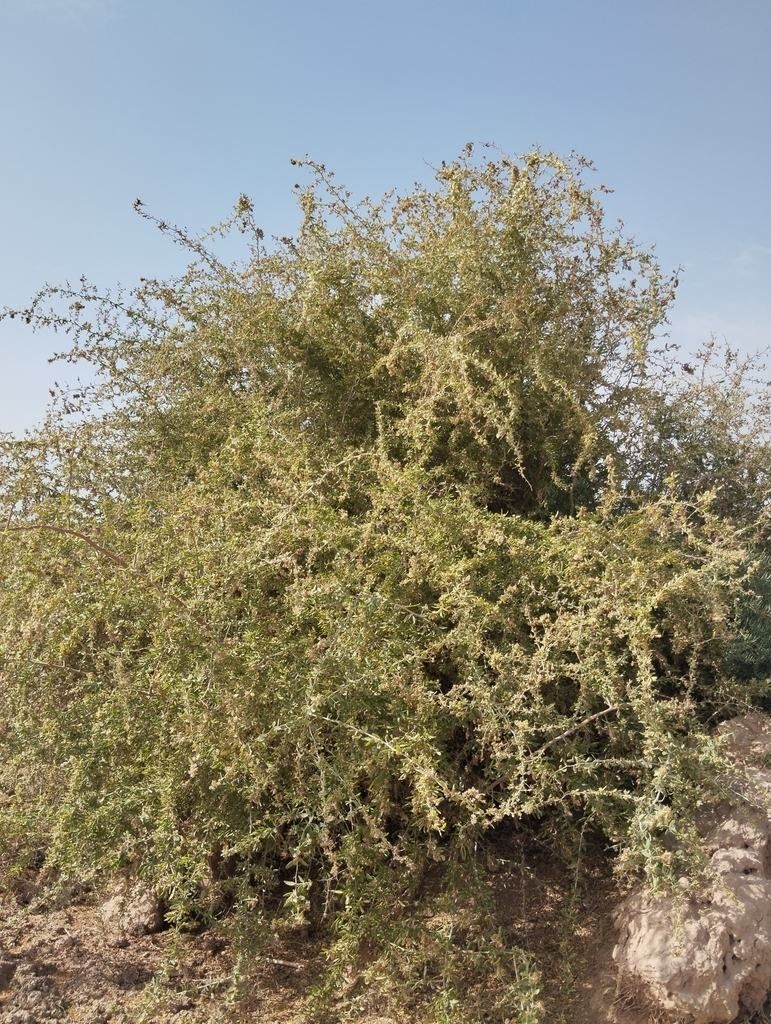
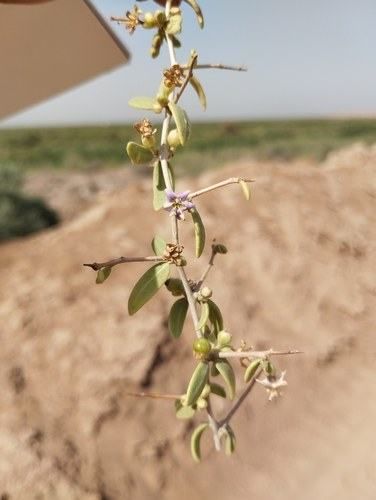
Restoration use by landscape
Kugitangtau Pilot score 75 · rank 39 of 100 shortlisted · rank 47 of 1 208 scored
- Succession role
- Nurse / intermediate shrub
- Suited to
- Eroded slopes; Rocky slopes; Landslide-prone areas; Gullies & drainage lines; Riparian / sai (other); Degraded pistachio–almond woodland
- Establishment
- seed, cuttings or root suckers
- Why this category
- Strong: erosion control potential, climate resilience; Weak: ecological suitability, seed; -> promising but propagation/supply or field performance not proven at scale: pilot plots
- Local habitat
- Rocky areas, Grassland, Shrubland, Forest, Desert, Wetlands (inland), Artificial terrestrial · Rare
Criteria scores
Propagation
seed, cuttings or root suckers
Planting material and suppliers
No commercial offer found in November 2026: material has to come from wild seed collection or contracted propagation. See Nurseries & supply.
Description
- Morphology
- Branched spiny shrub, up to 1.5 m tall with strong, sometimes several sinuous branches, clothed light-grey, along трещиноватой bark. Young shoots whitish or light-yellow, glabrous, spineless or at the apex spiny-acute, some from them shortened and превращены in spines, last leafless or bearing leaves and flowers. Leaves on young shoots solitary, on old along 2–5 in fascicles, from narrow-ovate or narrow-elliptic up to obovate or ovate-elliptic, from 10 mm long and 3 mm wide up to 3.5 cm long and 1.5 cm wide, acute or bluntish, light-glaucous, thickish, with prominent veins, on short glabrous petioles. Flowers solitary in the upper part elongated shoots in axils of leaves or in fascicles along 2–6 together with leaves on more old branches, on pedicels (3)4–13 mm long. Calyx campanulate, 3–4 mm long, 4–5-toothed or incised on 2–3 lobes, along the margin sparsely-ciliate, and on end white-felted. Corolla violet-blue, (8)9–11(13) mm long, with almost cylindrical tube, suddenly broadened under limb and bearing inside ring of short hairs higher than the place of attachment of stamen, and limb, twice more short, than tube, divided on 5 (4–6) broad ovate lobes, last at the base with auricles and along the margin densely-ciliate. Stamens attached near 1 / 2 tube, longer than the corolla, with filaments in the lower part in front short-downy. Berries red, globose or ovate-globose. Seed brown, small, 1.5–2 mm long, reniform. [Flora of Uzbekistan (Tree of Life)]
- Habitat
- Fine-earth, gravelly, stony slopes, rocks, screes, outcrops of variegated rocks, conglomerates, clayey cliffs, residual hills, saline place, solonchaks, takyrs, sandy deserts, tugais, gorge, valley of river
- Altitudinal belts
- Plain, foothills, low mountains, mid-mountains
- Phenology
- Flowering Apr–Aug, fruiting Jun–Sep
- Distribution
- Kazakhstan small hills, Alakol depression, Balkhash and Aral deserts, Betpakdala, valley of river or, Muyunkum, lower reaches of river Chu and Sarysu, valley of river Syr Darya, Ustyurt, Prikarataus and Trans-Karatau foothill plains, Kyzylkum, Fergana valley, Pritashkentekiye of chul, Mirzachul, valley of river Zeravshan, Surkhan-Sherabad and Bishkent valley, southern and southwestern spurs of Dzungarian Alatau, Tian Shan (Ketmentau, Chu-Ili mountains, Trans-Ili Alatau, Kungey Alatau, Terskey Alatau, Kyrgyz Alatau, Talas Alatau, mountains in basin of river Naryn, Mogoltau, Karzhantau, Karatau), Pamir-Alai (ranges Alai, Turkestan, Zarafshan -basin of river Fan, Hissar: northern slope -Pinvon, Tiodif, southwestern spurs -environs of settlement Tashkurgan, Derbent, Dekhkanabad, mountains Pistalitau)
- Uses
- forest amelioration / agroforestry, medicinal, melliferous, oil
- Conservation
- IUCN NE