Species / Sapindaceae
Acer tataricum
Sapindaceae · Tree · Uzbek: Semenov zarangi; Russian: Клен Семенова
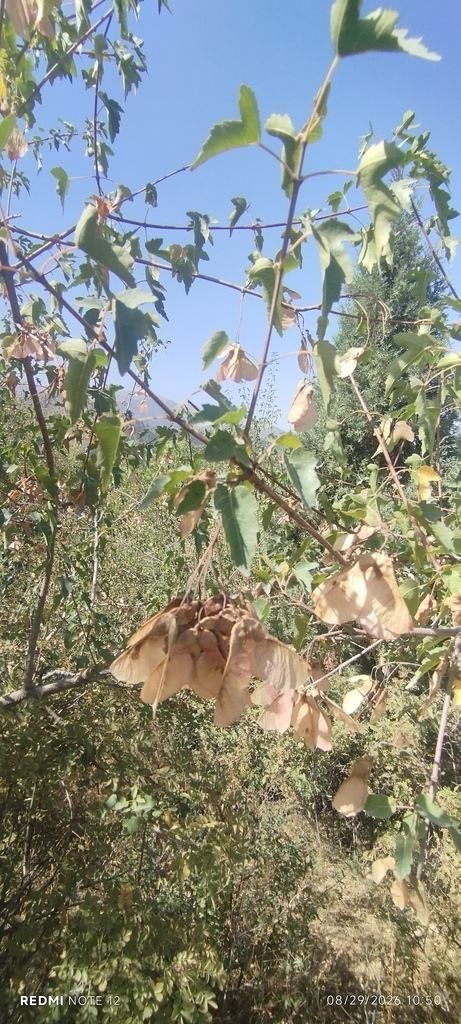
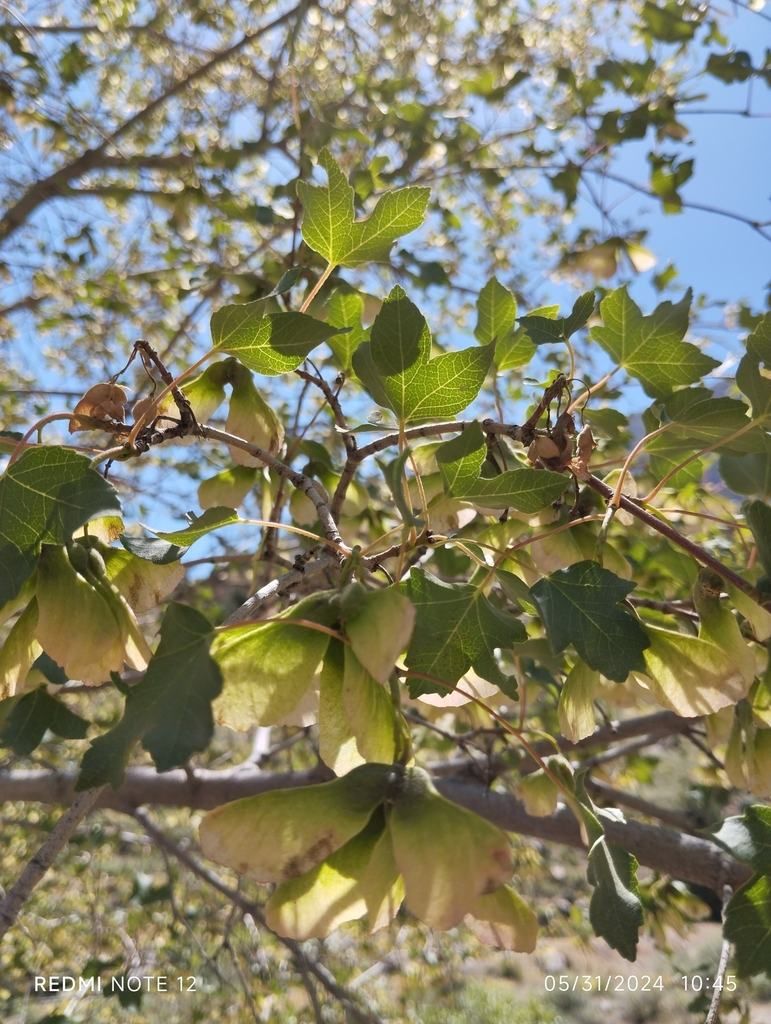
Restoration use by landscape
Nuratau Pilot score 70 · rank 72 of 80 shortlisted · rank 102 of 640 scored
- Succession role
- Climax / long-term (canopy)
- Suited to
- Eroded slopes; Rocky slopes; Gullies & drainage lines; Degraded juniper woodland
- Establishment
- stratified seed; nursery seedlings
- Why this category
- Strong: seed; Weak: grazing tolerance; in documented forestry/nursery use (D1); -> promising but propagation/supply or field performance not proven at scale: pilot plots
- Cautions
- protect from grazing for 3-5 yrs
- Local habitat
- Forest, Shrubland, Grassland, Rocky areas · Frequent
Criteria scores
Kugitangtau Pilot score 68 · rank 85 of 100 shortlisted · rank 153 of 1 208 scored
- Succession role
- Climax / long-term (canopy)
- Suited to
- Eroded slopes; Gullies & drainage lines; Riparian / sai (other); Degraded juniper woodland
- Establishment
- stratified seed; nursery seedlings
- Why this category
- Strong: seed; Weak: grazing tolerance; in documented forestry/nursery use (D1); -> promising but propagation/supply or field performance not proven at scale: pilot plots
- Cautions
- protect from grazing for 3-5 yrs
- Local habitat
- Forest, Grassland, Rocky areas, Shrubland, Wetlands (inland) · Frequent
Criteria scores
Propagation
stratified seed; nursery seedlings
Where it fits in the degradation matrix
- Nuratau: Eroded slopes (long-term)
- Nuratau: Rocky slopes (long-term)
- Nuratau: Gullies & drainage lines (long-term)
- Nuratau: Degraded juniper woodland (long-term)
- Kugitangtau: Eroded slopes (long-term)
- Kugitangtau: Gullies & drainage lines (long-term)
- Kugitangtau: Degraded juniper woodland (long-term)
- Kugitangtau: Riparian / sai (other) (long-term)
Planting combinations
- Nuratau: Juniper woodland (mid-mountains, above ~1,400 m) (Phase 3)
- Kugitangtau: Degraded juniper woodland (Kugitang and Baysuntau, above ~1,500 m) (Phase 3)
Planting material and suppliers
No commercial offer found in November 2026: material has to come from wild seed collection or contracted propagation. See Nurseries & supply.
Description
- Morphology
- Trees or tall shrubs with smooth dark gray or nearly black bark and reddish or brownish shoots hairy when young; leaves 6–10 cm long, 3–7 mm wide, dark green above, slightly paler beneath, hairy along nerves, oblong-ovate (f. oblongofoium Rac) to suborbicular (f. r o t u nd if o liu m Rac), entire or slightly 3 -lobed, irregularly biserrate at margin, sometimes undulate (f. cuspidatum Pax, garden), shallowly cordate at base, rarely truncate; petioles hairy, shorter than blades. Panicles dense, oval-corymbiform, with pubescent rhachis and pedicels covered with glands; flowers with yellowish sepals and white petals; samaras 3–4 cm long, with glabrous (f. typicum Blonsk. and f. decalvens Blonsk.) or pubescent (f. hebecarpum Blonsk. and f. pubigerim Blonsk.) nuts always beset with glands and tapering at base, wings dilated above, erect with nearly parallel outer margins (f. genuinum Rac.) or diverging at acute or nearly right angles (f. slendzinskii Rac). Fl. May-June, Fr. from September. [Flora of the USSR (Tree of Life)]
- Habitat
- Fine-earth, gravelly, stony slopes, valley of river
- Altitudinal belts
- Low mountains, mid-mountains
- Phenology
- Flowering May–Jun, fruiting Jul–Oct
- Distribution
- Dzungarian Alatau, Tian Shan (Ketmentau, Kungey Alatau, Trans-Ili Alatau, Chu-Ili mountains. Kyrgyz Alatau, Terskey Alatau, mountains Kavaktau, mountains in the lower part basin of river Naryn, Karatau, Talas Alatau, Karzhantau, ranges Ugam, Pskem, Koksuy, Sandalash, Chatkal, Kurama, Mogoltau, Fergana, Uzun-akhmat, Atoynok), Pamir-Alai (ranges Alai, Turkestan, Nurata, Zarafshan, Hissar)
- Uses
- forest amelioration / agroforestry, ornamental, technical
- Conservation
- IUCN LC