Species / Amaranthaceae
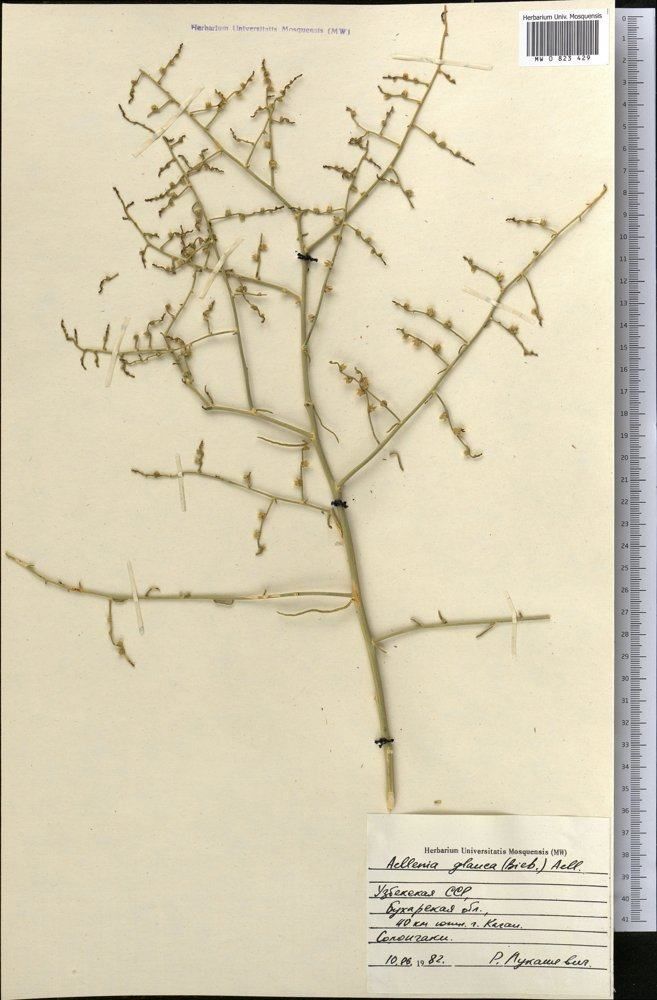
Halothamnus glaucus
Amaranthaceae · Subshrub · Uzbek: kulrang galotamnus; Russian: Галотамнус сизый, Элления сизая
Restoration use by landscape
Kugitangtau Pilot score 72 · rank 68 of 100 shortlisted · rank 79 of 1 208 scored
- Succession role
- Pioneer (ground cover)
- Suited to
- Eroded slopes; Rocky slopes; Overgrazed rangelands; Degraded pistachio–almond woodland
- Establishment
- direct seeding; seed islands
- Why this category
- Strong: drought tolerance, climate resilience; Weak: ecological suitability, seed; -> promising but propagation/supply or field performance not proven at scale: pilot plots
- Local habitat
- Desert, Grassland, Rocky areas · Rare
Criteria scores
Propagation
direct seeding; seed islands
Planting material and suppliers
No commercial offer found in November 2026: material has to come from wild seed collection or contracted propagation. See Nurseries & supply.
Description
- Morphology
- Undershrub, 30–75 cm high, distinctly glaucous, with gray woody branches from base; shoots branched, glabrous, the branches obliquely ascending; leaves alternate, terete, convex beneath, flattish above, sessile, acute, mostly somewhat upcurved; bracts broader at base, as long as or more commonly surpassing the perianth; bracteoles in lower part mostly broad-ovate or broader and scarious -margined, in upper part tapering to a slender tip, also about the length of perianth; flowers in a spiciform inflorescence; perianth segments glabrous, scarious -margined, winged in fruit below the middle; wings broadly obovate, overlapping, faintly yellowish or more rarely pale roseate; fruiting perianth including wings 10 — mm across; lobes above the wings connivent, forming a rather compact cone; filaments linear, dilated toward base; anther divergent below the middle, terminating in an obsolescent oblong obtuse sessile appendage; stigmas flat, enlarged at the end, with scarious crenulate summit, glabrous, half as long as to longer than the style. May July. [Flora of the USSR (Tree of Life)]
- Habitat
- Gravelly gypsiferous soils, clayey, gravelly deserts, takyrs, limestones, solonchaks
- Altitudinal belts
- Plain, foothills, low mountains
- Phenology
- Flowering and fruiting May–Sep
- Distribution
- Throughout Central Asia (excluding Pamir)
- Uses
- forage, medicinal
- Conservation
- IUCN NE