Species / Amaranthaceae
Caroxylon orientale
Amaranthaceae · Subshrub · Uzbek: Sharq sho‘ragi, quyryauq; Russian: Солянка восточная
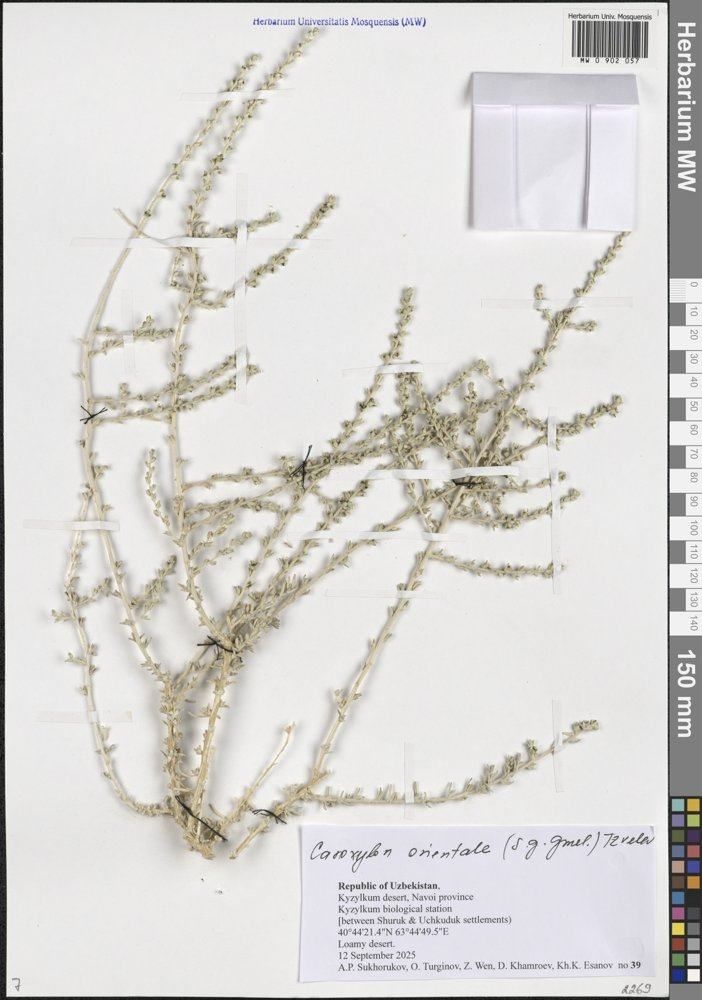
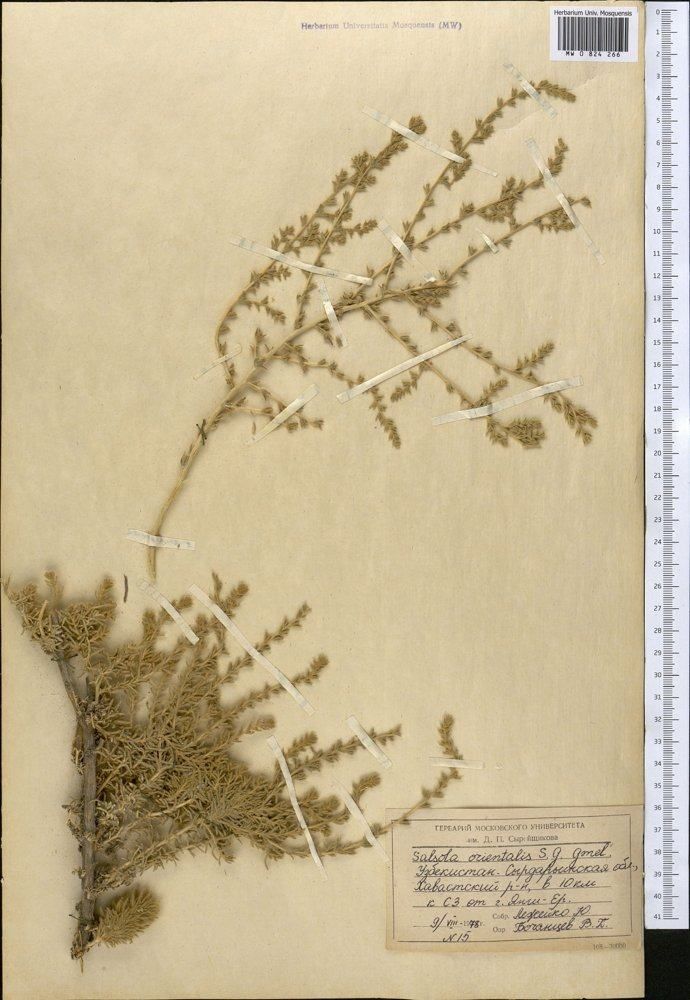
Restoration use by landscape
Nuratau Pilot score 73 · rank 59 of 80 shortlisted · rank 67 of 640 scored
- Succession role
- Pioneer (ground cover)
- Suited to
- Eroded slopes; Rocky slopes; Overgrazed rangelands; Degraded juniper woodland; Degraded pistachio–almond woodland
- Establishment
- seed (protocol to confirm)
- Why this category
- Strong: drought tolerance, climate resilience; -> promising but propagation/supply or field performance not proven at scale: pilot plots
- Local habitat
- Desert, Shrubland, Rocky areas · Occasional
Criteria scores
Propagation
seed (protocol to confirm)
Planting material and suppliers
No commercial offer found in November 2026: material has to come from wild seed collection or contracted propagation. See Nurseries & supply.
Description
- Morphology
- Under shrub, 15–50 cm high, divaricately much branched from base; branches rough, rigid, woody; annotinous shoots elongated, covered with short crisp hairs and long straight ones, heavily woolly when young (var. vest it a Fenzl in Ldb., 1. c), later often somewhat glabrescent (var. calvescens Fenzl, 1. c); leaves alternate, linear, almost semiterete, obtuse, very slightly dilated and subappressed -hairy at base; bracteoles broad, obtusely keeled, scarious -margined; flowers solitary in a broadly paniculate inflorescence; perianth segments ovate, scarious -margined, hairy, rarely becoming glabrate in fruit, winged at the middle; wings reniform (purple ? or roseate ? or possibly yellowish turning brown or dark -colored); perianth including wings 7–10mm across, connivent above the wings into a loose gently sloping cone; anthers obsoletely appendiculate; stigmas short, thickish, flat, villous on the inside, mostly half as long as the thick style. July — September. [Flora of the USSR (Tree of Life)]
- Habitat
- Sandy, clayey, gravelly deserts, saline-alkaline place, takyrs, stony, gravelly slopes, outcrops of variegated rocks
- Altitudinal belts
- Plain, foothills, low mountains, mid-mountains, high mountains
- Phenology
- Flowering and fruiting Jun–Oct
- Distribution
- Kazakhstan small hills, Balkhash, Aral and Pre-Caspian deserts, Ustyurt, Betpakdala, Muyunkum, Kyzylkum, Karakum, Tian Shan, Pamir-Alai (excluding Pamir), Badkhyz, Kopet Dag
- Uses
- forage
- Conservation
- IUCN NE