Species / Amaranthaceae
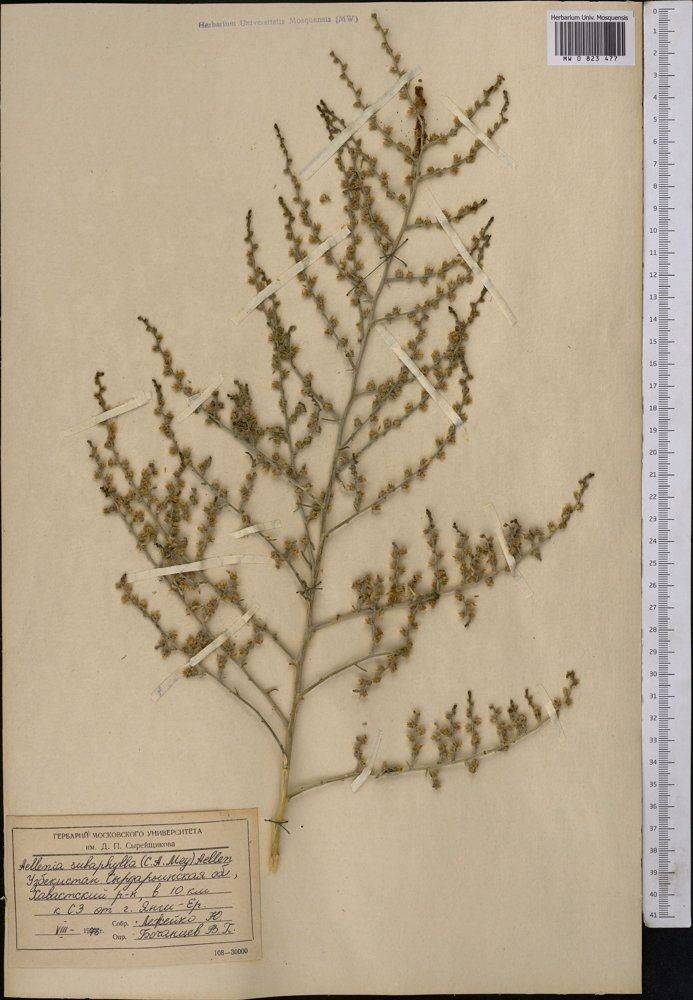
Halothamnus subaphyllus
Amaranthaceae · Subshrub · Uzbek: kambargli galotamnus, cho‘g‘on; Russian: Галотамнус малолистный, Элления малолистная
Restoration use by landscape
Nuratau Immediate score 76 · rank 28 of 80 shortlisted · rank 31 of 640 scored
- Succession role
- Pioneer (ground cover)
- Suited to
- Eroded slopes; Rocky slopes; Overgrazed rangelands; Degraded juniper woodland; Degraded pistachio–almond woodland
- Establishment
- direct seeding; seed islands
- Why this category
- Strong: drought tolerance, climate resilience; Weak: ecological suitability; in documented forestry/nursery use (D1); -> routine propagation and available material: use now
- Local habitat
- Desert, Shrubland, Rocky areas · Rare
Criteria scores
Kugitangtau Immediate score 76 · rank 26 of 100 shortlisted · rank 28 of 1 208 scored
- Succession role
- Pioneer (ground cover)
- Suited to
- Eroded slopes; Rocky slopes; Overgrazed rangelands; Degraded pistachio–almond woodland
- Establishment
- direct seeding; seed islands
- Why this category
- Strong: drought tolerance, climate resilience; Weak: ecological suitability; in documented forestry/nursery use (D1); -> routine propagation and available material: use now
- Local habitat
- Desert, Grassland, Rocky areas · Rare
Criteria scores
Propagation
direct seeding; seed islands
Where it fits in the degradation matrix
- Kugitangtau: Rocky slopes (pioneer)
Planting combinations
- Nuratau: Foothill and low-mountain rangeland (Phase 2)
Planting material and suppliers
Wild seed collection needed. No supplier confirmed in the landscapes Action: Collect seed in October–November and sow in the same winter; the seed does not keep
Rangeland use
- Grazing tolerance
- Medium
- Forage value
- High in autumn and winter, after the first frosts
- Recovery
- Medium. From seed
- Management
- Desert margin and saline foothills
Description
- Morphology
- Undershrub or shrub 30 120 cm high; stems covered with light gray longitudinally fissured bark, profusely branched, glabrous, pale green or rarely glaucescent, commonly diffusely pustulose; branches mostly spreading; leaves alternate, thickish, linear-terete, sessile, acute, spreading; bracts short, the upper broadly ovate or orbicular and then equaling or shorter than the orbicular scarious -margined carinate bracteoles; flowers solitary in spiciform inflorescences disposed in a panicle; perianth glabrous, exceeding the bracteoles; perianth segments oblong-ovate, broadly scarious -margined, obtuse, winged in fruit below the middle; wings semipellucid, reniform or orbicular or obovate (more rarely some of the wings narrower), mostly overlapping, colorless or roseate, the margins somewhat reflexed; fruiting perianth including _._ wings ca. [Flora of the USSR (Tree of Life)]
- Habitat
- Fine-earth, gravelly, stony gypsum-rich slopes, sandy deserts, solonchaks, takyrs
- Altitudinal belts
- Plain, foothills, low mountains, mid-mountains
- Phenology
- Flowering and fruiting Jun–Oct
- Distribution
- Throughout Central Asia
- Uses
- dye, forage, medicinal
- Conservation
- IUCN NE