Species / Amaranthaceae
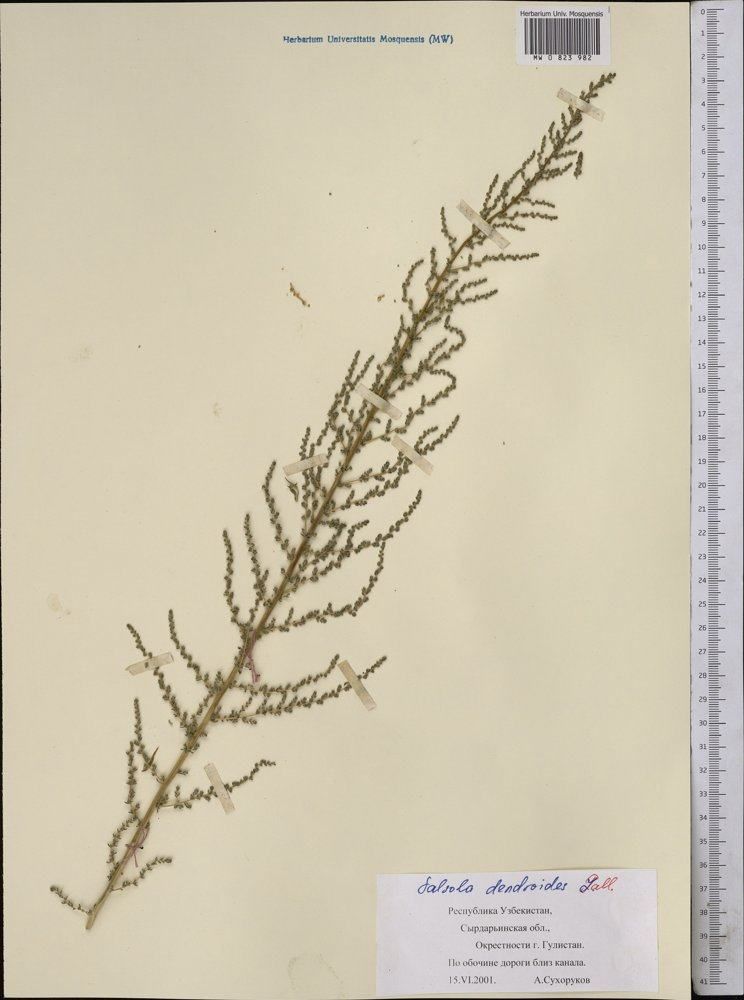
Caroxylon dendroides
Amaranthaceae · Subshrub · Uzbek: daraxtsimon sho‘rak, sho‘rbuta; Russian: Солянка древовидная
Restoration use by landscape
Kugitangtau Pilot score 76 · rank 25 of 100 shortlisted · rank 27 of 1 208 scored
- Succession role
- Pioneer (ground cover)
- Suited to
- Eroded slopes; Rocky slopes; Overgrazed rangelands; Degraded juniper woodland; Degraded pistachio–almond woodland
- Establishment
- seed (protocol to confirm)
- Why this category
- Strong: climate resilience; -> promising but propagation/supply or field performance not proven at scale: pilot plots
- Local habitat
- Artificial terrestrial, Desert, Forest, Grassland, Rocky areas, Wetlands (inland) · Frequent
Criteria scores
Propagation
seed (protocol to confirm)
Where it fits in the degradation matrix
- Kugitangtau: Degraded juniper woodland (pioneer)
Planting combinations
- Kugitangtau: Overgrazed rangeland (foothill and low-mountain pasture) (Phase 2)
Planting material and suppliers
No commercial offer found in November 2026: material has to come from wild seed collection or contracted propagation. See Nurseries & supply.
Description
- Morphology
- Undershrub, 75–150cm high, with a stout stem 5–10cm in height; branches long, branching only at the ends, grayish-green, densely covered with crisp hairs sometimes interspersed with long ones; leaves alternate, small, 2–5 mmlong, linear, fleshy, obtuse, very slightly dilated at base, later deciduous; bracts ovate -triangular, keeled, often half as long as the suborbicular scarious -margined bracteoles; flowers numerous, solitary, forming a dense widely paniculate inflorescence; perianth segments ovate, obtuse, membranous except for the herbaceous center, winged in fruit; wings semiorbicular or obovate, colorless, yellowish or roseate; lobes of fruiting perianth connivent; anthers obsoletely appendiculate; stigmas flat, thickish, long-villous, as long as or very slightly longer than the style; seeds ca. 1.5 mm in diameter. — July September. [Flora of the USSR (Tree of Life)]
- Habitat
- Solonchaks, saline place, outcrops of gypsum-rich clay, loess, gravelly slopes, valley of river, field
- Altitudinal belts
- Plain, foothills, low mountains, mid-mountains
- Phenology
- Flowering and fruiting Jun–Sep
- Distribution
- Balkhash, Aral, Pre-Caspian deserts, Kyzylkum, Karakum, western Tian Shan, Pamir-Alai (western and southern)
- Uses
- forest amelioration / agroforestry, forage
- Conservation
- IUCN NE