Species / Cyperaceae
Carex pachystylis
Cyperaceae · Perennial · Uzbek: yo‘g‘onustunchali qorabosh, rang, qorabosh; Russian: Осока толстостолбиковая
Restoration use by landscape
West Tian Shan Pilot score 72 · rank 56 of 79 shortlisted · rank 70 of 1 194 scored
- Succession role
- Pioneer (ground cover)
- Suited to
- Eroded slopes; Rocky slopes
- Establishment
- division of tussocks/rhizomes
- Why this category
- Strong: drought tolerance, climate resilience; Weak: biodiversity value, nursery propagation feasibility, restoration cost-effectiveness; -> promising but propagation/supply or field performance not proven at scale: pilot plots
- Cautions
- propagation protocol to develop
- Local habitat
- Rocky areas, Grassland, Artificial terrestrial · Frequent
Criteria scores
Nuratau Pilot score 75 · rank 35 of 80 shortlisted · rank 38 of 640 scored
- Succession role
- Pioneer (ground cover)
- Suited to
- Eroded slopes; Rocky slopes
- Establishment
- division of tussocks/rhizomes
- Why this category
- Strong: ecological suitability, drought tolerance, climate resilience; Weak: biodiversity value, nursery propagation feasibility, restoration cost-effectiveness; -> promising but propagation/supply or field performance not proven at scale: pilot plots
- Cautions
- propagation protocol to develop
- Local habitat
- Desert, Forest, Shrubland, Grassland, Rocky areas, Artificial terrestrial · Dominant
Criteria scores
Kugitangtau Pilot score 72 · rank 71 of 100 shortlisted · rank 82 of 1 208 scored
- Succession role
- Pioneer (ground cover)
- Suited to
- Eroded slopes; Rocky slopes
- Establishment
- division of tussocks/rhizomes
- Why this category
- Strong: drought tolerance, climate resilience; Weak: biodiversity value, nursery propagation feasibility, restoration cost-effectiveness; -> promising but propagation/supply or field performance not proven at scale: pilot plots
- Cautions
- propagation protocol to develop
- Local habitat
- Artificial terrestrial, Desert, Forest, Grassland, Rocky areas · Frequent
Criteria scores
Propagation
division of tussocks/rhizomes
Planting material and suppliers
No commercial offer found in November 2026: material has to come from wild seed collection or contracted propagation. See Nurseries & supply.
Description
- Morphology
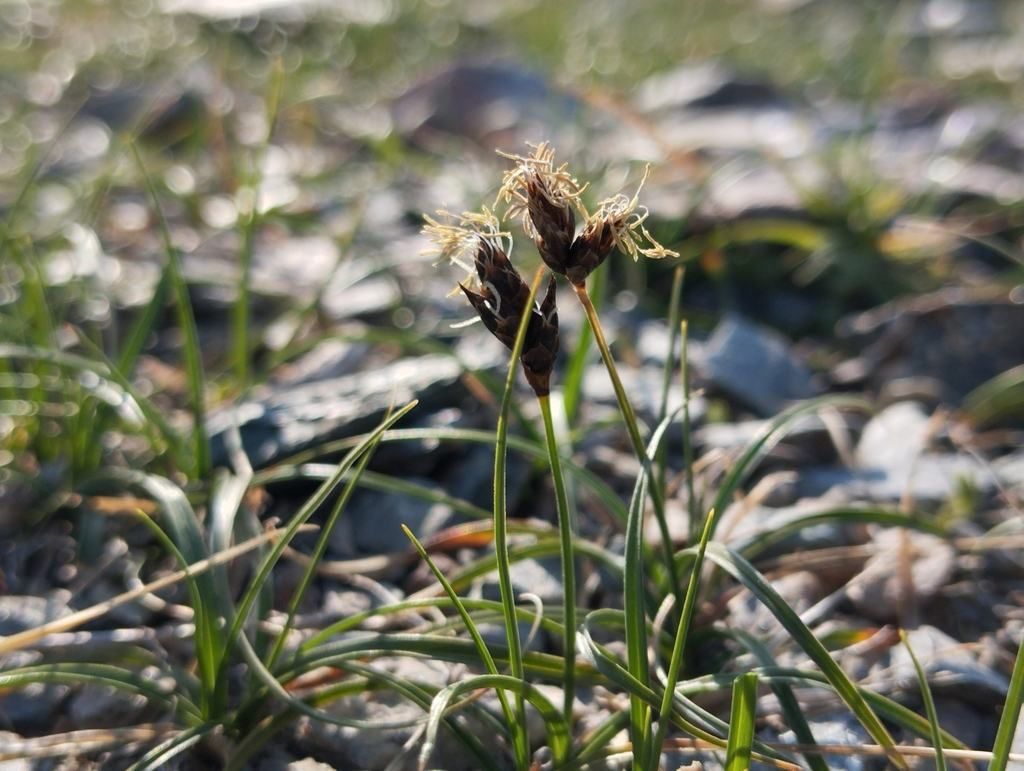
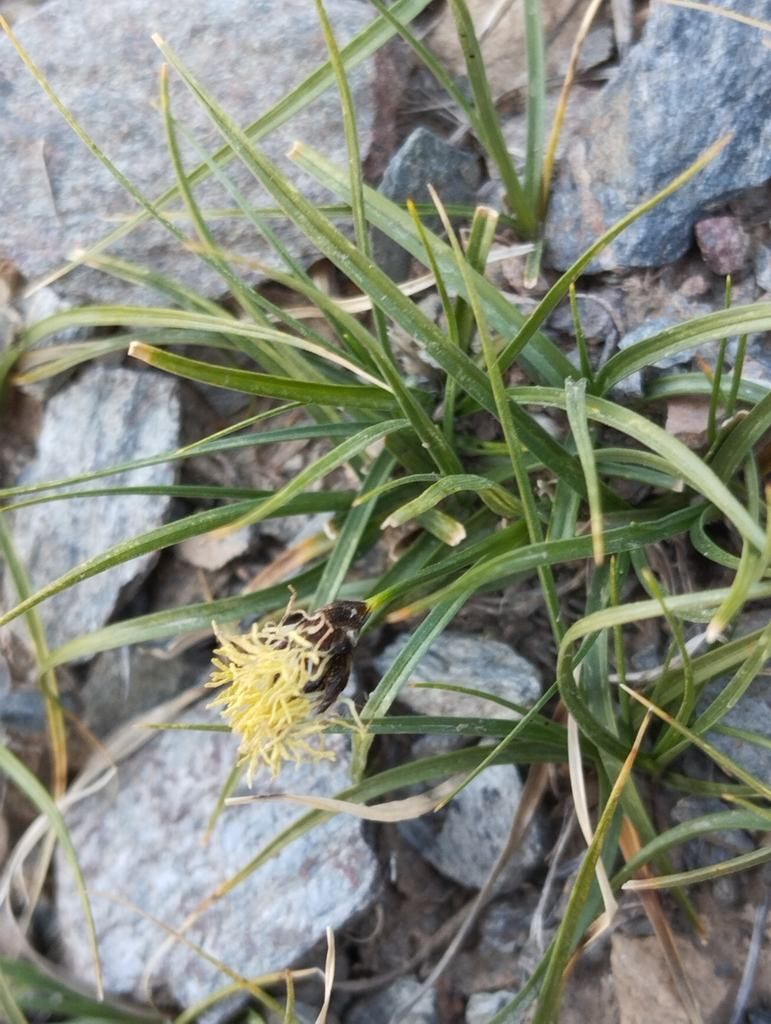
- Perennial plants; rhizome slender, creeping, covered with fibers, giving rise to discrete clusters forming loose tufts; culms obscurely triangular, mostly smooth, 7-30 cm tall, covered to considerable height with castaneous -brov/n, loose, split -fibrillose basal sheaths; leaves rather soft, flat to subinvolute, 1-2 mm broad, shorter than the culm, somewhat crisp, scabrous; spikelets 4-6, aggregated in a compact, rhomboid or triangular -ovoid head 0.8-2 cm long and 0.7-1 cm broad; scales ferruginous-brown or castaneous throughout, ovate, acute, about as long as the perigynia; perigynia rounded -ovoid to ellipsoid, 4-5.5 long, round -based, mm short-stipitate, obscurely nerved or nerveless, rather abruptly contracted into a smooth (or slightly scabrous at base), bidentate, dorsally cleft beak, castaneous at the summit. Fr. April— June. (Plate VIII, Figure 8). [Flora of the USSR (Tree of Life)]
- Habitat
- Sandy, clayey, gravelly deserts, residual low mountains, foothill plains, loess, fine-earth, gravelly, stony slopes, fallows
- Altitudinal belts
- Plain, foothills, low mountains, mid-mountains, high mountains
- Phenology
- Flowering Feb–Apr, fruiting Mar–Jun
- Distribution
- Balkhash-Alakol lowland (environs of lake Alakul), valley of river Lepsa, or and Chu, Muyunkum, valley of river Syr Darya and adjacent plains, Kyzylkum (including residual mountains in environs of settlement Tegelek-kyra), valley of river Zeravshan, Sherabad valley, Dzungarian Alatau (pass in valley of bark), Tian Shan (Chu-Ili mountains, Trans-Ili and Kungey Alatau, basin of river Naryn, Karatau, Kyrgyz Alatau, valley of river Talas, Fergana and Kurama ranges), Pamir-Alai (ranges Alai and Trans-Alai -valley of river Kaindy, Samarkand mountains, Turkestan, Nuratau, Zarafshan, Hissar, Karategin, Vakhsh ranges, western Pamir, foothills of southern Tajikistan, range Kugitang), upland Karabil, Badkhyz, Kopet Dag, Greater Balkhan
- Uses
- forage
- Conservation
- IUCN NE