Species / Elaeagnaceae
Elaeagnus angustifolia
Elaeagnaceae · Tree · Uzbek: uzunbarg jiyda; Russian: Лох узколистный
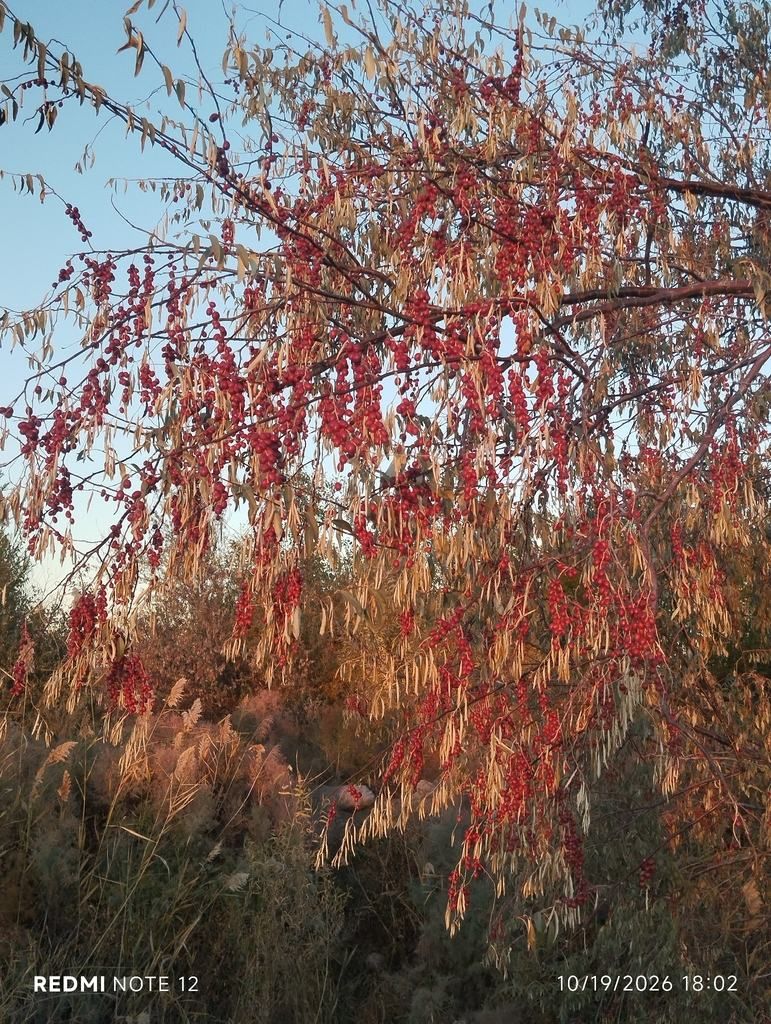
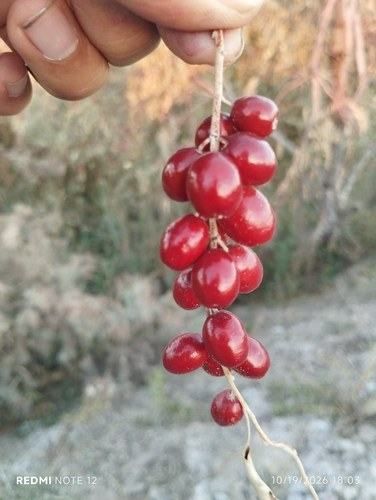
Restoration use by landscape
West Tian Shan Pilot score 76 · rank 24 of 79 shortlisted · rank 31 of 1 194 scored
- Succession role
- Pioneer (riparian stabiliser)
- Suited to
- Gullies & drainage lines; Riparian / sai (other)
- Establishment
- seed, cuttings or root suckers
- Why this category
- Strong: climate resilience, seed; Weak: drought tolerance, grazing tolerance; in documented forestry/nursery use (D1); -> promising but propagation/supply or field performance not proven at scale: pilot plots
- Cautions
- needs moist sites; protect from grazing for 3-5 yrs; risk of cultivar/orchard or non-local material – wild local provenance only; pilot first; native status and invasiveness outside riparian zone to verify (D1 s.3.2.6)
- Local habitat
- Grassland, Wetlands (inland) · Frequent
Criteria scores
Nuratau Pilot score 74 · rank 44 of 80 shortlisted · rank 50 of 640 scored
- Succession role
- Pioneer (riparian stabiliser)
- Suited to
- Gullies & drainage lines; Riparian / sai (other)
- Establishment
- seed, cuttings or root suckers
- Why this category
- Strong: climate resilience, seed; Weak: drought tolerance, grazing tolerance; in documented forestry/nursery use (D1); -> promising but propagation/supply or field performance not proven at scale: pilot plots
- Cautions
- needs moist sites; protect from grazing for 3-5 yrs; risk of cultivar/orchard or non-local material – wild local provenance only; pilot first; native status and invasiveness outside riparian zone to verify (D1 s.3.2.6)
- Local habitat
- Forest, Wetlands (inland), Artificial aquatic, Artificial terrestrial · Frequent
Criteria scores
Kugitangtau Pilot score 76 · rank 30 of 100 shortlisted · rank 32 of 1 208 scored
- Succession role
- Pioneer (riparian stabiliser)
- Suited to
- Gullies & drainage lines; Riparian / sai (other)
- Establishment
- seed, cuttings or root suckers
- Why this category
- Strong: climate resilience, seed; Weak: drought tolerance, grazing tolerance; in documented forestry/nursery use (D1); -> promising but propagation/supply or field performance not proven at scale: pilot plots
- Cautions
- needs moist sites; protect from grazing for 3-5 yrs; risk of cultivar/orchard or non-local material – wild local provenance only; pilot first; native status and invasiveness outside riparian zone to verify (D1 s.3.2.6)
- Local habitat
- Desert, Grassland, Shrubland, Wetlands (inland) · Frequent
Criteria scores
Propagation
seed, cuttings or root suckers
Where it fits in the degradation matrix
- West Tian Shan: Gullies & drainage lines (pioneer)
- West Tian Shan: Riparian / sai (other) (pioneer)
- Nuratau: Gullies & drainage lines (pioneer)
- Nuratau: Riparian / sai (other) (pioneer)
- Kugitangtau: Gullies & drainage lines (pioneer)
- Kugitangtau: Riparian / sai (other) (pioneer)
Planting combinations
- Kugitangtau: Gullies, sai and Sherabad river margins (Phase 3)
Planting material and suppliers
| Supplier | Material | Quantity | Price | Source |
|---|---|---|---|---|
| Smart Forestry platform (Qashqadaryo SFE) | Seedling | 18 000 UZS per piece | Table 7.4 | |
| Tashkent Botanical Garden | seed 5 kg at 400 000 UZS/kg | stock 17 Sep 2026, prices to 31 Dec 2026 | Table 7.6 |
Description
- Morphology
- A shrub or tree, ca. 3m high, with reddish-brown bark, and with spines 1.5-2cm long or unarmed; leaves and young branchlets silvery-white, densely covered with round stellate scales; leaves ovate-oblong, oval, oval-lanceolate, oblong-lanceolate or elliptical, 1.5~5cm long, 0.7–2cm broad, or small, 1.5-1.7mm [?] long (f. sphaerocarpa Litw.), obtuse, petiole 0.5–1cm long, YU, length of blade; flowers on pedicels 2–2.5mm long, fragrant, 1–3 in leaf axils; perianth campanulate, 7.5~8 mm long, or large, 0.8-1cm long (f. culta Litw.),or smaller, 0.5cm long (f. [Flora of the USSR (Tree of Life)]
- Habitat
- Valley of river, tugais
- Altitudinal belts
- Plain, foothills, low mountains, mid-mountains
- Phenology
- Flowering Apr–Jun, fruiting Jun
- Distribution
- Throughout Central Asia, with the exception of Pamir and Kopet Dag
- Uses
- forest amelioration / agroforestry, dye, food, medicinal, melliferous, ornamental, tannin, technical
- Conservation
- IUCN LC