Species / Rosaceae
Prunus verrucosa
Rosaceae · Shrub · Uzbek: gujum chiya; Russian: Вишня бородавчатая
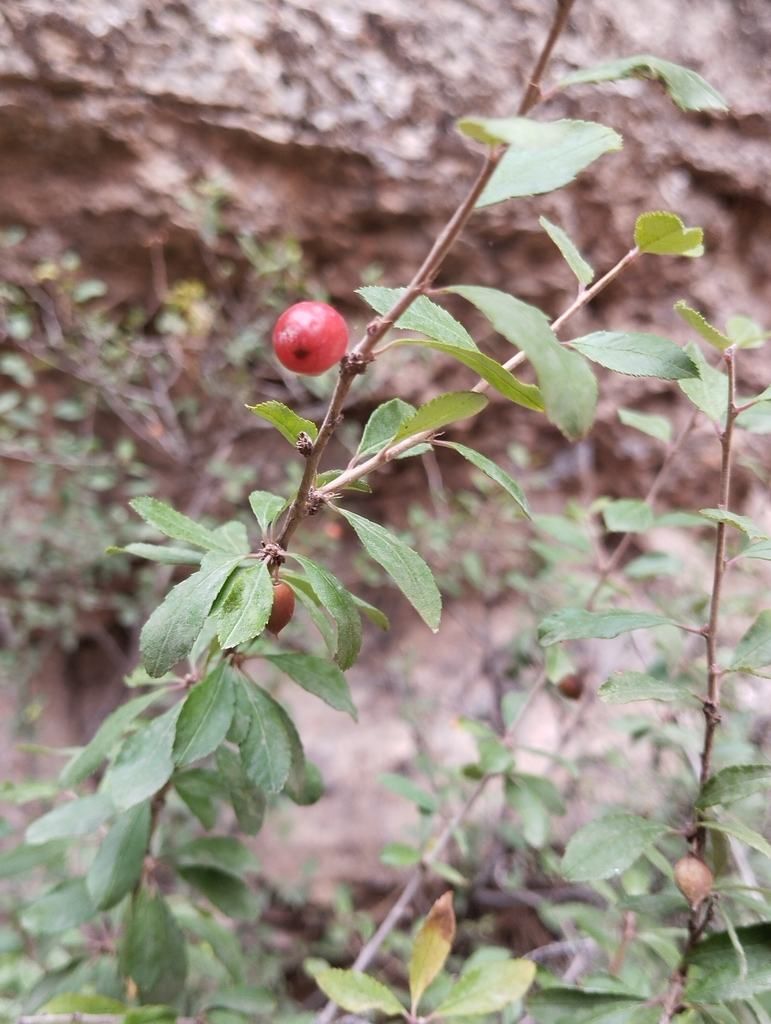
Restoration use by landscape
West Tian Shan Pilot score 74 · rank 44 of 79 shortlisted · rank 53 of 1 194 scored
- Succession role
- Nurse / intermediate shrub
- Suited to
- Eroded slopes; Rocky slopes; Landslide-prone areas; Degraded pistachio–almond woodland
- Establishment
- direct sowing of stratified seed / nursery seedlings
- Why this category
- Strong: drought tolerance, erosion control potential; Weak: grazing tolerance; -> promising but propagation/supply or field performance not proven at scale: pilot plots
- Cautions
- protect from grazing for 3-5 yrs
- Local habitat
- Rocky areas, Grassland · Occasional
Criteria scores
Kugitangtau Immediate score 79 · rank 14 of 100 shortlisted · rank 14 of 1 208 scored
- Succession role
- Nurse / intermediate shrub
- Suited to
- Eroded slopes; Rocky slopes; Landslide-prone areas; Gullies & drainage lines; Riparian / sai (other); Degraded pistachio–almond woodland
- Establishment
- direct sowing of stratified seed / nursery seedlings
- Why this category
- Strong: erosion control potential; Weak: grazing tolerance; -> routine propagation and available material: use now
- Cautions
- protect from grazing for 3-5 yrs
- Local habitat
- Rocky areas, Grassland, Shrubland, Wetlands (inland) · Frequent
Criteria scores
Propagation
direct sowing of stratified seed / nursery seedlings
Where it fits in the degradation matrix
- Kugitangtau: Gullies & drainage lines (nurse)
- Kugitangtau: Riparian / sai (other) (nurse)
Planting combinations
- Kugitangtau: Degraded juniper woodland (Kugitang and Baysuntau, above ~1,500 m) (Phase 2)
Planting material and suppliers
Seed collection and nursery propagation needed. No supplier found Action: Collect seed in summer 2027; direct sowing of scarified or stratified seed, or nursery stock from 2028
Description
- Morphology
- Low shrub, with dense crown of nodose branches and erect, generally short shoots, villous when young; annotinous shoots pale, grayish yellow, older branches variegated, brownish gray; stipules linear-subulate, twice as long as petioles, 6mm long, pinnatifid in lower part; petioles shortpubescent, 0.5--1.5mm, on 2(3)mm long shoots; leaves generally glabrous on both sides, rarely (mainly on sterile shoots) appressed-pubescent beneath when young, obovate or obovate-lanceolate, with rounded or acute apex, on the long shoots often elliptic, mucronate; margin often acutely toothed from base, 5–15{17)mm long, (2.5)—3.5–6.5 mm wide, on long shoots to 15–20mm long, 6-8mm wide. [Flora of the USSR (Tree of Life)]
- Habitat
- Stony, gravelly slopes, rocks, screes, thickets of shrubs
- Altitudinal belts
- Low mountains, mid-mountains, high mountains
- Phenology
- Flowering Apr–May, fruiting Jun–Jul
- Distribution
- Tian Shan (Susamyrtau, Kavaktau, Talas Alatau, Kyrgyz Alatau, Ichkeletau, Karatau, Chatkal, Fergana ranges, Mogoltau), Pamir-Alai
- Uses
- forest amelioration / agroforestry, melliferous, ornamental
- Conservation
- IUCN NE