Species / Rosaceae
Prunus cerasifera
Rosaceae · Tree · Uzbek: Sug‘d olxo‘risi, tog‘olcha, olicha; Russian: Слива растопыренная, Алыча
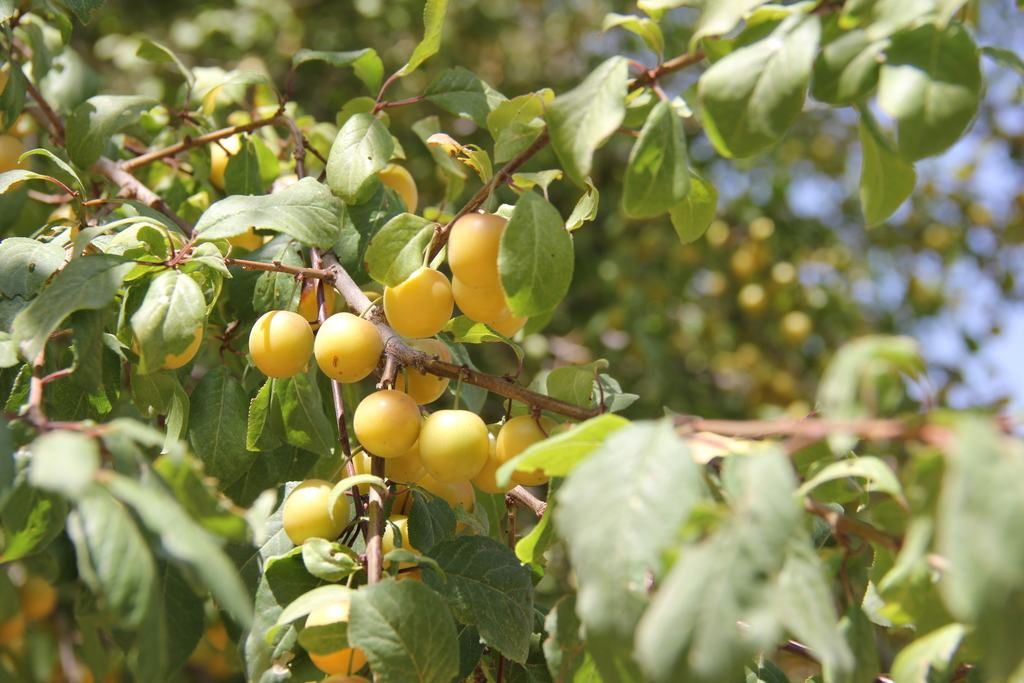
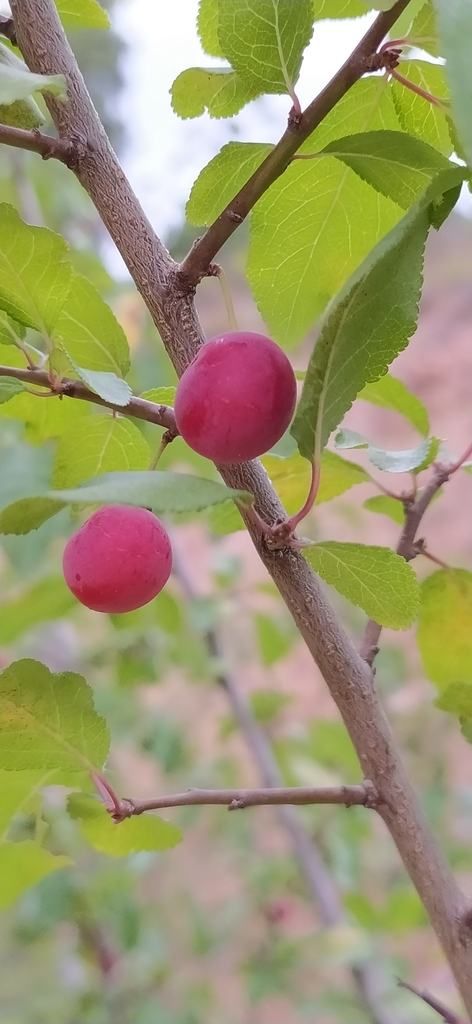
Restoration use by landscape
West Tian Shan Pilot score 76 · rank 23 of 79 shortlisted · rank 30 of 1 194 scored
- Succession role
- Climax / long-term (canopy)
- Suited to
- Gullies & drainage lines; Degraded walnut–fruit and broadleaf woodland (other)
- Establishment
- direct sowing of stratified seed / nursery seedlings
- Why this category
- Weak: grazing tolerance; -> promising but propagation/supply or field performance not proven at scale: pilot plots
- Cautions
- protect from grazing for 3-5 yrs; risk of cultivar/orchard or non-local material – wild local provenance only; pilot first
- Local habitat
- Rocky areas, Grassland · Frequent
Criteria scores
Kugitangtau Pilot score 73 · rank 65 of 100 shortlisted · rank 76 of 1 208 scored
- Succession role
- Climax / long-term (canopy)
- Suited to
- Gullies & drainage lines; Degraded walnut–fruit and broadleaf woodland (other)
- Establishment
- direct sowing of stratified seed / nursery seedlings
- Why this category
- Strong: erosion control potential; Weak: grazing tolerance; -> promising but propagation/supply or field performance not proven at scale: pilot plots
- Cautions
- protect from grazing for 3-5 yrs; risk of cultivar/orchard or non-local material – wild local provenance only; pilot first
- Local habitat
- Rocky areas, Grassland, Shrubland, Forest, Wetlands (inland) · Occasional
Criteria scores
Propagation
direct sowing of stratified seed / nursery seedlings
Where it fits in the degradation matrix
- West Tian Shan: Gullies & drainage lines (long-term)
- West Tian Shan: Degraded walnut–fruit and broadleaf woodland (other) (long-term)
- Kugitangtau: Gullies & drainage lines (long-term)
Planting material and suppliers
| Supplier | Material | Quantity | Price | Source |
|---|---|---|---|---|
| Smart Forestry platform (Qashqadaryo SFE) | Seedling | 15 000 UZS per piece | Table 7.4 |
Description
- Morphology
- Shrub; tree (often many-stemmed) or shrub (1.5)4–10(15) m high, with more or less spiny, broadly flexuous, thin, erect or drooping branches; young shoots reddish brown, perennial branches dark gray; winter buds glabrous, rarely slightly pubescent, oblong-ovoid, small; leaves of annual shoots alternate, on spurs, approximate, in subsessile fascicles; petioles (0.5) 1–1.5(2.3) cm long, glabrous, rarely sparingly pubescent, eglandulose; lamina oval or oval-ovate to oval-lanceolate (1)4.5–6(10) cm long, (0.5)2–4(6) em wide, gradually acuminate, narrowly or broadly cuneate at base, with finely, obtusely, rarely acutely, sometimes doubly serrate-dentate, eciliate margin, glabrous above, densely, rarely slightly tomentose or pubescent along veins beneath. [Flora of the USSR (Tree of Life)]
- Habitat
- Fine-earth, stony slopes, screes, deciduous forest and shrubs, juniper woodlands, valley of river, gorge
- Altitudinal belts
- Low mountains, mid-mountains
- Phenology
- Flowering Mar, Apr–Aug, Sep (Flora of the USSR)
- Distribution
- Tian Shan (Kyrgyz Alatau, Karatau, Talas Alatau, range Uzun-akhmat, Tashkent Alatau, Chatkal, Fergana and Kurama ranges), Pamir-Alai (ranges Alai, Turkestan, Zarafshan, Hissar, Karategin, Peter the Great, Darvaz, Vanch, Khozretishi, foothills of southern Tajikistan: mountains Sarsaryak, Rengentau, Gardani-ushty, Karatau, environs Baldzhuana)
- Uses
- forest amelioration / agroforestry, food, medicinal, melliferous, oil, ornamental
- Conservation
- IUCN DD