Species / Rosaceae
Prunus bucharica
Rosaceae · Tree, shrub · Uzbek: Buxoro bodomi, yovvoyi bodom; Russian: Миндаль бухарский
Restoration use by landscape
West Tian Shan Immediate score 78 · rank 12 of 79 shortlisted · rank 17 of 1 194 scored
- Succession role
- Climax / long-term (canopy)
- Suited to
- Eroded slopes; Rocky slopes; Landslide-prone areas; Gullies & drainage lines; Degraded pistachio–almond woodland
- Establishment
- direct sowing of stratified seed / nursery seedlings
- Why this category
- Strong: erosion control potential, biodiversity value; Weak: grazing tolerance; IUCN VU; in documented forestry/nursery use (D1); G3 flag: nursery-raised material only; restricted wild collection; -> routine propagation and available material: use now
- Cautions
- protect from grazing for 3-5 yrs; use local provenance only; limit wild seed harvest
- Local habitat
- Rocky areas, Grassland · Occasional
Criteria scores
Nuratau Immediate score 86 · rank 2 of 80 shortlisted · rank 2 of 640 scored
- Succession role
- Climax / long-term (canopy)
- Suited to
- Eroded slopes; Rocky slopes; Landslide-prone areas; Gullies & drainage lines; Degraded pistachio–almond woodland
- Establishment
- direct sowing of stratified seed / nursery seedlings
- Why this category
- Strong: ecological suitability, erosion control potential, biodiversity value, seed; Weak: grazing tolerance; IUCN VU; in documented forestry/nursery use (D1); G3 flag: nursery-raised material only; restricted wild collection; -> routine propagation and available material: use now
- Cautions
- protect from grazing for 3-5 yrs; use local provenance only; limit wild seed harvest
- Local habitat
- Forest, Shrubland, Grassland, Rocky areas · Dominant
Criteria scores
Kugitangtau Immediate score 81 · rank 8 of 100 shortlisted · rank 8 of 1 208 scored
- Succession role
- Climax / long-term (canopy)
- Suited to
- Eroded slopes; Landslide-prone areas; Gullies & drainage lines; Riparian / sai (other); Degraded pistachio–almond woodland
- Establishment
- direct sowing of stratified seed / nursery seedlings
- Why this category
- Strong: erosion control potential, biodiversity value, seed; Weak: grazing tolerance; IUCN VU; in documented forestry/nursery use (D1); G3 flag: nursery-raised material only; restricted wild collection; -> routine propagation and available material: use now
- Cautions
- protect from grazing for 3-5 yrs; use local provenance only; limit wild seed harvest
- Local habitat
- Grassland, Rocky areas, Shrubland, Wetlands (inland) · Frequent
Criteria scores
Propagation
direct sowing of stratified seed / nursery seedlings
Where it fits in the degradation matrix
- West Tian Shan: Eroded slopes (long-term)
- West Tian Shan: Rocky slopes (long-term)
- West Tian Shan: Landslide-prone areas (long-term)
- West Tian Shan: Gullies & drainage lines (long-term)
- West Tian Shan: Degraded pistachio–almond woodland (long-term)
- Nuratau: Eroded slopes (long-term)
- Nuratau: Rocky slopes (long-term)
- Nuratau: Landslide-prone areas (long-term)
- Nuratau: Gullies & drainage lines (long-term)
- Nuratau: Degraded pistachio–almond woodland (long-term)
- Kugitangtau: Eroded slopes (long-term)
- Kugitangtau: Landslide-prone areas (long-term)
- Kugitangtau: Gullies & drainage lines (long-term)
- Kugitangtau: Degraded pistachio–almond woodland (long-term)
- Kugitangtau: Riparian / sai (other) (long-term)
Planting combinations
- West Tian Shan: Degraded pistachio–almond woodland (Kurama and Chatkal foothills, ~700–1,400 m) (Phase 3)
- West Tian Shan: Eroded and landslide-prone slopes (Akhangaran mining and road cuts, steep loess slopes) (Phase 3)
- Nuratau: Pistachio–almond woodland (foothills, ~600–1,400 m) (Phase 3)
- Nuratau: Eroded and landslide-prone slopes (Phase 3)
- Kugitangtau: Degraded pistachio woodland (foothills and low mountains, ~600–1,400 m) (Phase 3)
- Kugitangtau: Eroded, rocky and landslide-prone slopes (Phase 3)
Description
- Morphology
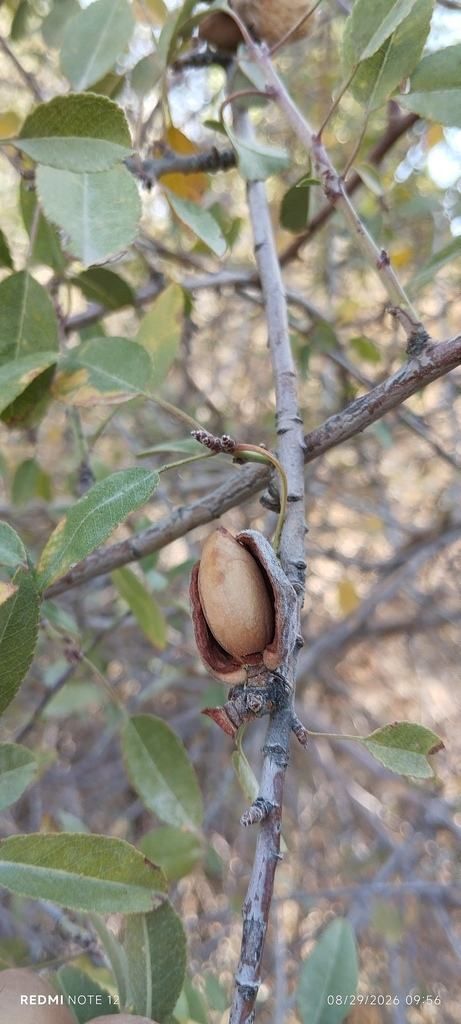
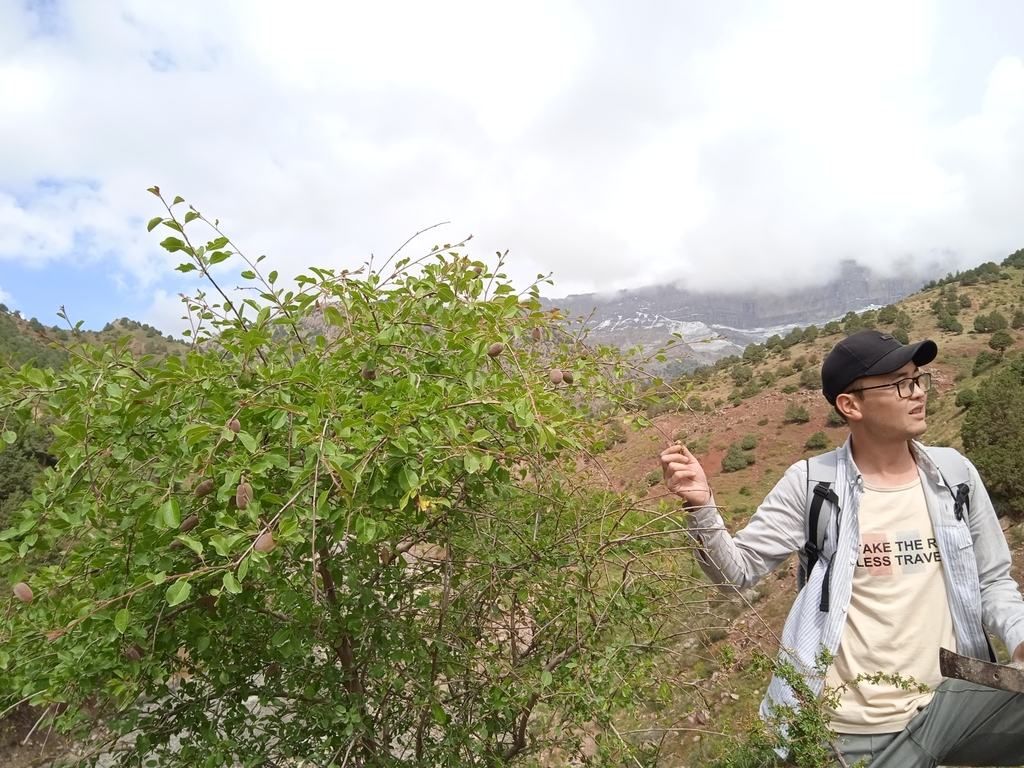
- Shrub; small tree or shrub, from 1.5–2 to 4–6(8)m high, with erect or spreading unarmed branches with numerous reduced branchlets; annual shoots glabrous, brown or gray with dense velutinous pubescence, perennial branches pale ash-gray or dark gray; winter buds long, narrow, 5— lOmim mm long, 2–2.5 in diameter, reminiscent of spruce cones; stipules subulate, mm glandular -fimbriate, 2–4 long; leaves on annual branches alternate, on spurs approximate, sessile in fascicles, all long-petioluled; petioles 2–2.5 cm, with or without 2 glands at base of blade; leaf blades broadly lanceolate, oblong-ovate or oval, 3–4(6) cm long, 1,5–2(3, 5) cm wide, obtuse at apex or prolonged -acuminate, orbicular or broadly cuneate at base, glabrous above, glabrous or more or less short velutinous -pubescent beneath, margin shallowly, obtusely, remotely serrate -dentate, glandular. [Flora of the USSR (Tree of Life)]
- Habitat
- Stony, gravelly, fine-earth slopes, rocks, screes, valley of river, cones of outwash
- Altitudinal belts
- Foothills, low mountains, mid-mountains
- Phenology
- Flowering Feb–Apr, fruiting Jun–Aug
- Distribution
- Southern Kyzylkum (residual hills), Tian Shan (western tip of Kurama range), Pamir-Alai (ranges Alai, Turkestan, Nuratau, Hissar, Karategin, Peter the Great, Darvaz, Khozretishi, foothills of southern Tajikistan, Babatag, Kugitang)
- Uses
- forest amelioration / agroforestry, dye, food, medicinal, melliferous, oil, ornamental, technical
- Conservation
- IUCN VU