Species / Poaceae
Poa versicolor
Poaceae · Perennial · Uzbek: o‘rmalovchi qo‘ng‘irbosh; Russian: Мятлик расползающийся
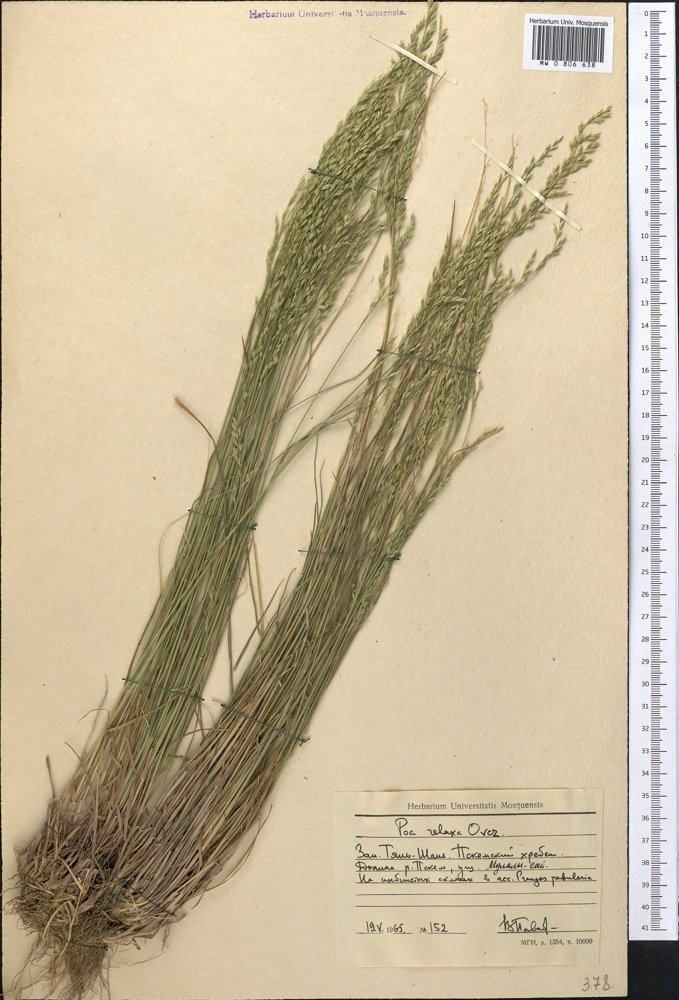
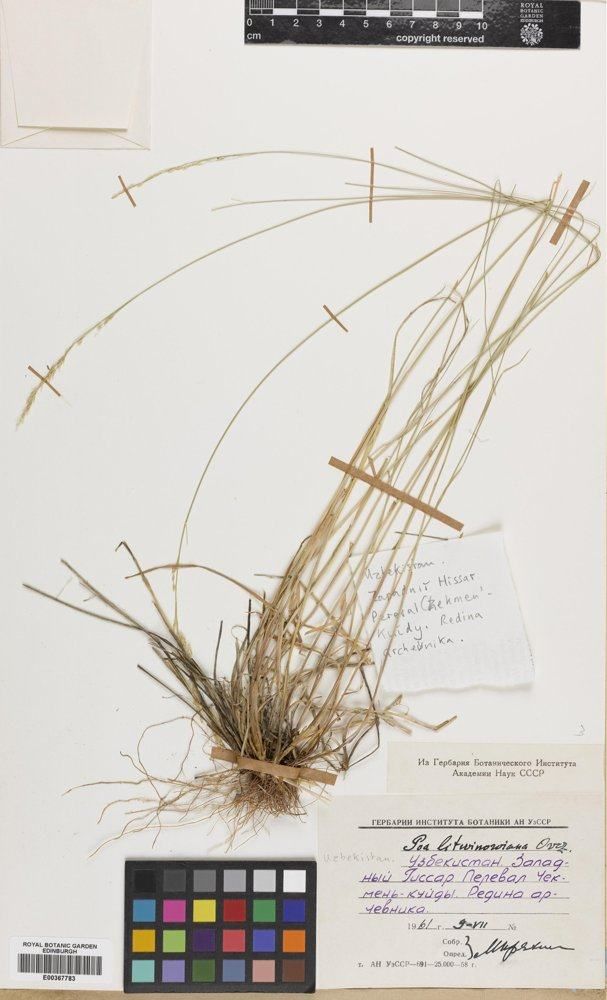
Restoration use by landscape
West Tian Shan Pilot score 74 · rank 40 of 79 shortlisted · rank 49 of 1 194 scored
- Succession role
- Pioneer (ground cover)
- Suited to
- Eroded slopes; Rocky slopes; Overgrazed rangelands
- Establishment
- direct seeding; Poa bulbosa by bulbils
- Why this category
- Strong: drought tolerance, erosion control potential; Weak: biodiversity value; -> promising but propagation/supply or field performance not proven at scale: pilot plots
- Local habitat
- Rocky areas, Grassland · Occasional
Criteria scores
Nuratau Immediate score 79 · rank 11 of 80 shortlisted · rank 12 of 640 scored
- Succession role
- Pioneer (ground cover)
- Suited to
- Eroded slopes; Rocky slopes; Overgrazed rangelands; Degraded juniper woodland
- Establishment
- direct seeding; Poa bulbosa by bulbils
- Why this category
- Strong: drought tolerance, erosion control potential; Weak: biodiversity value; -> routine propagation and available material: use now
- Local habitat
- Shrubland, Grassland, Rocky areas · Frequent
Criteria scores
Kugitangtau Pilot score 74 · rank 46 of 100 shortlisted · rank 54 of 1 208 scored
- Succession role
- Pioneer (ground cover)
- Suited to
- Eroded slopes; Rocky slopes; Overgrazed rangelands
- Establishment
- direct seeding; Poa bulbosa by bulbils
- Why this category
- Strong: drought tolerance, erosion control potential; Weak: biodiversity value; -> promising but propagation/supply or field performance not proven at scale: pilot plots
- Local habitat
- Rocky areas, Grassland · Occasional
Criteria scores
Propagation
direct seeding; Poa bulbosa by bulbils
Where it fits in the degradation matrix
- Nuratau: Eroded slopes (pioneer)
- Nuratau: Rocky slopes (pioneer)
- Nuratau: Overgrazed rangelands (pioneer)
- Nuratau: Degraded juniper woodland (pioneer)
- Kugitangtau: Eroded slopes (pioneer)
Planting combinations
- Nuratau: Juniper woodland (mid-mountains, above ~1,400 m) (Phase 1)
- Kugitangtau: Degraded juniper woodland (Kugitang and Baysuntau, above ~1,500 m) (Phase 1)
Planting material and suppliers
Wild seed collection needed. No commercial seed found Action: Collect bulbils and seed in May–July 2027 for sowing in autumn 2027; start seed plots
Rangeland use
- Grazing tolerance
- High. Tussock grass of stony slopes
- Forage value
- Medium. Spring and early summer
- Recovery
- Medium. Tillering; slow from seed
- Management
- As for Festuca valesiaca; use on stony slopes
Description
- Morphology
- Perennial. Culms 50-70cm tall, erect, terete, glabrous, very prominently scabrous; leaves narrowly linear, 1.5-3mm broad, flat or involute, very scabrous; ligules to 3mm long, more or less lacerate. Panicles large, to 18cm long and 10cm broad, oblong or pyramidal, with prominently scabrous branches to 8em long; spikelets lanceolate-acuminate, 6-8mm long, 3~5-flowered, motley-tinged; glumes linear-lanceolate, the upper larger than the lower; lemmas narrowly lanceolate, to 7mm long, acute, obscurely nerved, glabrous, sericeous only on the nerves, webbed at the base. (Plate XXX, Figure 1). [Flora of the USSR (Tree of Life)]
- Habitat
- Fine-earth, gravelly, stony slopes, rocks, screes
- Altitudinal belts
- Mid-mountains, high mountains
- Phenology
- Flowering and fruiting Jun–Sep
- Distribution
- Dzungarian Alatau, Tian Shan, Pamir-Alai, Kopet Dag
- Uses
- forage
- Conservation
- IUCN NE