Species / Poaceae
Poa nemoralis
Poaceae · Perennial · Uzbek: qorag‘ayzor qo‘ng‘irboshi; Russian: Мятлик боровой
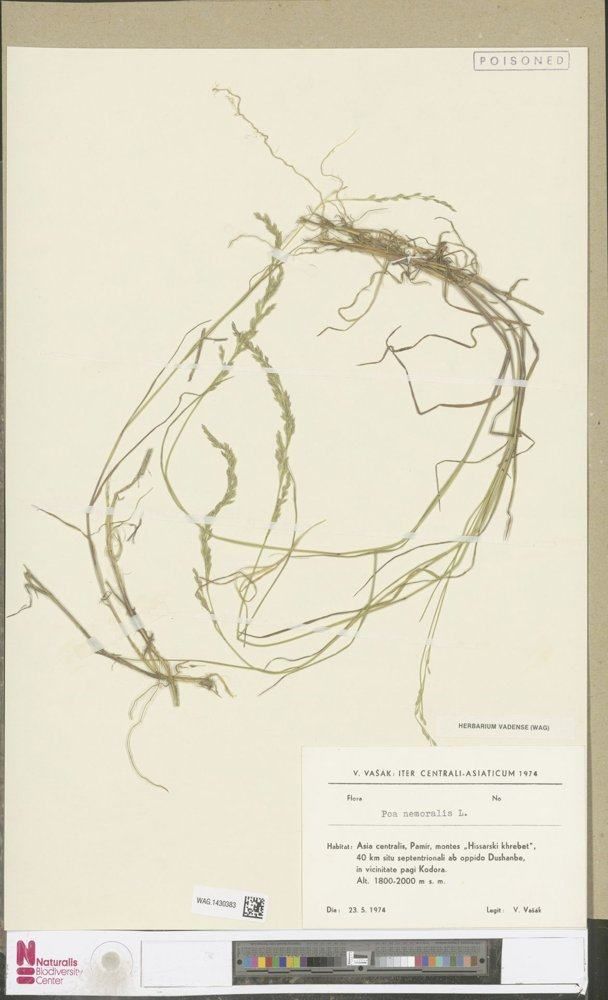
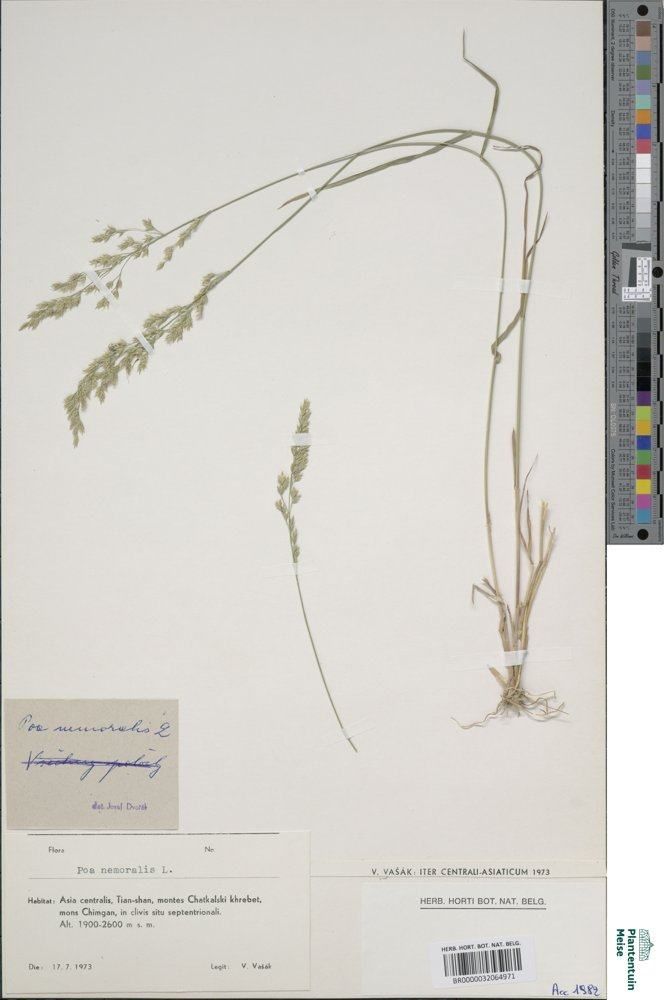
Restoration use by landscape
West Tian Shan Pilot score 72 · rank 58 of 79 shortlisted · rank 73 of 1 194 scored
- Succession role
- Pioneer (ground cover)
- Suited to
- Eroded slopes; Gullies & drainage lines; Overgrazed rangelands
- Establishment
- direct seeding; Poa bulbosa by bulbils
- Why this category
- Strong: erosion control potential; Weak: biodiversity value; -> promising but propagation/supply or field performance not proven at scale: pilot plots
- Local habitat
- Rocky areas, Grassland · Occasional
Criteria scores
Propagation
direct seeding; Poa bulbosa by bulbils
Planting combinations
- West Tian Shan: Degraded walnut–fruit and broadleaf woodland (northern slopes, valleys, ~1,000–2,000 m) (Phase 1)
Planting material and suppliers
No commercial offer found in November 2026: material has to come from wild seed collection or contracted propagation. See Nurseries & supply.
Description
- Morphology
- Perennial. Light green plants, with short stolons, loosely tufted; culms 30-100cm tall, ascending, often rooting at the nodes, smooth; leaves narrowly linear, to 2mm broad, rather scabrous, strongly spreading with Smooth, more rarely very scabrous (var. rigidula Martens et Koch), sheaths; ligules lacking or very short. Panicles to 10cm long, rather opeTM more rarely contracted (var, coa retata Gaud.), with scaberulous branches; spikelets 2- 5-flowered, more rarely 1-flowered (var. uniflora Mertens et Koch), 3-4mm long (in var. firmula Gaud.-5mm), rachilla pubescent; pale green, golden-tipped, glumes subequal; lemmas obscurely nerved, puberulent on the keel and lateral nerves, glabrous elsewhere, scantily webbed at the base. Spikelets occasionally proliferous (var. vivipara Litw.), May-July. (Plate XXX, Figure 5, a, b). [Flora of the USSR (Tree of Life)]
- Habitat
- Fine-earth slopes, gorge, valley of river, bank of streams, rocks, juniper woodlands, deciduous forest and shrubs
- Altitudinal belts
- Low mountains, mid-mountains, high mountains
- Phenology
- Flowering and fruiting May–Sep
- Distribution
- Tarbagatai, Dzungarian Alatau, Tian Shan, Pamir-Alai (without Pamir), Kopet Dag
- Uses
- forage
- Conservation
- IUCN NE