Species / Poaceae
Poa fragilis
Poaceae · Perennial · Uzbek: mo‘rt qo‘ng‘irbosh; Russian: Мятлик ломкий
Restoration use by landscape
Nuratau Pilot score 77 · rank 18 of 80 shortlisted · rank 20 of 640 scored
- Succession role
- Pioneer (ground cover)
- Suited to
- Eroded slopes; Rocky slopes; Overgrazed rangelands; Degraded juniper woodland
- Establishment
- direct seeding; Poa bulbosa by bulbils
- Why this category
- Strong: drought tolerance, erosion control potential; Weak: biodiversity value; -> promising but propagation/supply or field performance not proven at scale: pilot plots
- Local habitat
- Shrubland, Grassland, Rocky areas · Occasional
Criteria scores
Propagation
direct seeding; Poa bulbosa by bulbils
Planting material and suppliers
No commercial offer found in November 2026: material has to come from wild seed collection or contracted propagation. See Nurseries & supply.
Description
- Morphology
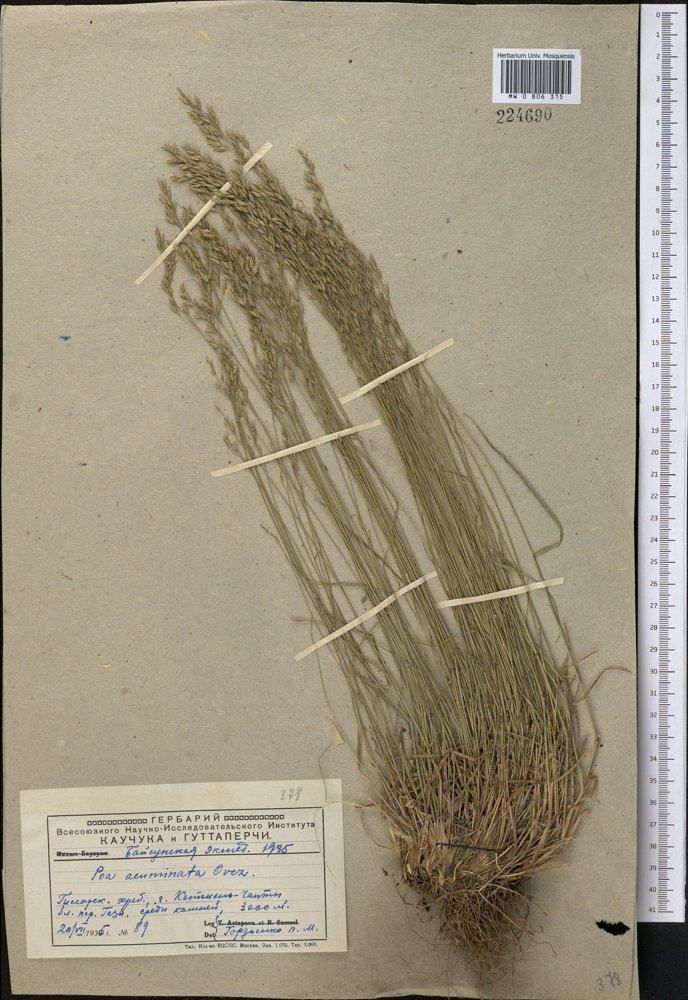
- Perennial. Densely tufted; with fibrous roots; culms to 38 cm tall, geniculate -ascending or erect, glabrous, scaberulous, surrounded at the base by short, brownish sheaths of old leaves; leaves to 1 mm broad, more or less involute or flat, linear, nearly smooth or scaberulous; sheaths smooth, longer than the internodes; ligules to 2mm long, oblong. Panicles oblong, to 6–7 (8)cm long, loose, contracted, branches short, unequal, 0.6-1cm long, stiff; spikelets oblong-elliptical, 6-7mm long, 4-5-flowered, purple; glumes lanceolate, acute, glabrous, more or less purplish on the margin; lemmas rather obscurely nerved, entirely glabrous; acuminate, serrate at the summit, variegated; anthers oblong, to 2mm long. August. [Flora of the USSR (Tree of Life)]
- Habitat
- Stony, gravelly, fine-earth slopes
- Altitudinal belts
- Mid-mountains, high mountains
- Phenology
- Flowering and fruiting Jul–Sep
- Distribution
- Pamir-Alai
- Uses
- forage
- Conservation
- IUCN NE