Species / Poaceae
Poa bulbosa
Poaceae · Perennial · Uzbek: piyozboshli qo‘ng‘irbosh; Russian: Мятлик луковичный
Restoration use by landscape
West Tian Shan Immediate score 83 · rank 2 of 79 shortlisted · rank 3 of 1 194 scored
- Succession role
- Pioneer (ground cover)
- Suited to
- Eroded slopes; Rocky slopes; Gullies & drainage lines; Overgrazed rangelands; Degraded juniper woodland; Degraded pistachio–almond woodland
- Establishment
- direct seeding; Poa bulbosa by bulbils
- Why this category
- Strong: grazing tolerance, erosion control potential, climate resilience; Weak: biodiversity value; -> routine propagation and available material: use now
- Local habitat
- Rocky areas, Shrubland, Grassland · Frequent
Criteria scores
Nuratau Immediate score 88 · rank 1 of 80 shortlisted · rank 1 of 640 scored
- Succession role
- Pioneer (ground cover)
- Suited to
- Eroded slopes; Rocky slopes; Gullies & drainage lines; Overgrazed rangelands; Degraded juniper woodland; Degraded pistachio–almond woodland
- Establishment
- direct seeding; Poa bulbosa by bulbils
- Why this category
- Strong: ecological suitability, drought tolerance, grazing tolerance, erosion control potential, climate resilience; Weak: biodiversity value; -> routine propagation and available material: use now
- Local habitat
- Desert, Forest, Shrubland, Grassland, Rocky areas, Artificial terrestrial · Dominant
Criteria scores
Kugitangtau Immediate score 83 · rank 4 of 100 shortlisted · rank 4 of 1 208 scored
- Succession role
- Pioneer (ground cover)
- Suited to
- Eroded slopes; Rocky slopes; Gullies & drainage lines; Overgrazed rangelands; Degraded juniper woodland; Degraded pistachio–almond woodland
- Establishment
- direct seeding; Poa bulbosa by bulbils
- Why this category
- Strong: grazing tolerance, erosion control potential, climate resilience; Weak: biodiversity value; -> routine propagation and available material: use now
- Local habitat
- Artificial terrestrial, Desert, Grassland, Rocky areas, Shrubland, Wetlands (inland) · Frequent
Criteria scores
Propagation
direct seeding; Poa bulbosa by bulbils
Where it fits in the degradation matrix
- West Tian Shan: Eroded slopes (pioneer)
- West Tian Shan: Rocky slopes (pioneer)
- West Tian Shan: Gullies & drainage lines (pioneer)
- West Tian Shan: Overgrazed rangelands (pioneer)
- West Tian Shan: Degraded juniper woodland (pioneer)
- West Tian Shan: Degraded pistachio–almond woodland (pioneer)
- Nuratau: Eroded slopes (pioneer)
- Nuratau: Rocky slopes (pioneer)
- Nuratau: Gullies & drainage lines (pioneer)
- Nuratau: Overgrazed rangelands (pioneer)
- Nuratau: Degraded juniper woodland (pioneer)
- Nuratau: Degraded pistachio–almond woodland (pioneer)
- Kugitangtau: Eroded slopes (pioneer)
- Kugitangtau: Rocky slopes (pioneer)
- Kugitangtau: Gullies & drainage lines (pioneer)
- Kugitangtau: Overgrazed rangelands (pioneer)
- Kugitangtau: Degraded juniper woodland (pioneer)
- Kugitangtau: Degraded pistachio–almond woodland (pioneer)
Planting combinations
- Nuratau: Pistachio–almond woodland (foothills, ~600–1,400 m) (Phase 1)
- Nuratau: Foothill and low-mountain rangeland (Phase 1)
- Nuratau: Eroded and landslide-prone slopes (Phase 1)
- Kugitangtau: Degraded pistachio woodland (foothills and low mountains, ~600–1,400 m) (Phase 1)
- Kugitangtau: Overgrazed rangeland (foothill and low-mountain pasture) (Phase 1)
- Kugitangtau: Eroded, rocky and landslide-prone slopes (Phase 1)
- Kugitangtau: Gullies, sai and Sherabad river margins (Phase 1)
Rangeland use
- Grazing tolerance
- High. Ephemeroid grass: growth ends in spring and the bulbs are dormant in summer; buds lie at soil level
- Forage value
- High in spring (March–May); short season, little value when dry
- Recovery
- High. Regrows from bulbs and bulbils; cover returns after 1–2 seasons of rest
- Management
- Base species of all seed mixes; graze after bulbils ripen
Description
- Morphology
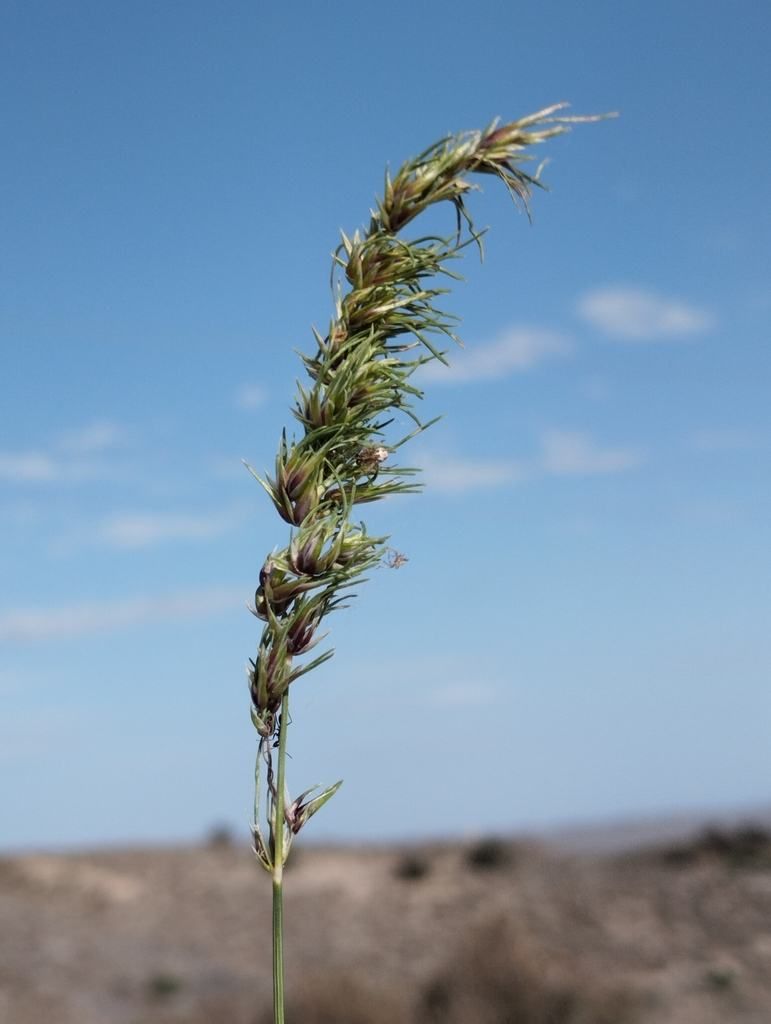
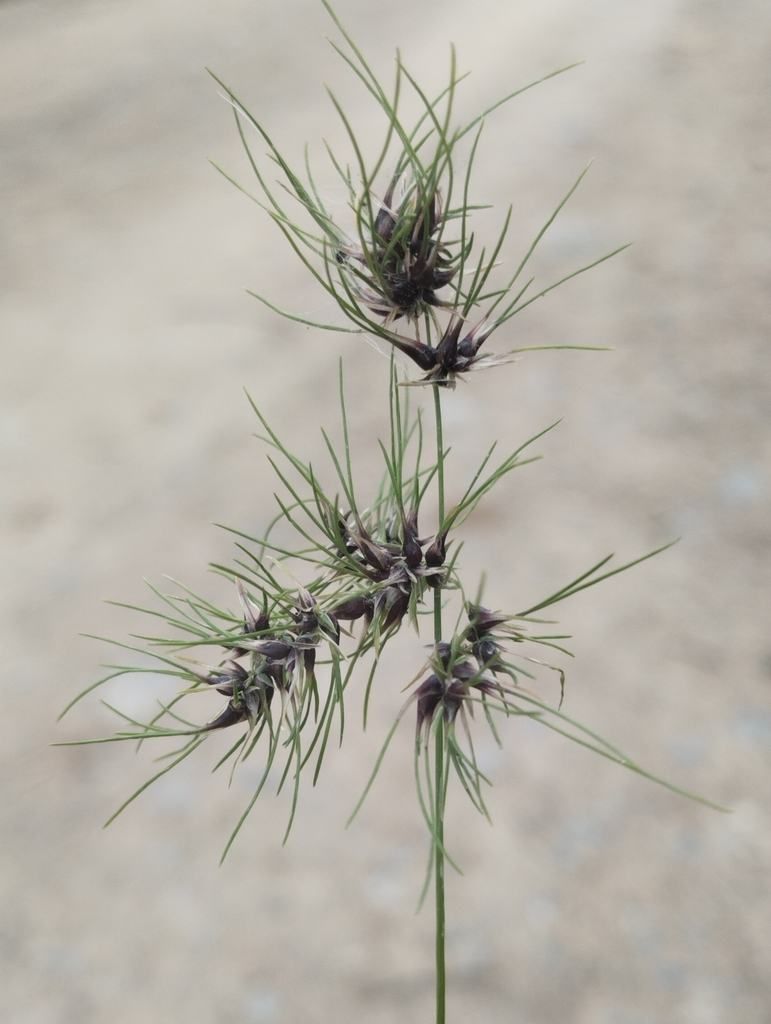
- Perennial. Tufts small; roots thin, fibrous; culms 10-30cm tall, erect, glabrous, leafless in upper part, bulbous at the base due to thickened sheaths of radical leaves; leaves narrowly linear, more or less involute, scabrous on the margin; ligules to 3.5mm long. Panicles oblong, to 6cm long, rather dense, more rarely open (f, patens Roshev.), with short, scabrous branches; spikelets to 6mm long, 4-7-flowered, green or more or less purple, very often forming proliferous buds which represent a modified apex of the spikelet, converted into a bulblet resembling the basal bulblets, but smaller (var. vivipara Koeler); glumes broadly ovate, with slender tips; lemmas obscurely nerved, pubescent on the keel and marginal nerves, with a tuft of web at the base. May-July. (Plate XXVIII, Figures 1, a,b, la, a, b).. [Flora of the USSR (Tree of Life)]
- Habitat
- Sandy, clayey, gravelly and saline deserts, foothill plains, loess, fine-earth, gravelly, stony slopes, valley of river, field, fallows, wastelands, trampled pasture, roadsides of road, inhabited settlements
- Altitudinal belts
- Plain, foothills, low mountains, mid-mountains
- Phenology
- Flowering and fruiting Apr–Jul
- Distribution
- Throughout Central Asia
- Uses
- forage
- Conservation
- IUCN NE