Species / Fabaceae
Onobrychis echidna
Fabaceae · Shrub · Uzbek: yexidna zirako‘ti; Russian: Эспарцет ехидна
Restoration use by landscape
West Tian Shan Pilot score 80 · rank 7 of 79 shortlisted · rank 9 of 1 194 scored
- Succession role
- Nurse / intermediate shrub
- Suited to
- Eroded slopes; Rocky slopes; Landslide-prone areas; Gullies & drainage lines; Overgrazed rangelands
- Establishment
- direct seeding (scarified)
- Why this category
- Strong: erosion control potential, nursery propagation feasibility, restoration cost-effectiveness; -> promising but propagation/supply or field performance not proven at scale: pilot plots
- Local habitat
- Rocky areas, Grassland · Occasional
Criteria scores
Kugitangtau Pilot score 74 · rank 44 of 100 shortlisted · rank 52 of 1 208 scored
- Succession role
- Nurse / intermediate shrub
- Suited to
- Gullies & drainage lines; Riparian / sai (other)
- Establishment
- direct seeding (scarified)
- Why this category
- Strong: erosion control potential, nursery propagation feasibility, restoration cost-effectiveness; Weak: drought tolerance, climate resilience; -> promising but propagation/supply or field performance not proven at scale: pilot plots
- Cautions
- needs moist sites
- Local habitat
- Rocky areas, Grassland, Wetlands (inland) · Occasional
Criteria scores
Propagation
direct seeding (scarified)
Where it fits in the degradation matrix
- West Tian Shan: Eroded slopes (nurse)
- West Tian Shan: Rocky slopes (nurse)
- West Tian Shan: Landslide-prone areas (nurse)
- West Tian Shan: Gullies & drainage lines (nurse)
- West Tian Shan: Overgrazed rangelands (nurse)
Planting material and suppliers
No commercial offer found in November 2026: material has to come from wild seed collection or contracted propagation. See Nurseries & supply.
Description
- Morphology
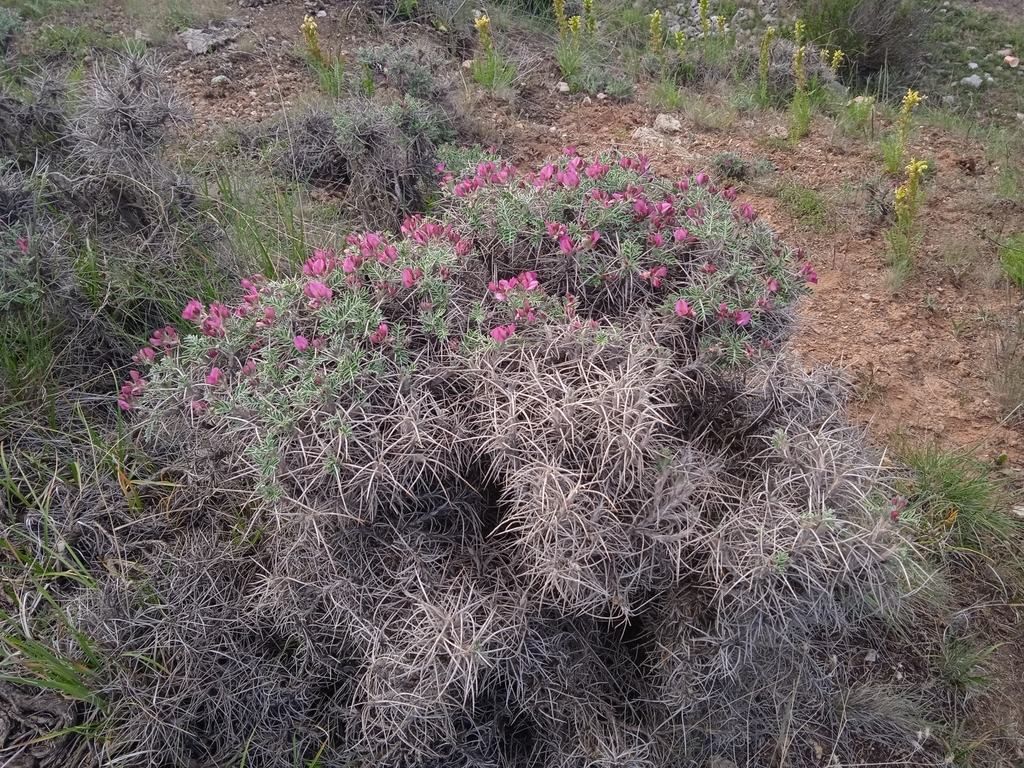
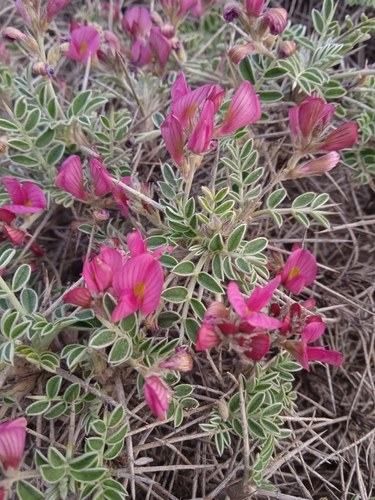
- Perennial; low spinous pulvinate shrubs; stems strongly branching, (20)40–80 cm high, densely beset with rigid relics of old petioles forming simple spines; stipules ovate, attenuate-acuminate, adnate to petioles; petioles 5–6(7) cm long; leaflets 4–7-paired, elliptic to lanceolate-elliptic, obtuse or acute, 3–6 mmlong, 2–2.5 mm wide, densely pubescent at both sides, sometimes very densely pubescent with admixture of long hairs (v. villosula Lipsky). Peduncles hardly longer than leaves; racemes 2–5(7)- flowered, loose; bracts 3–4 mm long, ovate-lanceolate, membranous, pubescent; pedicels very short, ca. 1 mm long; calyx 5 long, appressed-mm hairy, teeth lanceolate-subulate, triangular at base, as long as tube, densely hairy at margins; corolla 12–14 mm long, violet-purple; standard elliptic, emarginate; pods subglobular-ovate, up to 10 long, 6 mm wide, villous mm with short white hairs, with flattened prickles at base of disc. June— August. (Plate XVI, Figure l). [Flora of the USSR (Tree of Life)]
- Habitat
- Stony, gravelly slopes, screes, bank of river, fescue steppes, community of upland xerophytes
- Altitudinal belts
- High mountains
- Phenology
- Flowering May–Aug, fruiting Jul–Aug
- Distribution
- Tian Shan (ranges Talas Alatau, Kurama, Chatkal, Ugam, Kavaktau, Akshiyryaktau), Pamir-Alai (ranges Turkestan, Zarafshan, Hissar, Kugitang, Alai, Trans-Alai, Karategin, Vakhsh, Khozretishi, Peter the Great, Darvaz, Vanch, Shugnan, Ishkashim, Vakhan, Shakhdarin)
- Uses
- forage, melliferous
- Conservation
- IUCN NE