Species / Asteraceae
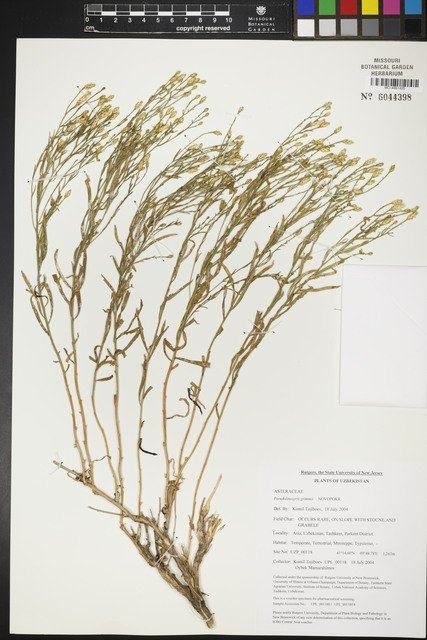
Galatella grimmii
Asteraceae · Subshrub · Uzbek: Grimm psevdolinozirisi; Russian: Псевдолинозирис Гримма
Restoration use by landscape
Nuratau Pilot score 74 · rank 49 of 80 shortlisted · rank 55 of 640 scored
- Succession role
- Pioneer (ground cover)
- Suited to
- Eroded slopes; Rocky slopes; Degraded juniper woodland; Degraded pistachio–almond woodland
- Establishment
- seed (protocol to confirm)
- Why this category
- Strong: drought tolerance, climate resilience; Weak: grazing tolerance; -> promising but propagation/supply or field performance not proven at scale: pilot plots
- Cautions
- protect from grazing for 3-5 yrs
- Local habitat
- Shrubland, Grassland, Rocky areas · Frequent
Criteria scores
Propagation
seed (protocol to confirm)
Planting material and suppliers
No commercial offer found in November 2026: material has to come from wild seed collection or contracted propagation. See Nurseries & supply.
Description
- Morphology
- Perennial. Stem branched, weakly sulcate, densely or sparsely covered with small lustrous yellowish glands and occasional multicellular hairs. Leaves dense, as long as internodes, usually longer, 2-4(5) cm long, 3-5 mm wide, lanceolate, with prominent and bright midrib beneath, lamina entire, weakly pubescent, with longer sparse flexuous hairs along margin and like stem covered with lustrous glands. Peduncles not equal, bearing one or two, less often three (then usually the third capitulum underdeveloped) capitula, almost erect, or somewhat divergent with two to four small bracteoles; capitula 2.0-2.2 cm long. Involucral bracts usually more than 20; outer bracts triangularly ovate, not acuminate; inner bracts oblong, obtuse or emarginate; all involucral bracts laciniate along margin and fimbriate-membranous, in middle and on sides straw-yellow, green above. Capitulum with four or five florets (six florets in specimens from Kugitang); corolla tube pinkish, particularly in upper part, with occasional small glands, and almost equal teeth or lobes. [Flora of the USSR (Tree of Life)]
- Habitat
- Fine-earth, gravelly, stony slopes, rocks, screes, red sandstones
- Altitudinal belts
- Plain, foothills, low mountains, mid-mountains
- Distribution
- Valley of river Syr Darya, Kyzylkum, valley of river Zeravshan, Tian Shan (Issykkul depression, ranges Karatau, Talas Alatau, Karzhantau, Ugam, Pskem, Sandalash, Chatkal, Kurama, Fergana), Pamir-Alai (ranges Alai, Turkestan, Nuratau, Zarafshan, Hissar, Kugitang, Babatag)
- Conservation
- IUCN NE