Species / Asteraceae
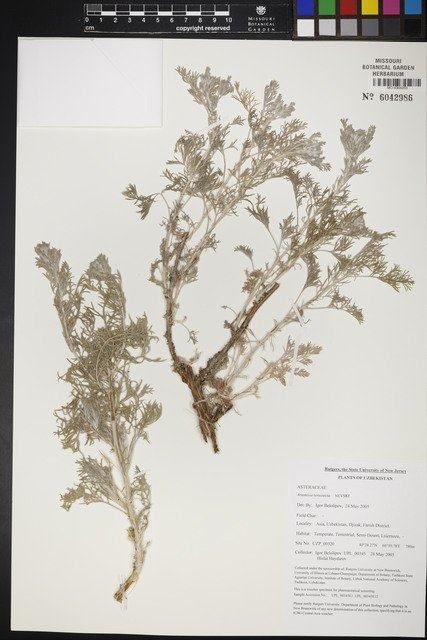
Artemisia tenuisecta
Asteraceae · Subshrub · Uzbek: ingichkabargli shuvoq; Russian: Полынь тонкорассеченная
Restoration use by landscape
Nuratau Immediate score 79 · rank 15 of 80 shortlisted · rank 16 of 640 scored
- Succession role
- Pioneer (ground cover)
- Suited to
- Eroded slopes; Rocky slopes; Overgrazed rangelands; Degraded juniper woodland; Degraded pistachio–almond woodland
- Establishment
- direct seeding (fine seed, surface sow in winter)
- Why this category
- Strong: ecological suitability; -> routine propagation and available material: use now
- Local habitat
- Shrubland, Grassland, Rocky areas · Dominant
Criteria scores
Kugitangtau Immediate score 74 · rank 42 of 100 shortlisted · rank 50 of 1 208 scored
- Succession role
- Pioneer (ground cover)
- Suited to
- Eroded slopes; Overgrazed rangelands
- Establishment
- direct seeding (fine seed, surface sow in winter)
- Why this category
- -> routine propagation and available material: use now
- Local habitat
- Grassland, Rocky areas, Wetlands (inland) · Frequent
Criteria scores
Propagation
direct seeding (fine seed, surface sow in winter)
Where it fits in the degradation matrix
- Nuratau: Degraded juniper woodland (pioneer)
Planting combinations
- Nuratau: Juniper woodland (mid-mountains, above ~1,400 m) (Phase 1)
- Kugitangtau: Degraded juniper woodland (Kugitang and Baysuntau, above ~1,500 m) (Phase 1)
Planting material and suppliers
Wild seed collection needed. No commercial seed found Action: Collect seed in October–November and surface-sow in winter
Description
- Morphology
- Perennial. Semishrub, 35-60(70) cm high, with thick, strongly branched, short, perennial, woody, nonflowering shoots covered with brownish-gray cracking bark. [Flora of the USSR (Tree of Life)]
- Habitat
- Loess, fine-earth, gravelly, stony slopes, rocks, screes, valley of river
- Altitudinal belts
- Low mountains, mid-mountains
- Phenology
- Flowering Aug–Sep, fruiting Sep
- Distribution
- Tian Shan (ranges Pskem, Sandalash, Chatkal, Kurama, Motoltau, Fergana), Pamir-Alai (ranges Alai, Turkestan, Nuratau, Zarafshan, Zirabulak-ziadin mountains, Alai долила, ranges Hissar, Karategin, Darvaz, Peter the Great, Kugitang, Babatag, foothills of southern Tajikistan)
- Uses
- essential oil, forage
- Conservation
- IUCN NE