Species / Poaceae
Festuca valesiaca
Poaceae · Perennial · Uzbek: qirg‘iz betagasi; Russian: Овсяница киргизская
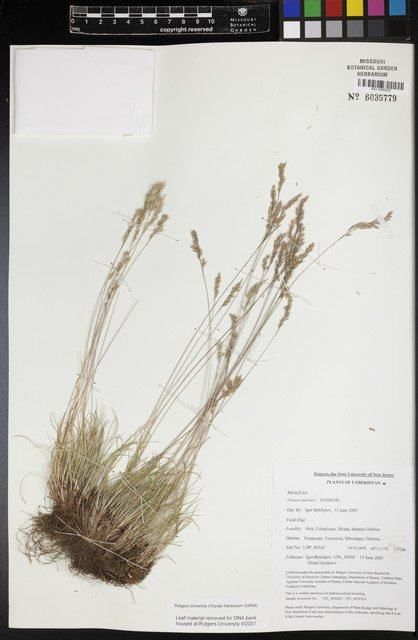
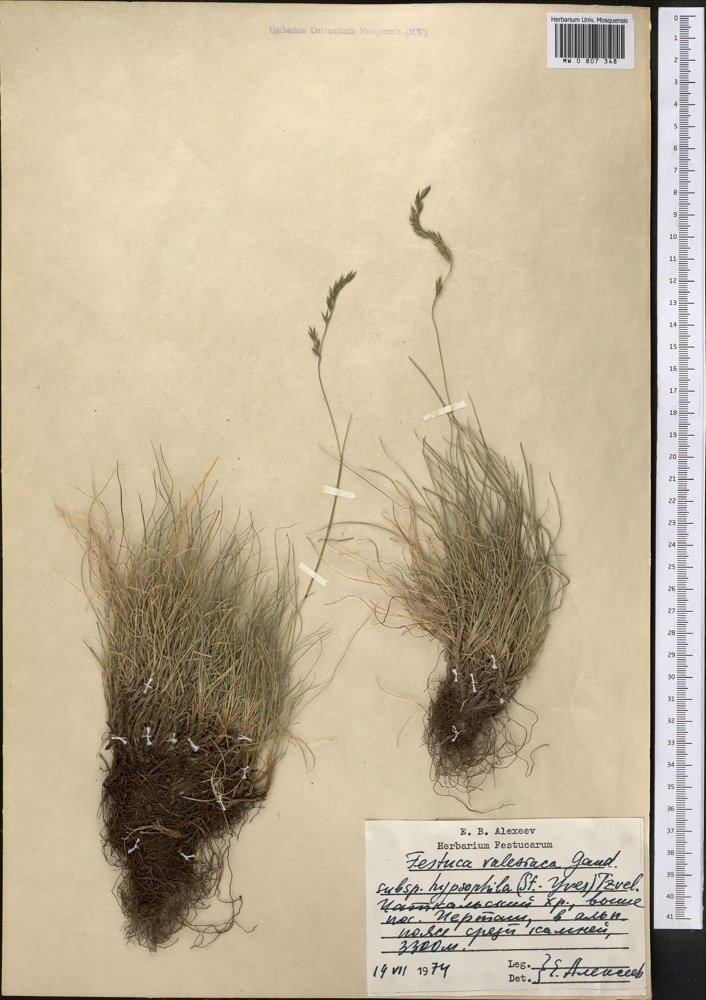
Restoration use by landscape
West Tian Shan Immediate score 78 · rank 10 of 79 shortlisted · rank 15 of 1 194 scored
- Succession role
- Pioneer (ground cover)
- Suited to
- Eroded slopes; Rocky slopes; Gullies & drainage lines; Overgrazed rangelands; Degraded pistachio–almond woodland
- Establishment
- direct seeding; Poa bulbosa by bulbils
- Why this category
- Strong: climate resilience; Weak: biodiversity value; -> routine propagation and available material: use now
- Local habitat
- Rocky areas, Grassland · Frequent
Criteria scores
Nuratau Immediate score 81 · rank 7 of 80 shortlisted · rank 7 of 640 scored
- Succession role
- Pioneer (ground cover)
- Suited to
- Eroded slopes; Rocky slopes; Gullies & drainage lines; Overgrazed rangelands; Degraded juniper woodland; Degraded pistachio–almond woodland
- Establishment
- direct seeding; Poa bulbosa by bulbils
- Why this category
- Strong: ecological suitability, climate resilience; Weak: biodiversity value; -> routine propagation and available material: use now
- Local habitat
- Shrubland, Grassland, Rocky areas · Dominant
Criteria scores
Propagation
direct seeding; Poa bulbosa by bulbils
Where it fits in the degradation matrix
- West Tian Shan: Eroded slopes (pioneer)
- West Tian Shan: Gullies & drainage lines (pioneer)
- West Tian Shan: Overgrazed rangelands (pioneer)
- West Tian Shan: Degraded pistachio–almond woodland (pioneer)
- Nuratau: Eroded slopes (pioneer)
- Nuratau: Gullies & drainage lines (pioneer)
- Nuratau: Overgrazed rangelands (pioneer)
- Nuratau: Degraded juniper woodland (pioneer)
- Nuratau: Degraded pistachio–almond woodland (pioneer)
Planting combinations
- West Tian Shan: Degraded pistachio–almond woodland (Kurama and Chatkal foothills, ~700–1,400 m) (Phase 1)
- West Tian Shan: Degraded juniper woodland (mid and upper belts, ~1,500–2,800 m) (Phase 1)
- West Tian Shan: Overgrazed rangeland (foothill and low-mountain pasture) (Phase 1)
- West Tian Shan: Eroded and landslide-prone slopes (Akhangaran mining and road cuts, steep loess slopes) (Phase 1)
- Nuratau: Pistachio–almond woodland (foothills, ~600–1,400 m) (Phase 1)
- Nuratau: Juniper woodland (mid-mountains, above ~1,400 m) (Phase 1)
- Nuratau: Foothill and low-mountain rangeland (Phase 1)
- Nuratau: Eroded and landslide-prone slopes (Phase 1)
- Nuratau: Gullies, sai and drainage lines (Phase 1)
Planting material and suppliers
Wild seed collection needed. No commercial seed found Action: Collect bulbils and seed in May–July 2027 for sowing in autumn 2027; start seed plots
Rangeland use
- Grazing tolerance
- High. Dense tussock with basal buds; withstands trampling
- Forage value
- Medium to high. Spring and early summer; also grazed as standing hay in autumn and winter
- Recovery
- Medium. Recovers by tillering in 2–3 years; slow from seed
- Management
- Rotational grazing with a spring rest every second or third year
Description
- Morphology
- No description in the Tree of Life; to be added from the Flora of Uzbekistan in Delivery 3.
- Habitat
- Fine-earth, gravelly, stony slopes, saline-alkaline meadow, rocks, screes, pebble beds, moraines
- Altitudinal belts
- Low mountains, mid-mountains, high mountains
- Distribution
- Throughout Central Asia
- Uses
- forage
- Conservation
- IUCN NE