Species / Ephedraceae
Ephedra strobilacea
Ephedraceae · Shrub · Uzbek: g‘uddali zog‘oza, borjoq, qizilcha; Russian: Хвойник шишконосный
Restoration use by landscape
Kugitangtau Research score 72 · rank 72 of 100 shortlisted · rank 83 of 1 208 scored
- Succession role
- Nurse / intermediate shrub
- Suited to
- Eroded slopes; Landslide-prone areas; Overgrazed rangelands; Degraded juniper woodland; Degraded pistachio–almond woodland
- Establishment
- seed or division; nursery
- Why this category
- Strong: drought tolerance, erosion control potential; Weak: seed; Red Data Book of Uzbekistan cat. 2; G3 flag: nursery-raised material only; restricted wild collection; -> key data gaps (propagation, seed, conservation): research/ex-situ trials first
- Cautions
- use local provenance only; limit wild seed harvest
- Local habitat
- Grassland, Desert · Occasional
Criteria scores
Propagation
seed or division; nursery
Planting material and suppliers
No commercial offer found in November 2026: material has to come from wild seed collection or contracted propagation. See Nurseries & supply.
Description
- Morphology
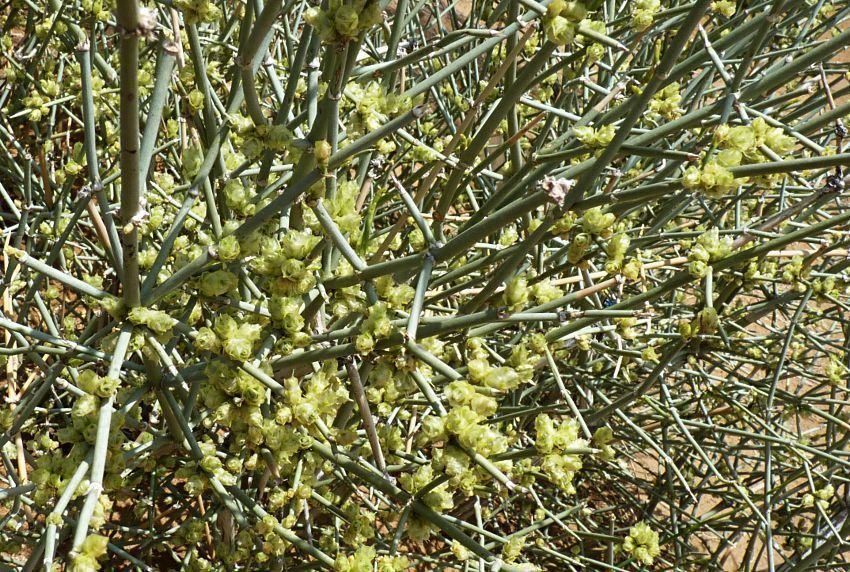
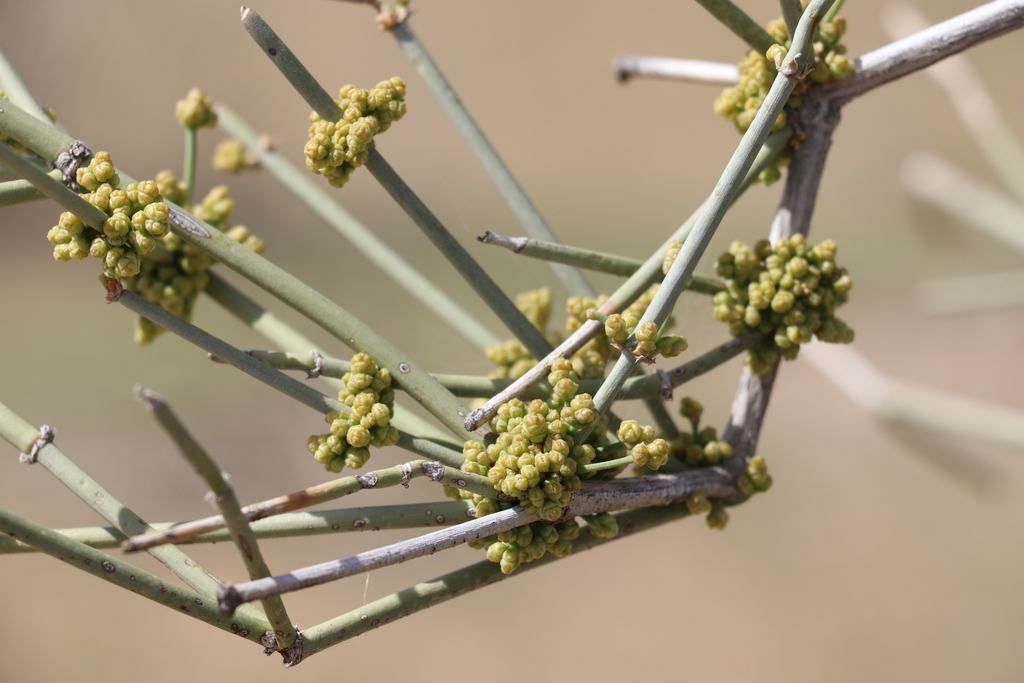
- An erect dioecious, much-branched shrub, to 2m tall; bark gray, on old branches fibrillose; young branches to 4mm in diameter, often verticillate, grayish green, smooth or somewhat scaberulous, the upper branches opposite; leaves in 2's or 3's, scalelike, acuminate, herbaceous, at the juncture membranaceous; staminate cones in capitate inflorescences, borne at the nodes of young branches, elliptic, to 5mm long; flowers 4–8, paired or in whorls of 3; bracts broad, to 2mm long, connate at base, short-pointed, the margin broadly membranous, erose; staminal column short, little exserted; anthers 5 or 6, on filaments to 1mm long; ovulate cones, like the staminate, borne at the nodes of young branches, spherical or ovoid, crowded in heads; bracts paired or in threes, in 5 or 6 whorls, free, rounded-obovate, herbaceous on the back, the margin broadly membranous, erose, ciliate; flowers in twos or threes, the straight tubillus to 3mm long; fruit 6–7mm long, with divaricate reflexed scales; seeds dark gray or greenish, 5–6mm long, ovate or elliptic, slightly keeled on the back. Fl. May; fr. [Flora of the USSR (Tree of Life)]
- Habitat
- Sandy and clayey deserts, solonchaks, takyrs, residual low mountains
- Altitudinal belts
- Plain, foothills
- Phenology
- Flowering Mar–Apr, fruiting Jun–Jul
- Distribution
- Aral deserts, Kyzylkum, Karakum, residual hill Sultanuizdag, deserts in lower reaches of river Syr Darya, Vakhsh and Kafirnigan, Badkhyz (rarely), Kopet Dag (Kyuren-dag), Lesser Balkhan
- Uses
- forest amelioration / agroforestry, forage
- Conservation
- IUCN LC; Red Data Book of Uzbekistan, category 2; Red Data Book of Uzbekistan category 2