Species / Ephedraceae
Ephedra intermedia
Ephedraceae · Shrub · Uzbek: Oraliq zog‘oza, cho‘lqizilcha; Russian: Хвойник промежуточный
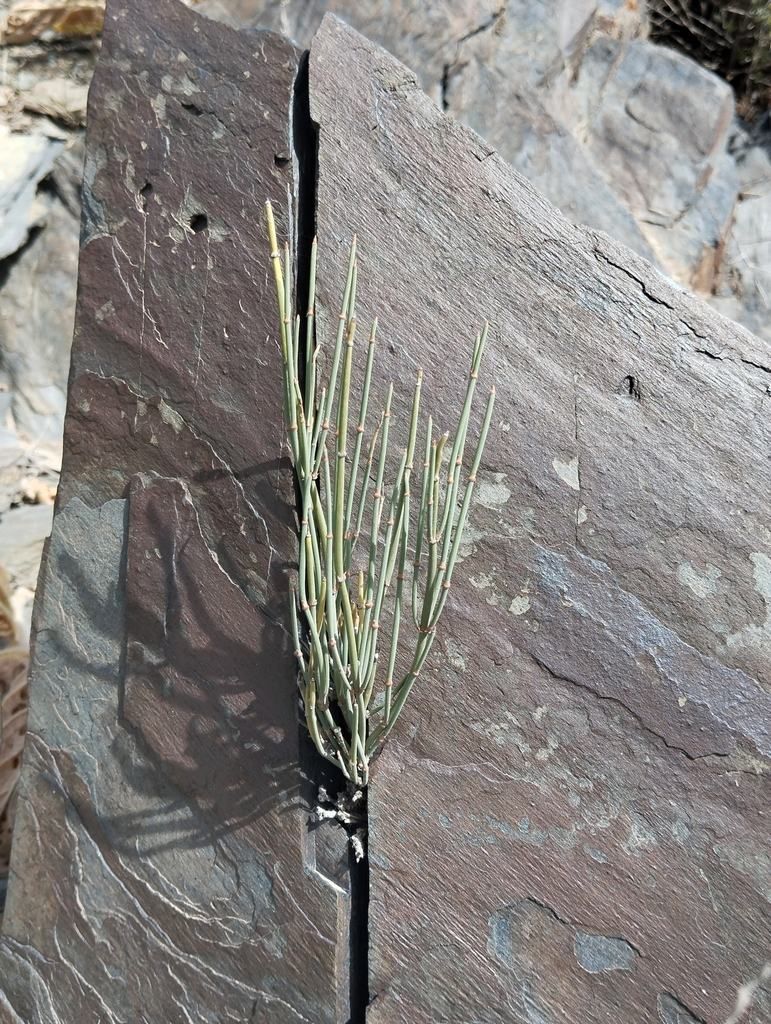
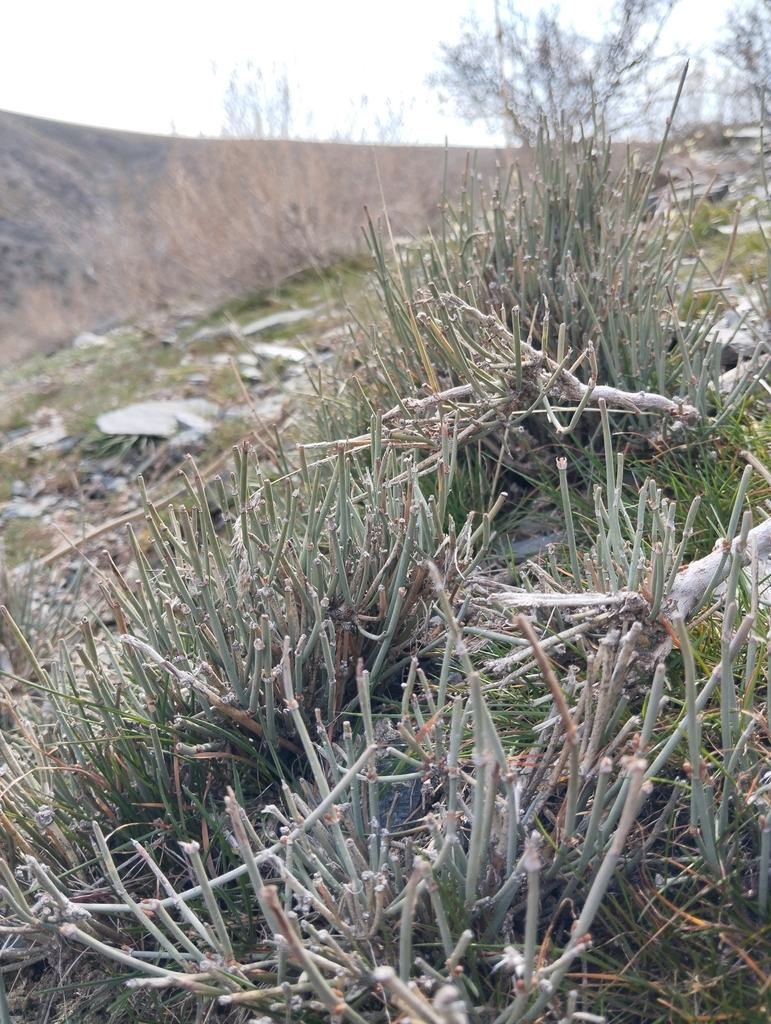
Restoration use by landscape
Nuratau Pilot score 75 · rank 34 of 80 shortlisted · rank 37 of 640 scored
- Succession role
- Nurse / intermediate shrub
- Suited to
- Eroded slopes; Rocky slopes; Landslide-prone areas; Degraded pistachio–almond woodland
- Establishment
- seed or division; nursery
- Why this category
- Strong: drought tolerance, erosion control potential; Weak: grazing tolerance; -> promising but propagation/supply or field performance not proven at scale: pilot plots
- Cautions
- protect from grazing for 3-5 yrs
- Local habitat
- Shrubland, Grassland, Rocky areas · Frequent
Criteria scores
Propagation
seed or division; nursery
Planting combinations
- Nuratau: Pistachio–almond woodland (foothills, ~600–1,400 m) (Phase 2)
Planting material and suppliers
No commercial offer found in November 2026: material has to come from wild seed collection or contracted propagation. See Nurseries & supply.
Description
- Morphology
- Shrub to 1 m, the strict branches connivent at the top, subparallel, densely forking, with gray fibrillose bark; branchlets straight, opposite or verticillate, to 2–3 mm in diameter, glaucescent, smooth or finely scaberulous, the internodes short or elongated (to 5 cm long); leaves paired, rarely in threes or fours, rudimentary, connate at base, scarious, triangular, to 3.5 mm long; staminate cones crowded in inflorescences to cm in diameter, disposed along the branches, ovoid, ca. 6 long, with mm or 4 pairs of flowers; bracts rounded-ovate, narrowly scarious-margined, connate through one-third, ca. 2.5mm long, the inner ones longer; staminal column slightly exserted, entire or divided down to base; anthers 6–8, commonly short-stalked; ovulate cones 2- or 3-flowered, sometimes terminal; bracts 2 or 3 pairs, occasionally in whorls of 3, the lower ones (of 3 pairs) short, the middle ones (of 2 pairs) about as long as the inner ones, these connate up to or somewhat beyond the middle, broad, obtusish to subacuminate, narrowly scarious-margined, entire, the tube ca. [Flora of the USSR (Tree of Life)]
- Habitat
- Or dwarf shrub. Sands, щебневатые sierozems in plains, stony, gravelly and fine-earth slopes in foothills, lower and middle belts of mountains
- Phenology
- Flowering May–Jun, fruiting Jun–Jul
- Distribution
- Zaisan basin, Balkhash deserts, Betpakdala, Muyung, Kyzylkum, Tashkent chul, Saur, Tarbagatai, Dzungarian Alatau, Tian Shan, Pamir-Alai, Badkhye, Kopet Dag
- Uses
- alkaloid, medicinal
- Conservation
- IUCN LC