Species / Polygonaceae
Atraphaxis spinosa
Polygonaceae · Shrub · Uzbek: tikanli tuyasingren; Russian: Курчавка колючая
Restoration use by landscape
Nuratau Pilot score 77 · rank 24 of 80 shortlisted · rank 27 of 640 scored
- Succession role
- Nurse / intermediate shrub
- Suited to
- Eroded slopes; Rocky slopes; Landslide-prone areas; Gullies & drainage lines; Overgrazed rangelands; Degraded pistachio–almond woodland
- Establishment
- seed or cuttings; nursery
- Why this category
- Strong: erosion control potential; -> promising but propagation/supply or field performance not proven at scale: pilot plots
- Local habitat
- Shrubland, Grassland, Rocky areas · Occasional
Criteria scores
Kugitangtau Pilot score 79 · rank 13 of 100 shortlisted · rank 13 of 1 208 scored
- Succession role
- Nurse / intermediate shrub
- Suited to
- Eroded slopes; Rocky slopes; Landslide-prone areas; Gullies & drainage lines; Overgrazed rangelands; Riparian / sai (other); Degraded juniper woodland; Degraded pistachio–almond woodland
- Establishment
- seed or cuttings; nursery
- Why this category
- Strong: erosion control potential; -> promising but propagation/supply or field performance not proven at scale: pilot plots
- Local habitat
- Artificial terrestrial, Desert, Grassland, Rocky areas, Wetlands (inland) · Frequent
Criteria scores
Propagation
seed or cuttings; nursery
Where it fits in the degradation matrix
- Nuratau: Gullies & drainage lines (nurse)
- Nuratau: Overgrazed rangelands (nurse)
- Kugitangtau: Gullies & drainage lines (nurse)
- Kugitangtau: Overgrazed rangelands (nurse)
- Kugitangtau: Degraded juniper woodland (nurse)
- Kugitangtau: Degraded pistachio–almond woodland (nurse)
- Kugitangtau: Riparian / sai (other) (nurse)
Planting combinations
- Kugitangtau: Degraded pistachio woodland (foothills and low mountains, ~600–1,400 m) (Phase 2)
Planting material and suppliers
No commercial offer found in November 2026: material has to come from wild seed collection or contracted propagation. See Nurseries & supply.
Description
- Morphology
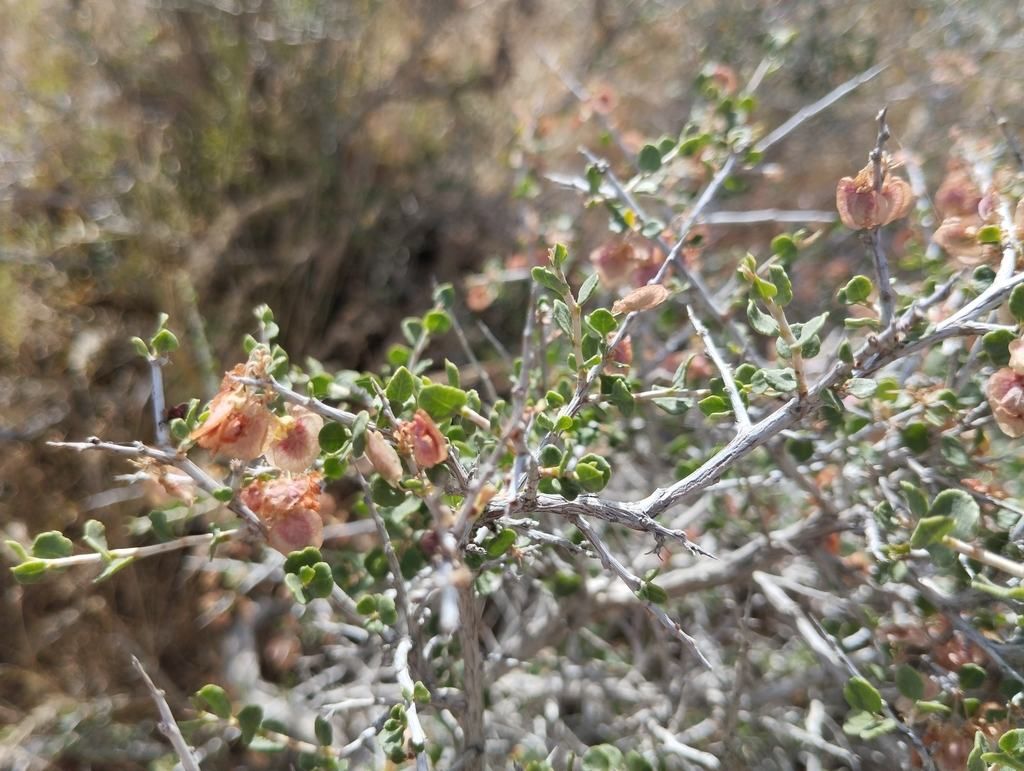
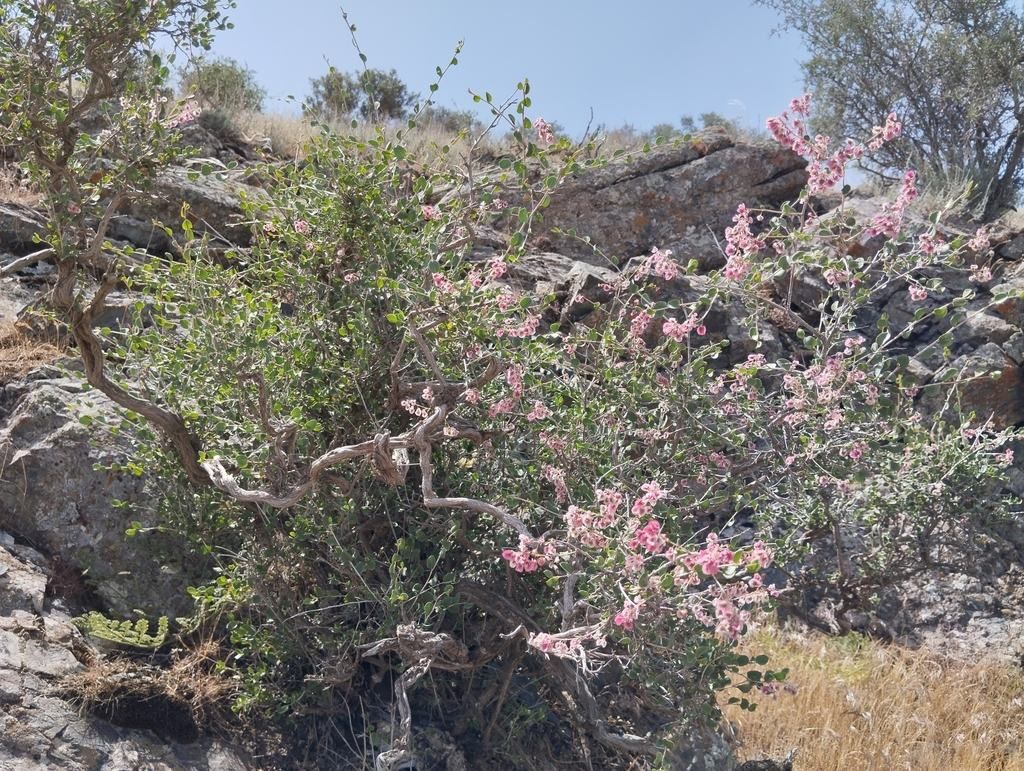
- Shrub 30–80cm high; stem slender; branches long, spreading, slender, flexuous, woody, leafless at the ends, spine -pointed, covered with scabrous bark, the epidermis splitting longitudinally and peeling off; current year's herbaceous branchlets of the second order soon becoming lignified, leafless at the ends, slender, straight or slightly flexuous, pointed, quite glabrous; ocreae short -cylindric, 1–2 mm long, brownish at base, membranaceous and obscurely nerved in upper part, much shorter than the internodes, on one side cleft into 2 short aristate teeth; leaves glaucous or glaucescent-green, 3–5 mm long and 3–4 mm broad, stiffish, thick, orbicular or rounded -elliptic, rarely broad -obovate, cuneately short -tapering at base to a very short petiole, obtuse or rounded at apex, slightly crisped-plicate at the margin, glabrous on both sides, smooth above, faintly reticulate -veined beneath; flowers in fascicles of 2–6, in the leaf axils at the ends of short branchlets of the current year, these borne laterally on old woody branches; pedicels long, jointed at or slightly below the mid. [Flora of the USSR (Tree of Life)]
- Habitat
- Sandy hummocks, loams, pebble beds, gravelly deserts, outcrops of variegated rocks, gravelly, stony slopes
- Altitudinal belts
- Plain, foothills
- Phenology
- Flowering and fruiting May–Jun
- Distribution
- Throughout Central Asia
- Uses
- dye, forage, melliferous, ornamental, tannin
- Conservation
- IUCN NE