Species / Fabaceae
Astragalus lasiosemius
Fabaceae · Subshrub · Uzbek: paxmoq astragal; Russian: Астрагал мохнатый
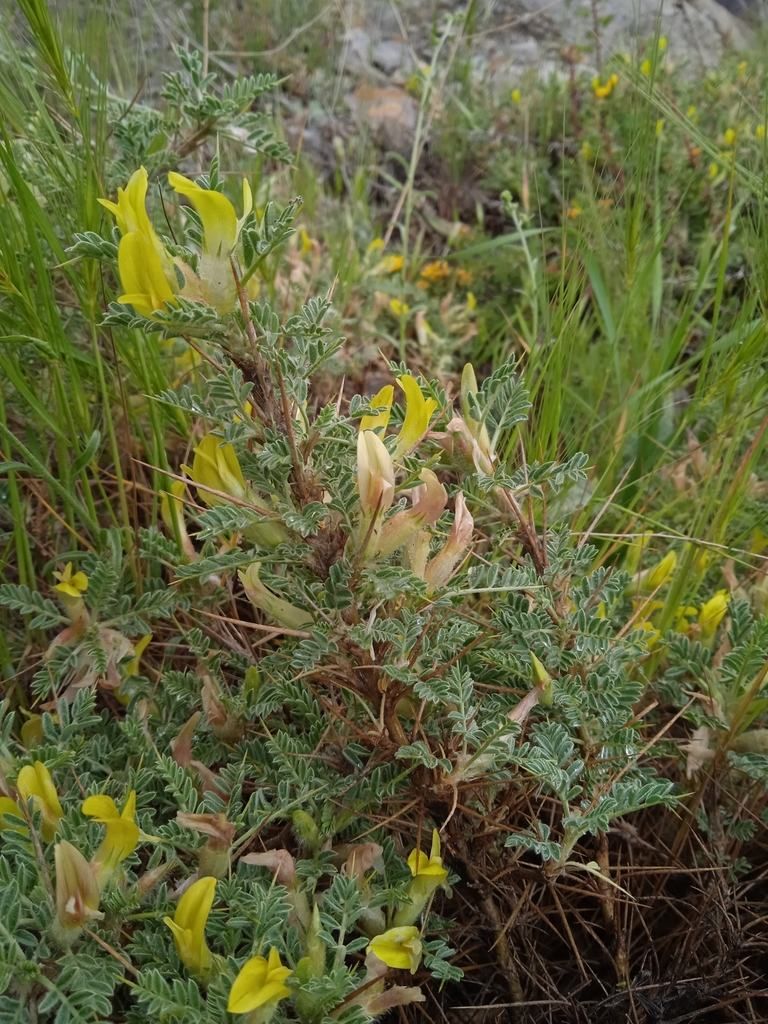
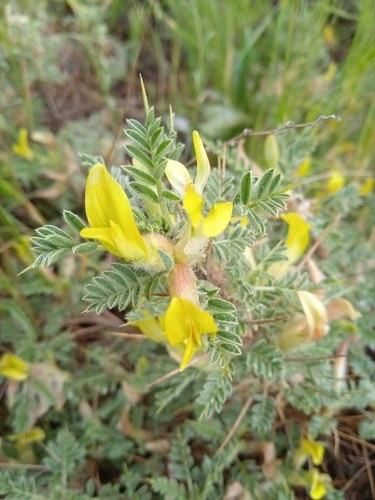
Restoration use by landscape
West Tian Shan Pilot score 74 · rank 41 of 79 shortlisted · rank 50 of 1 194 scored
- Succession role
- Pioneer (ground cover)
- Suited to
- Eroded slopes; Rocky slopes; Overgrazed rangelands
- Establishment
- scarified seed; nursery or direct seeding
- Why this category
- Strong: drought tolerance; -> promising but propagation/supply or field performance not proven at scale: pilot plots
- Local habitat
- Rocky areas, Grassland · Frequent
Criteria scores
Kugitangtau Pilot score 74 · rank 43 of 100 shortlisted · rank 51 of 1 208 scored
- Succession role
- Pioneer (ground cover)
- Suited to
- Eroded slopes; Rocky slopes; Overgrazed rangelands; Degraded juniper woodland
- Establishment
- scarified seed; nursery or direct seeding
- Why this category
- Strong: drought tolerance; -> promising but propagation/supply or field performance not proven at scale: pilot plots
- Local habitat
- Rocky areas, Grassland, Forest, Artificial terrestrial · Frequent
Criteria scores
Propagation
scarified seed; nursery or direct seeding
Where it fits in the degradation matrix
- Kugitangtau: Degraded juniper woodland (pioneer)
Planting combinations
- Kugitangtau: Overgrazed rangeland (foothill and low-mountain pasture) (Phase 1)
Planting material and suppliers
No commercial offer found in November 2026: material has to come from wild seed collection or contracted propagation. See Nurseries & supply.
Description
- Morphology
- A densely branched spiny low shrub, 10-25 cm tall, loosely or rather compactly pulvinate; spines on the lignified branches (2) 3-5 cm long; shoots of the year 2-5 cm long, densely leafy, rather densely hairy, the internodes 1-3 (5) mm long; stipules lanceolate, 5-8 mm long, long -acuminate, more or less hairy; leaves (2) 3-5 (6) cm long, the rachis more or less hairy; leaflets 6-11 pairs, obovate to oblong -lanceolate, subobtuse to subacute, commonly mucronate, (2) 3-8 (9) mm long, rather densely covered with hairs on both sides; flowers 2-3 on very short peduncles (ca. [Flora of the USSR (Tree of Life)]
- Habitat
- Stony, gravelly slopes, screes, outcrops of variegated rocks, juniper woodlands, rose gardens, umbellars, fescue steppes, high-mountain wormwood steppes, upland xerophytes
- Altitudinal belts
- Mid-mountains, high mountains
- Phenology
- Flowering Jun–Aug, fruiting Jul–Sep
- Distribution
- Western Tian Shan, Pamir-Alai
- Uses
- forage
- Conservation
- IUCN NE