Species / Fabaceae
Astragalus kudrjaschovii
Fabaceae · Shrub · Uzbek: Kudryashev astragali; Russian: Астрагал Кудряшева
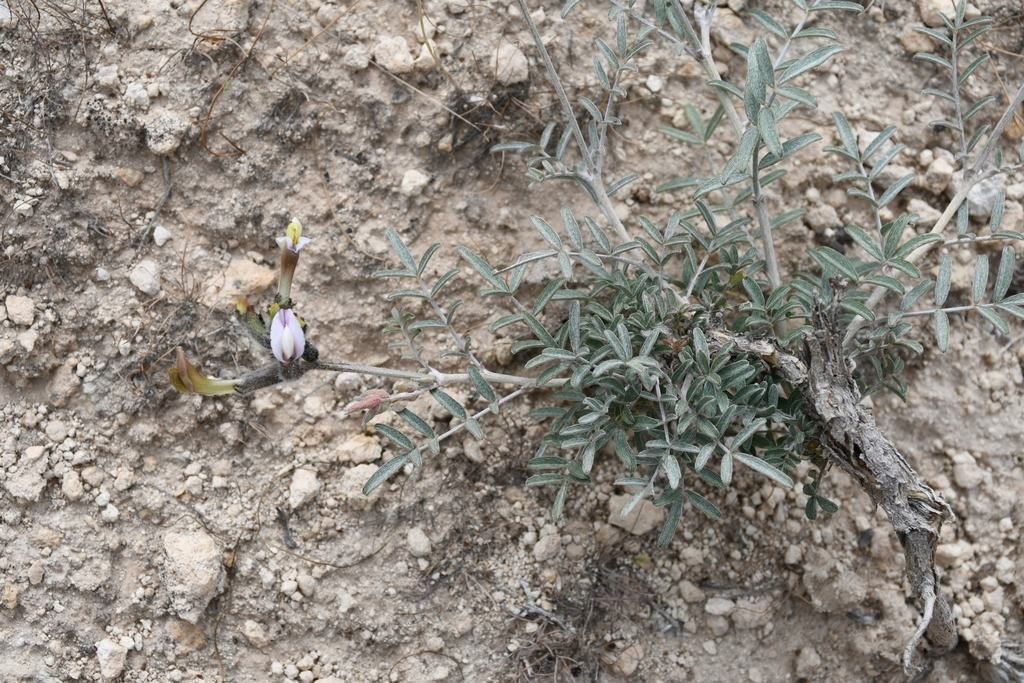
Restoration use by landscape
Kugitangtau Pilot score 73 · rank 59 of 100 shortlisted · rank 67 of 1 208 scored
- Succession role
- Nurse / intermediate shrub
- Suited to
- Eroded slopes; Rocky slopes; Landslide-prone areas; Degraded pistachio–almond woodland
- Establishment
- scarified seed; nursery or direct seeding
- Why this category
- Strong: drought tolerance, erosion control potential; Weak: grazing tolerance; -> promising but propagation/supply or field performance not proven at scale: pilot plots
- Cautions
- protect from grazing for 3-5 yrs
- Local habitat
- Artificial terrestrial, Grassland, Rocky areas · Frequent
Criteria scores
Propagation
scarified seed; nursery or direct seeding
Planting material and suppliers
No commercial offer found in November 2026: material has to come from wild seed collection or contracted propagation. See Nurseries & supply.
Description
- Morphology
- Perennial, suffrutescent, 30-45 cm tall, the caudex 10-25 cm tall, covered with castaneous~brown bark; stems of the year 5-10 (18) em long, finely sulcate, densely white-tomentose by appressed hairs; stipules free, triangular-lanceolate, 25-3 mm long, covered with appressed white hairs; leaves (3) 4-7 cm long, the petiole and the much longer rachis hoary by appressed white hairs; leaflets (4) 5-6 (7) pairs, linear, (4) 6-12 mm long, 1-1.5 (1-3) mm broad, obtuse, covered sparsely or scatteredly above and densely beneath with appressed hairs; peduncles twice as long as the leaves, densely covered with appressed white and, beneath the inflorescence, mixed white and black hairs; racemes loose, oblong, rather many-flowered, 10-18 cm long in fruit, subremotely flowered, the distant fruits horizontally spreading to subcernuous; bracts lanceolate, 3-5 (6) mm long, covered with black and white hairs, twice the length of the pedicel; calyx cylindric, 15-16 mm long, villous with very short black and predominantly white spreading hairs, the subulate-linear teeth 3-4 mm long, the tube 3-3.5times . [Flora of the USSR (Tree of Life)]
- Habitat
- Fine-earth, stony, gravelly, clayey slopes, screes, outcrops of variegated rocks
- Altitudinal belts
- Foothills, low mountains
- Phenology
- Flowering Apr–May, fruiting May–Jun
- Distribution
- Pamir-Alai (ranges Zarafshan, Hissar, Kugitang, foothills of southern Tajikistan: Aktau, Aruktau, Gardani-ushti and Gazimaylik
- Conservation
- IUCN NE