Species / Poaceae
Agropyron badamense
Poaceae · Perennial · Uzbek: bodom bug‘doyig‘i; Russian: Житняк бадамский
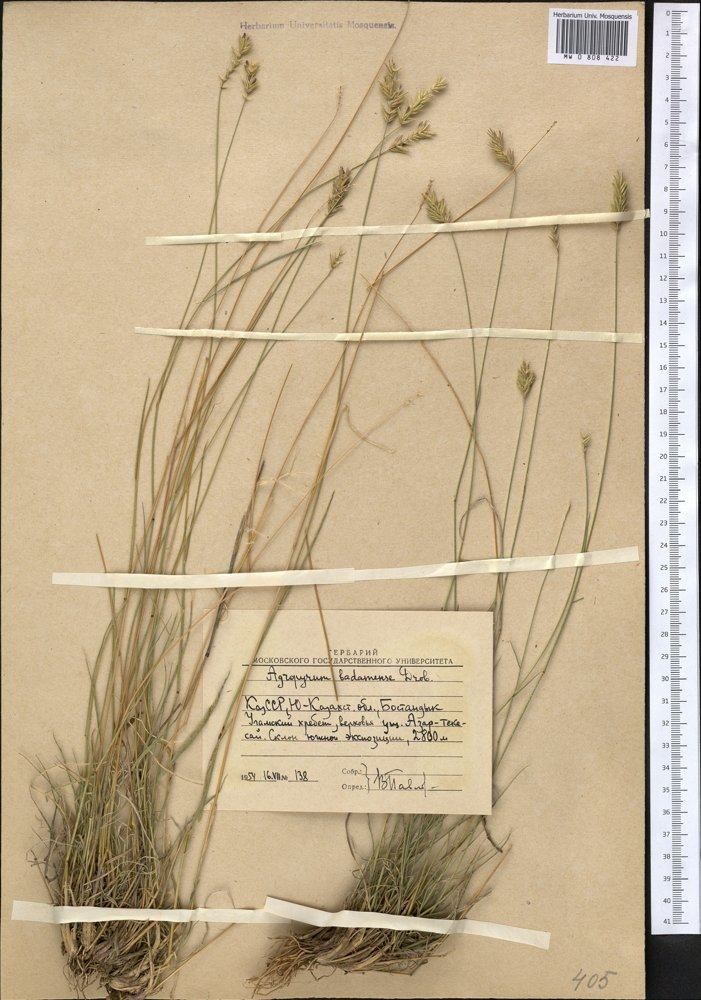
Restoration use by landscape
West Tian Shan Pilot score 73 · rank 51 of 79 shortlisted · rank 61 of 1 194 scored
- Succession role
- Pioneer (ground cover)
- Suited to
- Eroded slopes; Rocky slopes; Overgrazed rangelands
- Establishment
- direct seeding / drilling
- Why this category
- Strong: drought tolerance, restoration cost-effectiveness; Weak: biodiversity value; -> promising but propagation/supply or field performance not proven at scale: pilot plots
- Local habitat
- Rocky areas, Grassland · Occasional
Criteria scores
Propagation
direct seeding / drilling
Planting material and suppliers
No commercial offer found in November 2026: material has to come from wild seed collection or contracted propagation. See Nurseries & supply.
Description
- Morphology
- Perennial. A densely tufted plant; culms thickened at base, 10-40cm tall,slender, smooth; sheaths smooth; ligule obsolete; leaves short, subinvolute or flat, 0.3 cm broad, glabrous and smooth underneath, scabrous on the upper surface. Spikes 1.5-3 cm long, oblong-ovalo id, 0.6-0.9 cm broad, not comb-like, dense; spikelets pale green or very slightly tinged, 0.9- 1.2 cm long, 3–4— flowered; glumes lanceolate-subulate, gradually acuminate from a broad basis, or ovate-lanceolate, with an awn-point 0.5–1.5 mm long, smooth, lustrous, prominently keeled, 0.3–0.5cm long (excluding awn); lemmas lanceolate, 0.5–0.6 cm long, glabrous, lustrous, with awn 1–2 mmlong; palea as long as the lemma, acuminate, sharply mm bidentate at the summit, ciliolate on the keels; anthers 3 long. June. [Flora of the USSR (Tree of Life)]
- Habitat
- Fine-earth, gravelly, stony slopes
- Altitudinal belts
- Mid-mountains, high mountains
- Phenology
- Flowering and fruiting Jun–Aug
- Distribution
- Tian Shan, Pamir-Alai (Turkestan and Zarafshan ranges)
- Uses
- forage
- Conservation
- IUCN NE