Species / Caryophyllaceae
Acanthophyllum aculeatum
Caryophyllaceae · Subshrub · Uzbek: tikanli bo‘ritikon; Russian: Колючелистник шиповатый
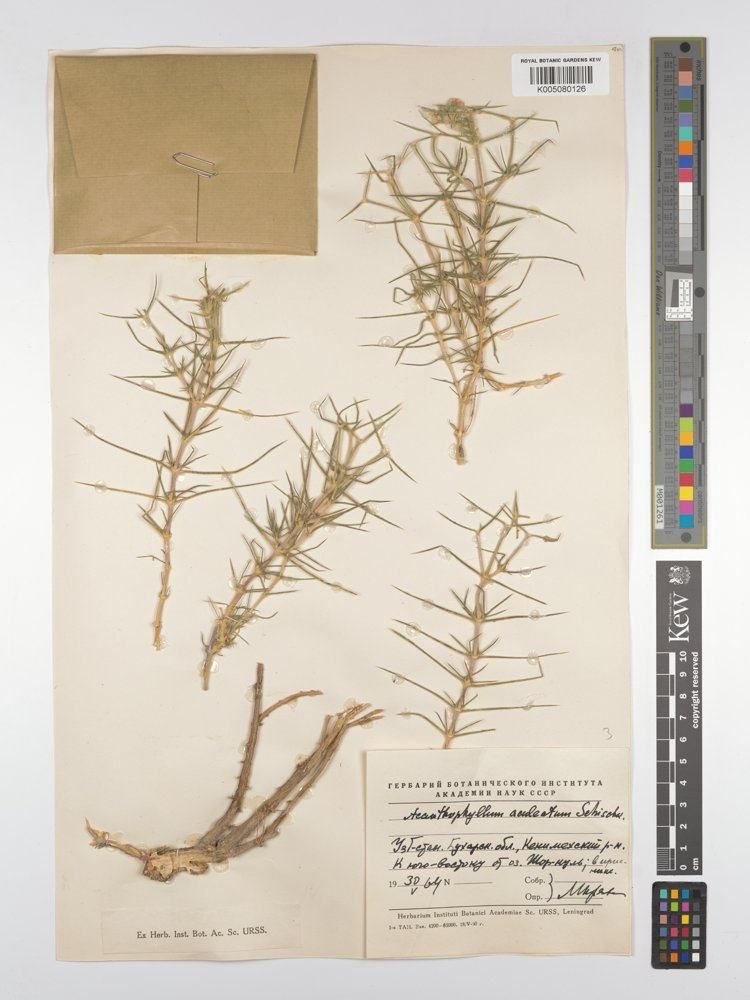
Restoration use by landscape
Nuratau Pilot score 76 · rank 26 of 80 shortlisted · rank 29 of 640 scored
- Succession role
- Pioneer (ground cover)
- Suited to
- Eroded slopes; Rocky slopes; Degraded juniper woodland; Degraded pistachio–almond woodland
- Establishment
- seed; little propagation experience
- Why this category
- Strong: drought tolerance, climate resilience; Weak: nursery propagation feasibility, restoration cost-effectiveness; -> promising but propagation/supply or field performance not proven at scale: pilot plots
- Cautions
- propagation protocol to develop
- Local habitat
- Desert, Shrubland, Grassland, Rocky areas · Frequent
Criteria scores
Propagation
seed; little propagation experience
Planting material and suppliers
No commercial offer found in November 2026: material has to come from wild seed collection or contracted propagation. See Nurseries & supply.
Description
- Morphology
- Perennial; stems branched from base, ascending, 10–15 cm long, scabridpubescent; leaves horizontally spreading, subulate, 1.5–2.5cm long and ca. 1 mm broad, scabrid-pubescent, acerose; axillary shoots nonelongated, reduced to fascicle of short subulate leaves; flowers in hemispherical head 2.5–3.5cm in diameter; bracts subulate, acerose, erect or slightly recurved, exceeding the flowers, crisp-pubescent on the declivity of the dilated base, broadly scarious-margined, ciliate, calyx tubular, 9mm long, puberulent; teeth lance-subulate, ca. 2mm long; petals whitish-rose; limb narrow-ovate, ca. 1mm broad, acute. June. [Flora of the USSR (Tree of Life)]
- Habitat
- Sandy deserts, foothill plains, loess, fine-earth, gravelly, stony slopes, outcrops of variegated rocks, screes
- Altitudinal belts
- Plain, foothills, low mountains, mid-mountains
- Phenology
- Flowering Jun (Flora of the USSR)
- Distribution
- Western Pamir-Alai
- Uses
- medicinal, melliferous, saponin
- Conservation
- IUCN NE