Species / Amaranthaceae
Xylosalsola arbuscula
Amaranthaceae · Shrub · Uzbek: daraxtsimon sho‘rak, boyalish; Russian: Солянка деревцевидная
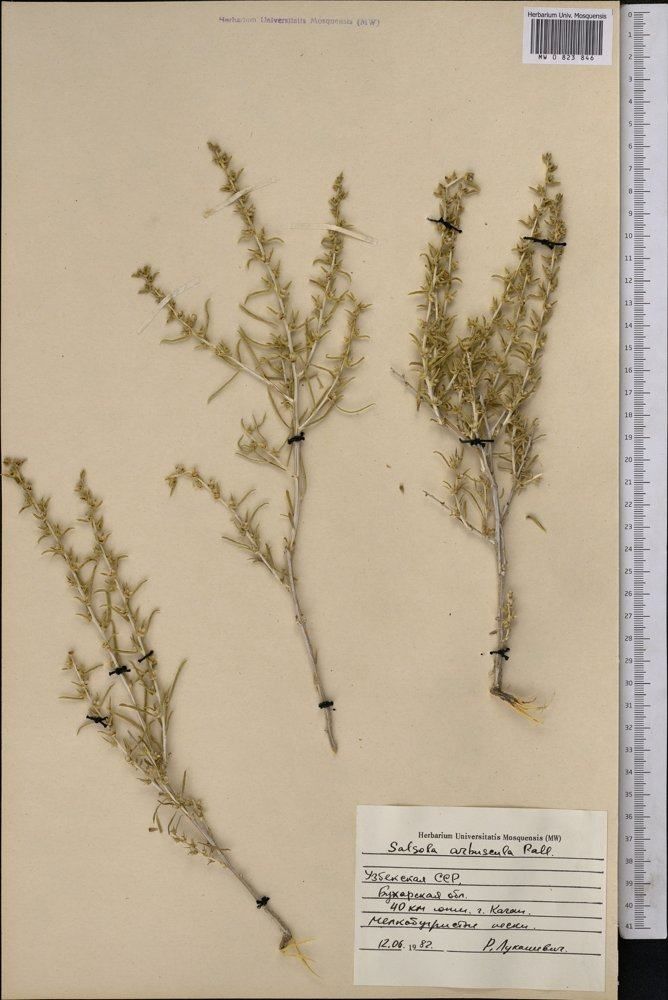
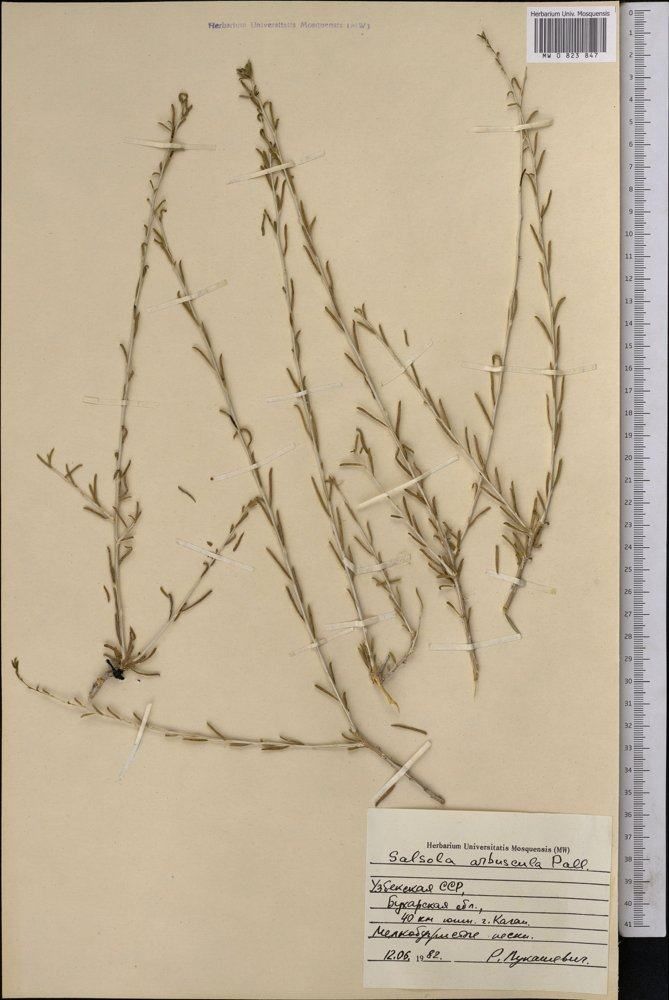
Restoration use by landscape
Nuratau Pilot score 76 · rank 30 of 80 shortlisted · rank 33 of 640 scored
- Succession role
- Nurse / intermediate shrub
- Suited to
- Eroded slopes; Rocky slopes; Landslide-prone areas; Gullies & drainage lines; Overgrazed rangelands; Degraded pistachio–almond woodland
- Establishment
- seed; nursery (protocol to confirm)
- Why this category
- Strong: drought tolerance, erosion control potential, climate resilience; -> promising but propagation/supply or field performance not proven at scale: pilot plots
- Local habitat
- Desert, Shrubland, Rocky areas · Occasional
Criteria scores
Kugitangtau Research score 77 · rank 20 of 100 shortlisted · rank 22 of 1 208 scored
- Succession role
- Nurse / intermediate shrub
- Suited to
- Eroded slopes; Rocky slopes; Landslide-prone areas; Gullies & drainage lines; Overgrazed rangelands; Riparian / sai (other); Degraded pistachio–almond woodland
- Establishment
- seed; nursery (protocol to confirm)
- Why this category
- Strong: erosion control potential, climate resilience; Weak: seed; Red Data Book of Uzbekistan cat. 2; G3 flag: nursery-raised material only; restricted wild collection; -> key data gaps (propagation, seed, conservation): research/ex-situ trials first
- Cautions
- use local provenance only; limit wild seed harvest
- Local habitat
- Artificial terrestrial, Desert, Grassland, Rocky areas, Wetlands (inland) · Frequent
Criteria scores
Propagation
seed; nursery (protocol to confirm)
Where it fits in the degradation matrix
- Nuratau: Rocky slopes (nurse)
- Nuratau: Overgrazed rangelands (nurse)
- Kugitangtau: Gullies & drainage lines (nurse)
- Kugitangtau: Overgrazed rangelands (nurse)
- Kugitangtau: Riparian / sai (other) (nurse)
Planting material and suppliers
No commercial offer found in November 2026: material has to come from wild seed collection or contracted propagation. See Nurseries & supply.
Description
- Morphology
- Shrublet 20 — cm high, divaricately much branched, with light gray longitudinally fissured bark; young branches milky-white and smooth like the leaves (var. typic a Litw. inSched. ad HFR, VIII (1922) 21= S. arbuscula var. laeviuscula Fenzl in Ldb. Fl. Ross. III (1851) 317, p. p.), or young branches hirtellous (var. hirta Litw., 1. [Flora of the USSR (Tree of Life)]
- Habitat
- Sandy, clayey, gravelly deserts, stony, gravelly slopes, pebble beds, outcrops of variegated rocks
- Altitudinal belts
- Plain, foothills, low mountains, mid-mountains, high mountains
- Phenology
- Flowering and fruiting Jun–Sep
- Distribution
- Throughout Central Asia
- Uses
- forest amelioration / agroforestry, dye, forage, tannin
- Conservation
- IUCN NE; Red Data Book of Uzbekistan category 2