Species / Lamiaceae
Thymus seravschanicus
Lamiaceae · Subshrub · Uzbek: Zarafshon tog‘jambili; Russian: Тимьян зеравшанский
Restoration use by landscape
Nuratau Pilot score 72 · rank 68 of 80 shortlisted · rank 77 of 640 scored
- Succession role
- Pioneer (ground cover)
- Suited to
- Eroded slopes; Rocky slopes; Degraded juniper woodland; Degraded pistachio–almond woodland
- Establishment
- seed or cuttings
- Why this category
- Strong: climate resilience; Weak: grazing tolerance; -> promising but propagation/supply or field performance not proven at scale: pilot plots
- Cautions
- protect from grazing for 3-5 yrs
- Local habitat
- Shrubland, Grassland, Rocky areas · Occasional
Criteria scores
Propagation
seed or cuttings
Planting material and suppliers
No commercial offer found in November 2026: material has to come from wild seed collection or contracted propagation. See Nurseries & supply.
Description
- Morphology
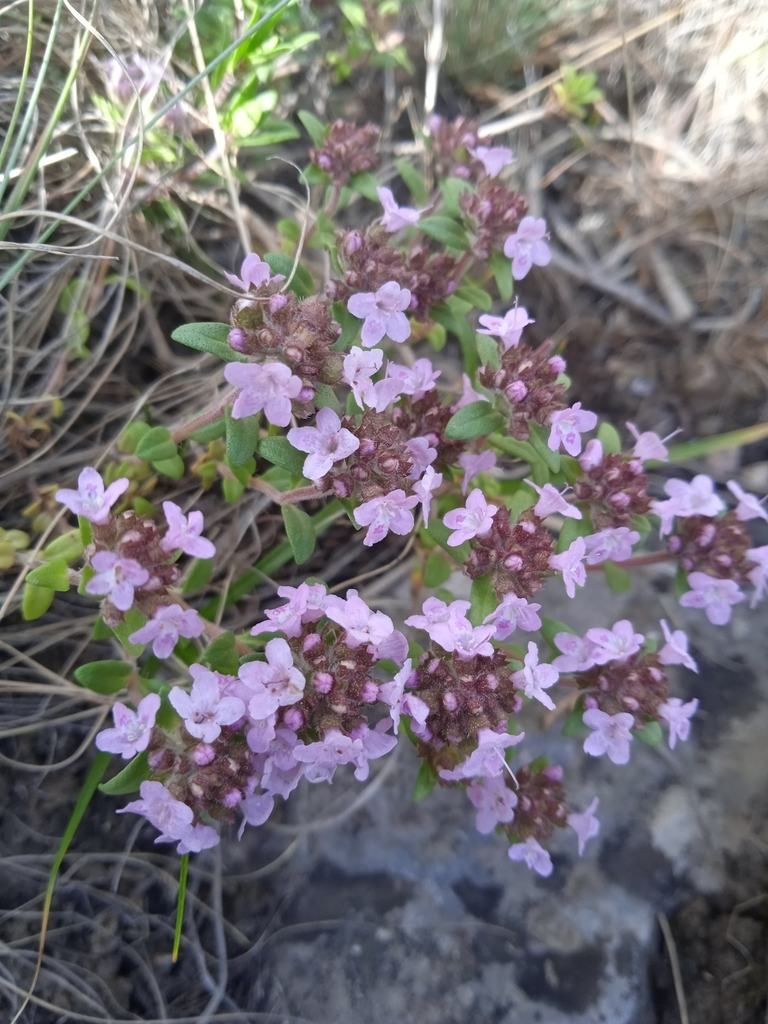
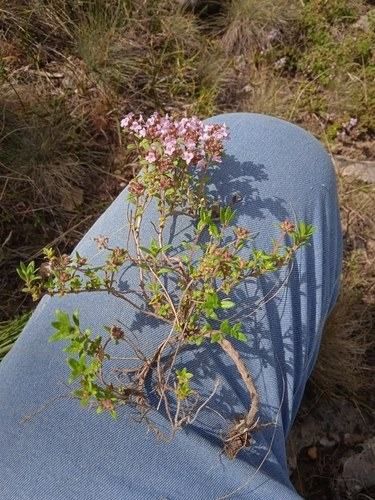
- Subshrub; stems long, strongly lignified, covered with gray bark, 2–3 mm thick, branching; flowering shoots arising from stem ramifications of first order, these terminating in a sterile shoot; lateral sterile shoots arising from stems curved and trailing or obliquely ascending, to 12 cm long; flowering branches assurgent at base or erect, 5–10 cm long, covered under the inflorescence with short recurved hairs, lower down Mdth fewer very short hairs; leaves oval or oblong-ovate, rarely elliptical, 4–16 (20) mm long, 1.5–8.5 mm broad, with length/width index 1.6–3.3, gradually narrowed at base to a very short petiole, the ciUa confined to lower third, few, 0.5–0.7 (l)mm long, the surface glabrous; lateral veins 3 or 4 pairs, slender, prominent but only slightly so; glands rather small, fairly distinct; basal leaves small, to 4 mm long, 1.25–1.5 mm broad; cauHne leaves usually 4 pairs, the middle ones on flowering branches much shorter than internodes, on sterile shoots as long as or longer than internodes; inflorescence capitate, sometimes with a strongly depauperate distant whorl; pe. [Flora of the USSR (Tree of Life)]
- Habitat
- Stony, gravelly, fine-earth slopes, rocks, screes, pebble beds
- Altitudinal belts
- Plain, low mountains, mid-mountains, high mountains
- Phenology
- Flowering Jun–Aug (Flora of the USSR)
- Distribution
- Balkhash deserts, Emba plateau, Fergana valley, Surkhan-Sherabad valley, Saur, Tarbagatai, Dzungarian Alatau, Tian Shan (ranges Trans-Ili Alatau, Kungey Alatau, Ketmentau, Terskey Alatau, Issykkul depression, ranges Kyrgyz Alatau, Ichkelitau, Talas Alatau, Susamyrtau, mountains in middle course of river Naryn, ranges Karatau, Karzhantau, Ugam, Pskem, Chatkal, Kurama, Fergana, Uzun-akhmat), Pamir-Alai (ranges Alai, Trans-Alai, Hissar, Karategin, Vakhsh, Peter the Great, Darvaz, Khozretisho, Alai valley, Pamir, foothills of southern Tajikistan)
- Uses
- essential oil, food, medicinal, melliferous
- Conservation
- IUCN NE