Species / Tamaricaceae
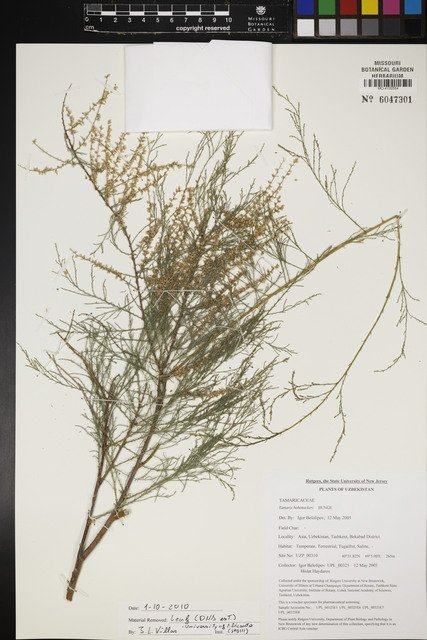
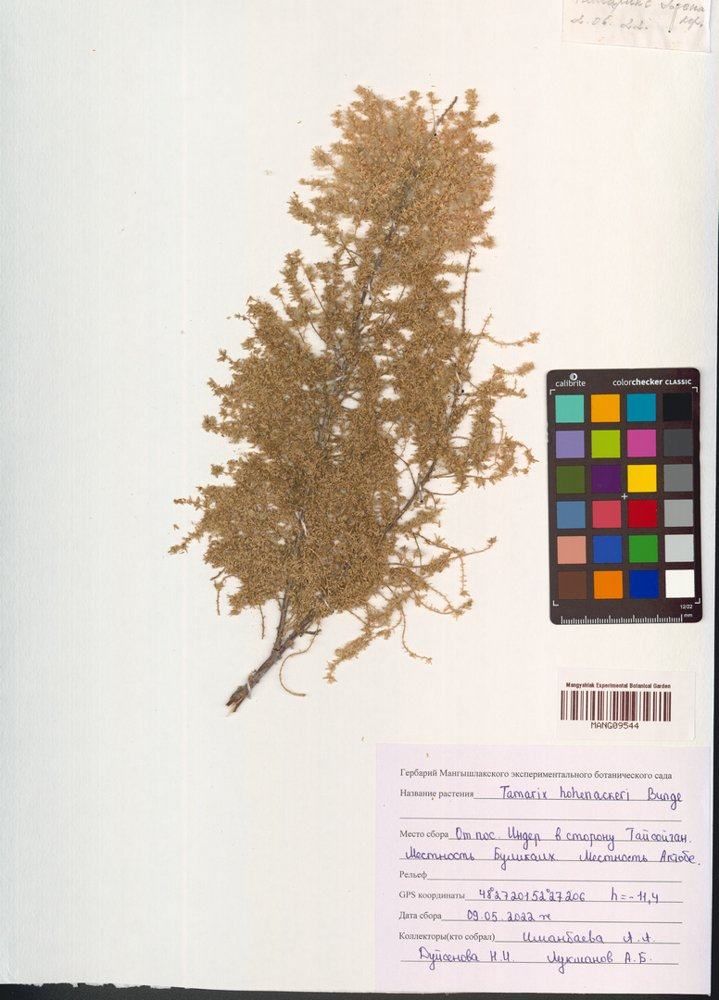
Tamarix hohenackeri
Tamaricaceae · Shrub · Uzbek: Gogenaker yulg‘uni; Russian: Гребенщик Гогенакера
Restoration use by landscape
Kugitangtau Immediate score 74 · rank 51 of 100 shortlisted · rank 59 of 1 208 scored
- Succession role
- Pioneer (riparian stabiliser)
- Suited to
- Gullies & drainage lines; Riparian / sai (other)
- Establishment
- hardwood cuttings / poles
- Why this category
- Strong: erosion control potential, nursery propagation feasibility, restoration cost-effectiveness; Weak: drought tolerance, grazing tolerance; -> routine propagation and available material: use now
- Cautions
- needs moist sites; protect from grazing for 3-5 yrs
- Local habitat
- Desert, Wetlands (inland) · Frequent
Criteria scores
Propagation
hardwood cuttings / poles
Planting material and suppliers
Cuttings or seed to be collected from local stands. No supplier found Action: Collect cuttings in winter 2026–2027 on the same river system
Description
- Morphology
- Shrub or small tree, 1–3(5) m high, with brownish-red bark; leaves lanceolate, 1–5 mm long, 0.5-1 mm broad, acute, incurved, dilated at base, decurrent, partly clasping; racemes lateral, solitary or clustered, 1.5-9cm long, 3–5(8) mm broad, loose, on peduncles 0.5–2cm long; bracts linear-oblong, 1-2 mm long, obtuse, exceeding pedicels, slightly shorter than or occasionally nearly equaling calyx (including pedicel), keeled; pedicels 0.5-1.5mm long; flowers 5-merous; calyx 1.3-1.5mm long, mostly one-third shorter than petals; sepals ovate, acutish, 0.8-1 mm long, 0.5mm broad, scarious-margined; petals ovate-elliptical, erect, pink, 2-—2.5mm long, 0.7-1mm broad, mostly persistent; stamens 5; disk 5-lobed, with deeply notched lobes; filaments slender, about same to 145 times length of corolla, inserted between lobes of disk; anthers cordate, obtuse; styles 3 (rarely 4), clavate-spatulate, 2-3 times shorter than ovary; capsule 4-5mm long, three times length of calyx. April—May. (Plate XV, Figure 2.) [Flora of the USSR (Tree of Life)]
- Habitat
- Bank of water bodies, pebble beds, saline-alkaline place
- Altitudinal belts
- Plain, foothills
- Phenology
- Flowering Apr–Aug, fruiting May–Sep
- Distribution
- Turgai depression, Alakol depression, Balkhash deserts, Aral deserts, Betpakdala, Muyunkum, valley of river Syrdari, Trans-Karatau plain, Kyzylkum, valley of rivers Amu Darya, Fergana valley, Tashkent chul, Mirzachul, Surkhan-Sherabad valley, Karakum, Dzungarian Alatau Tian Shan (ranges Trans-Ili Alatau, Kungey Alatau, Karatau, Talas Alatau, Chu-Ili mountains, Kurama), Pamir-Alai (ranges Babatag, western Pamir, foothills of southern Tajikistan), Kopet Dag, Badkhyz
- Uses
- forest amelioration / agroforestry, melliferous, ornamental
- Conservation
- IUCN NE