Species / Poaceae
Stipa capillata
Poaceae · Perennial · Uzbek: tukli chalov; Russian: Ковыль волосатик
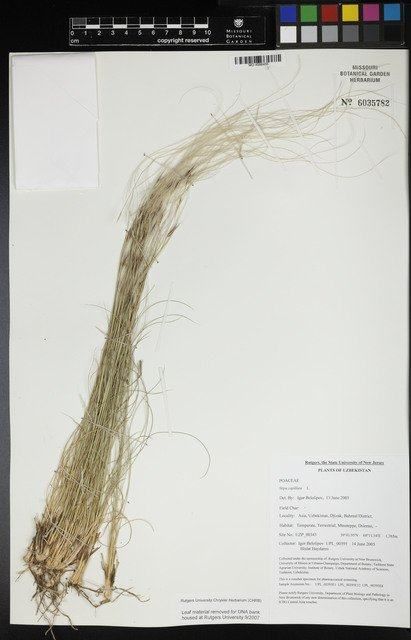
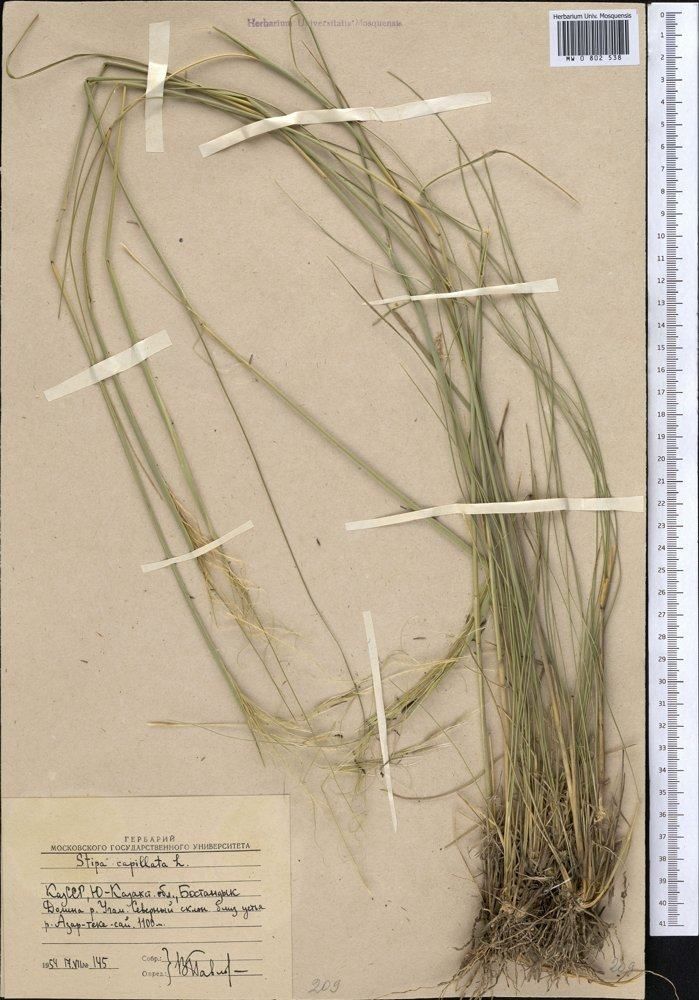
Restoration use by landscape
Kugitangtau Pilot score 72 · rank 78 of 100 shortlisted · rank 90 of 1 208 scored
- Succession role
- Pioneer (ground cover)
- Suited to
- Eroded slopes; Rocky slopes; Overgrazed rangelands; Degraded pistachio–almond woodland
- Establishment
- seed (awned, dormant) – hay transfer/seed harvesting
- Why this category
- Strong: drought tolerance; Weak: biodiversity value, nursery propagation feasibility; -> promising but propagation/supply or field performance not proven at scale: pilot plots
- Cautions
- propagation protocol to develop
- Local habitat
- Rocky areas, Grassland · Frequent
Criteria scores
Propagation
seed (awned, dormant) – hay transfer/seed harvesting
Planting material and suppliers
No commercial offer found in November 2026: material has to come from wild seed collection or contracted propagation. See Nurseries & supply.
Description
- Morphology
- Perennial. Tufts compact; culms 40- 80 cm tall, with 4-6 nodes, robust, more or less glabrous; leaf sheaths of the culm much longer than the internodes, more or less smooth, the upper often enveloping the inflorescence; leaves narrowly linear, setaceous -involute, more rarely flat, smooth or scaberulous on the outside, pilose on the inside; ligule on lower leaves 1-2 mmlong, on those of the culm 15-20 mm. Inflorescence 10-25 cm long, narrow, contracted, many-flowered; glumes subequal, long-acuminate, 2. 5-3. 5cm long, 3-nerved; lemma 10-12 mm long, with a pubescent cal-lus and 7 rows of hairs, of which the outer two reach nearly to the base of the awn; awn 12- 18 cm long, twice-geniculate, capillary, rather sharplyscabrous. June- July. [Flora of the USSR (Tree of Life)]
- Habitat
- Fine-earth, gravelly and stony slopes
- Altitudinal belts
- Low mountains, mid-mountains, high mountains
- Phenology
- Flowering Jun–Jul (Flora of the USSR)
- Distribution
- Kazakh Uplands, Tarbagatai, Dzungarian Alatau, Tian Shan, Pamir-Alai, Kopet Dag
- Uses
- forage, ornamental
- Conservation
- IUCN NE