Species / Lamiaceae
Scutellaria comosa
Lamiaceae · Subshrub · Uzbek: kokilli ko‘kamoron; Russian: Шлемник хохлатый
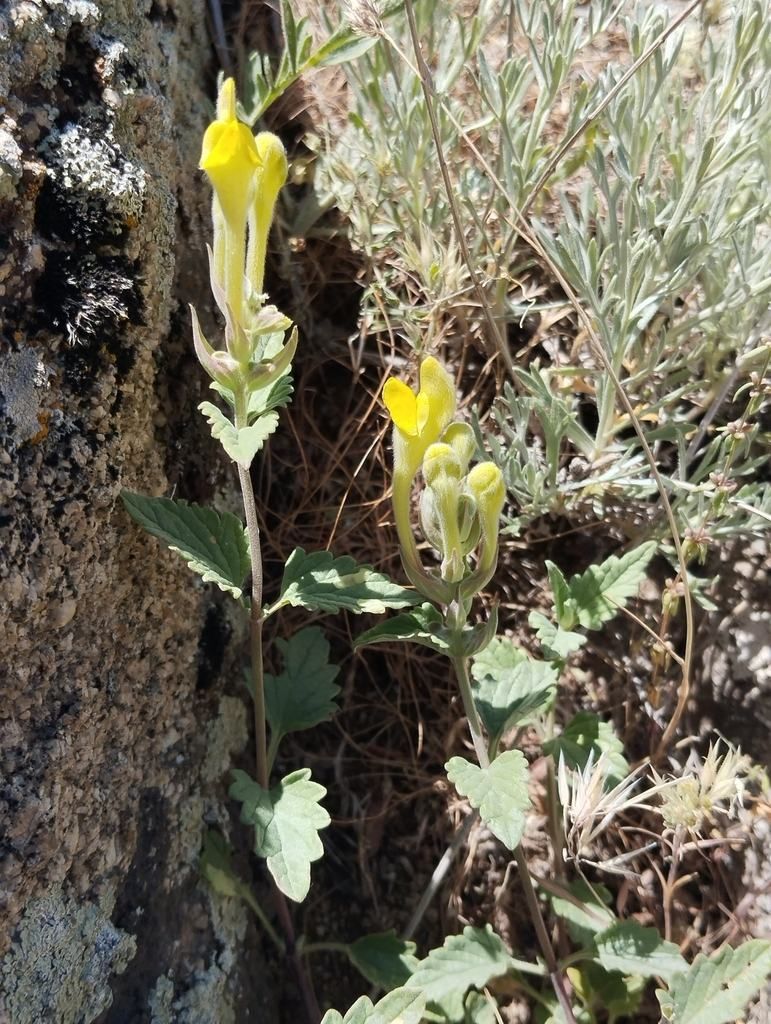
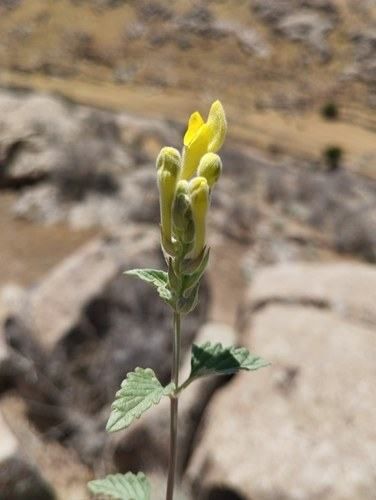
Restoration use by landscape
Nuratau Pilot score 72 · rank 67 of 80 shortlisted · rank 76 of 640 scored
- Succession role
- Pioneer (ground cover)
- Suited to
- Eroded slopes; Rocky slopes; Degraded juniper woodland; Degraded pistachio–almond woodland
- Establishment
- seed or cuttings
- Why this category
- Strong: drought tolerance, climate resilience; Weak: grazing tolerance; -> promising but propagation/supply or field performance not proven at scale: pilot plots
- Cautions
- protect from grazing for 3-5 yrs
- Local habitat
- Shrubland, Grassland, Rocky areas · Occasional
Criteria scores
Propagation
seed or cuttings
Planting material and suppliers
No commercial offer found in November 2026: material has to come from wild seed collection or contracted propagation. See Nurseries & supply.
Description
- Morphology
- Subshrub, with woody vertical flexuous root; stems few, 10-32 cm long, arched-ascending to suberect, strongly branching at base, with few usually short branches above, grayish-green with sparse short curved or slightly crisp hairs, sometimes turning lilac (especially in lower part); leaves 0.5-3 cm long, 0.4-2 cm wide, ovate or triangular-ovate, with truncate or sometimes subcordate base, obtuse (the lower) to acute, shallowly crenate-dentate with 3-9 uneven rounded angular mostly obtuse teeth on each margin, green or grayish-green above, covered with very short, fine appressed hairs, evenly densely and finely white- or gray-tomentose beneath, the tomentum completely concealed but the veins usually prominent; petioles 0.2-2 cm long, with short crisp hairs; inflorescence fewflowered, 2-4 cm long at the onset of flowering, with a conelike tuft of nonflowering bracts at summit, finally elongating to 10 cm; bracts 7-12 mm long, 2.5-4.5 mm wide, lanceolate or ovate-lanceolate, navicular, gradually tapering at apex to a long point, graygreen with rather dense fine appressed tomentum, eglan. [Flora of the USSR (Tree of Life)]
- Habitat
- Stony, gravelly slopes, rocks, screes
- Altitudinal belts
- Plain, foothills, low mountains, mid-mountains
- Phenology
- Flowering May–Jun, fruiting Jun–Jul
- Distribution
- Fergana valley, Hungry steppe, Tian Shan (ranges Chatkal, Fergana, Mogoltau), Pamir-Alai (Alai valley, ranges Turkestan, Nurata, Alai, Zarafshan)
- Conservation
- IUCN NE