Species / Rhamnaceae
Sageretia thea
Rhamnaceae · Shrub · Uzbek: yam-yashil sajeretsiya; Russian: Сажереция ярко-зеленая
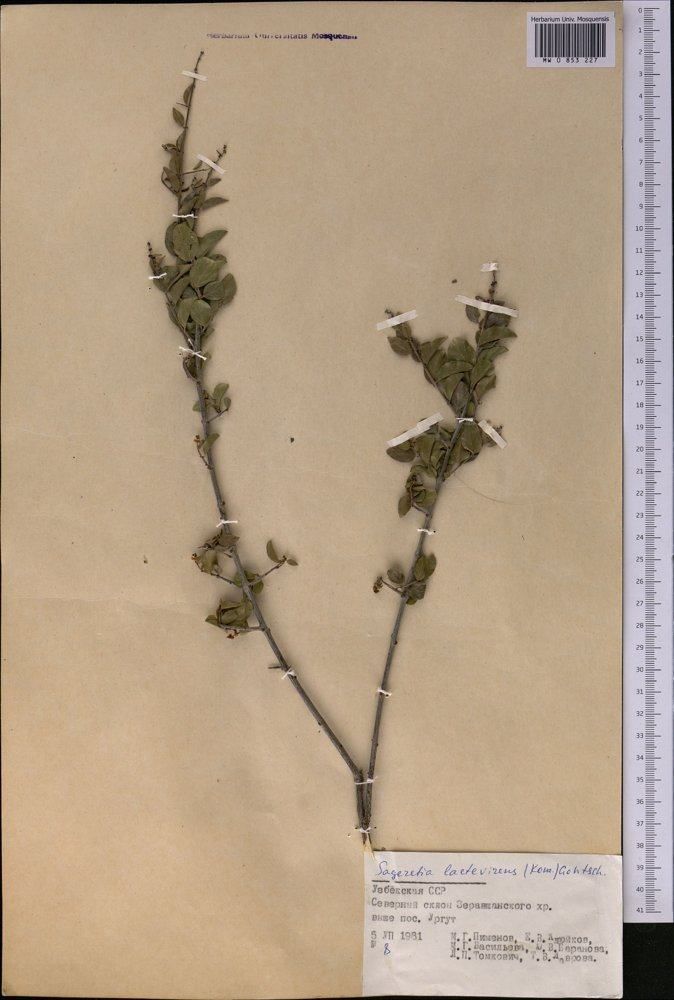
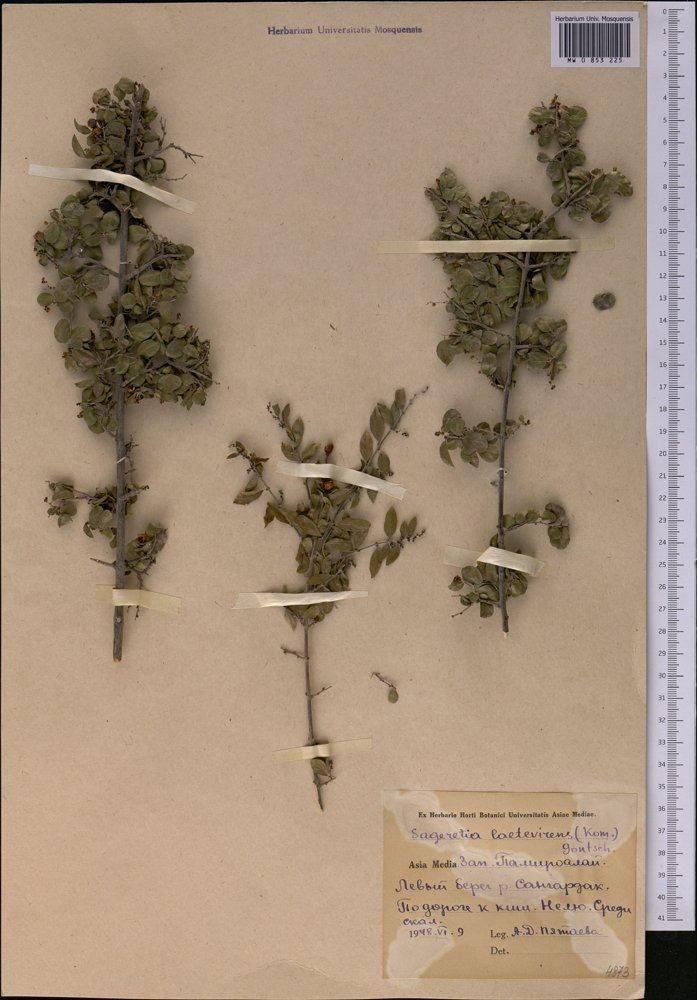
Restoration use by landscape
Kugitangtau Pilot score 73 · rank 64 of 100 shortlisted · rank 75 of 1 208 scored
- Succession role
- Nurse / intermediate shrub
- Suited to
- Eroded slopes; Rocky slopes; Landslide-prone areas; Degraded juniper woodland
- Establishment
- seed; nursery (protocol to confirm)
- Why this category
- Strong: drought tolerance, erosion control potential; Weak: grazing tolerance; -> promising but propagation/supply or field performance not proven at scale: pilot plots
- Cautions
- protect from grazing for 3-5 yrs
- Local habitat
- Rocky areas, Grassland · Frequent
Criteria scores
Propagation
seed; nursery (protocol to confirm)
Planting combinations
- Kugitangtau: Degraded juniper woodland (Kugitang and Baysuntau, above ~1,500 m) (Phase 2)
Planting material and suppliers
No commercial offer found in November 2026: material has to come from wild seed collection or contracted propagation. See Nurseries & supply.
Description
- Morphology
- Small shrubs up to 1.5 m high, robust, strongly spinose, with erect short branches, usually turning into large erect spines, bark pale brown, cinnamon or gray, often tomentose when young; leaves polymorphic, thin- or thickcoriaceous, bright or dark green, the adult glabrous, shiny, the juvenile usually pubescent or even loosely gray-tomentose beneath, small, 0.5–1.5(2)cm long, 0.3–1 cm wide, broadly lanceolate to oval, rounded, obtuse or even faintly emarginate at apex, Sometimes short-acuminate, rounded or slightly cordate at base, subsessile or with very short (rarely up to 5mm) petioles. Flowers small, ca. 1.5–2mm in diameter, dark yellow or reddish, sessile, in clusters forming spikes at ends of leafy branches; fruit pyriformtrihedral, 5–7 mm long, baccate, black, with small layer of succulent meso— carp or often nearly dry, coriaceous, cinnamon-brown, with 3 "stones"; seeds oblong-ovoid, trihedral, smooth, shiny, not furrowed, ca. 5mm long, light brown or yellow, in firm cartilaginous coat (endocarp). Fl. April-June; Fr. June—August (September). (Plate XXXIV, Figure 1.) [Flora of the USSR (Tree of Life)]
- Habitat
- Stony, gravelly slopes, rocks
- Altitudinal belts
- Low mountains, mid-mountains
- Phenology
- Fruiting Jun–Aug (Sep) (Flora of the USSR)
- Distribution
- Pamir-Alai (ranges Turkestan, Zarafshan, Hissar, Karategin, Vakhsh, Darvaz, Baysuntau, Babatag, Kugitang, foothills of southern Tajikistan)
- Uses
- forest amelioration / agroforestry, ornamental
- Conservation
- IUCN NE