Species / Anacaridaceae
Rhus coriaria
Anacaridaceae · Tree, shrub · Uzbek: oshlovchi totum; Russian: Сумах дубильный
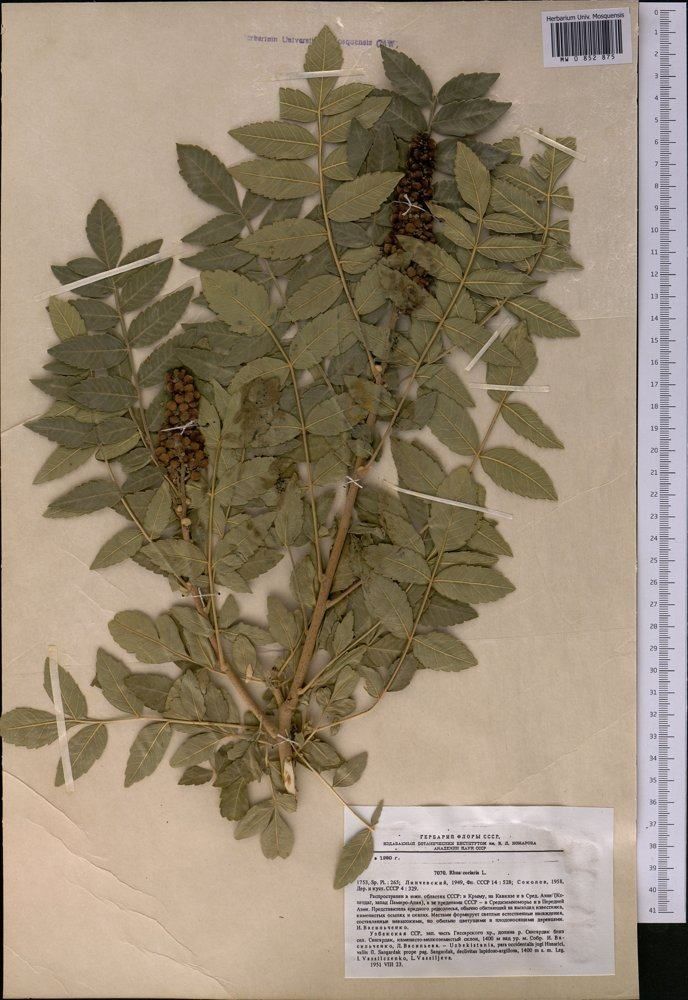
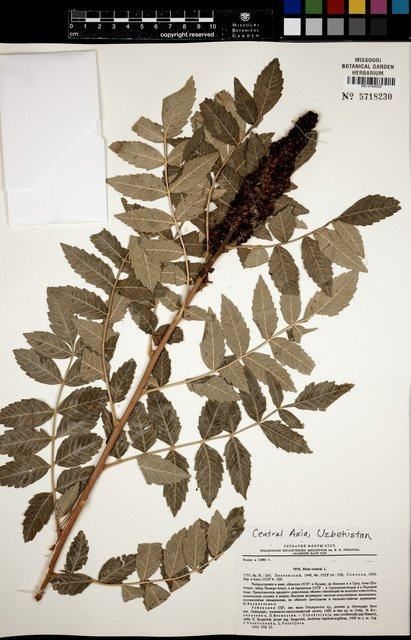
Restoration use by landscape
West Tian Shan Research score 69 · rank 71 of 79 shortlisted · rank 150 of 1 194 scored
- Succession role
- Climax / long-term (canopy)
- Suited to
- Eroded slopes; Rocky slopes; Landslide-prone areas
- Establishment
- seed; nursery (protocol to confirm)
- Why this category
- Strong: drought tolerance, erosion control potential; Weak: grazing tolerance, seed; Red Data Book of Uzbekistan cat. 1; G3 hold: conservation-only (ex-situ/reintroduction), no bulk wild seed collection; -> key data gaps (propagation, seed, conservation): research/ex-situ trials first
- Cautions
- protect from grazing for 3-5 yrs; use local provenance only; limit wild seed harvest
- Local habitat
- Rocky areas, Forest, Grassland · Occasional
Criteria scores
Propagation
seed; nursery (protocol to confirm)
Where it fits in the degradation matrix
- West Tian Shan: Eroded slopes (long-term)
- West Tian Shan: Rocky slopes (long-term)
- West Tian Shan: Landslide-prone areas (long-term)
Planting material and suppliers
No commercial offer found in November 2026: material has to come from wild seed collection or contracted propagation. See Nurseries & supply.
Description
- Morphology
- Small, comparatively few-branched trees or often shrubs, 1–3(5)m high; bark on annual shoots gray-brown, scabrous-hairy, on perennial branches brown; leaves 15–18cm long, imparipinnate, with 9-17 leaflets; petioles scabrous-hairy, winged in upper part; leaflets scabrous-hairy, sessile, oblong-ovate or lanceolate, largely crenate-serrate, 3–5(6) cm long, (1.5)2–3 cm wide, rounded or broadly cuneate at base, acuminate at apex. Flowers greenish-white, in terminal oblong-conical panicles, sometimes partly in small axillary panicles, subsessile, unisexual, staminate and pistillate flowers in different racemes, staminate flowers in loose longer panicles up to 20–25cm long; sepals 5, greenish, densely hairy and ciliate outside, orbicular-ovate, ca. 2mm long, 1–1.5mm wide; petals 5, whitish, ovate, 2.5-3.5mm long, ca. 1.5mm wide; stamens 5, attached at base of a broad disk bearing a rudimentary (undeveloped) ovary; filaments ca.1.5mm long; anthers ca. [Flora of the USSR (Tree of Life)]
- Habitat
- Loess, fine-earth, gravelly, stony slopes, screes, outcrops of variegated rocks
- Altitudinal belts
- Foothills, low mountains, mid-mountains
- Phenology
- Flowering Jun–Jul, fruiting Sep–Oct
- Distribution
- Pamir-Alai (ranges Zarafshan: basin of river Kshtut, Hissar, Karategin, Khozretishi, foothills of southern Tajikistan), Kopet Dag
- Uses
- forest amelioration / agroforestry, dye, medicinal, melliferous, ornamental, tannin
- Conservation
- IUCN LC; Red Data Book of Uzbekistan, category 1; Red Data Book of Uzbekistan category 1