Species / Fabaceae
Medicago sativa
Fabaceae · Perennial · Uzbek: ekiladigan beda; Russian: Люцерна посевная
Restoration use by landscape
Nuratau Pilot score 75 · rank 37 of 80 shortlisted · rank 41 of 640 scored
- Succession role
- Pioneer / companion (forb)
- Suited to
- Overgrazed rangelands
- Establishment
- direct seeding (scarified)
- Why this category
- Strong: climate resilience, nursery propagation feasibility, restoration cost-effectiveness; Weak: biodiversity value; -> promising but propagation/supply or field performance not proven at scale: pilot plots
- Cautions
- risk of cultivar/orchard or non-local material – wild local provenance only; pilot first
- Local habitat
- Desert, Forest, Shrubland, Grassland, Rocky areas, Wetlands (inland), Artificial aquatic, Artificial terrestrial · Occasional
Criteria scores
Propagation
direct seeding (scarified)
Planting material and suppliers
No commercial offer found in November 2026: material has to come from wild seed collection or contracted propagation. See Nurseries & supply.
Description
- Morphology
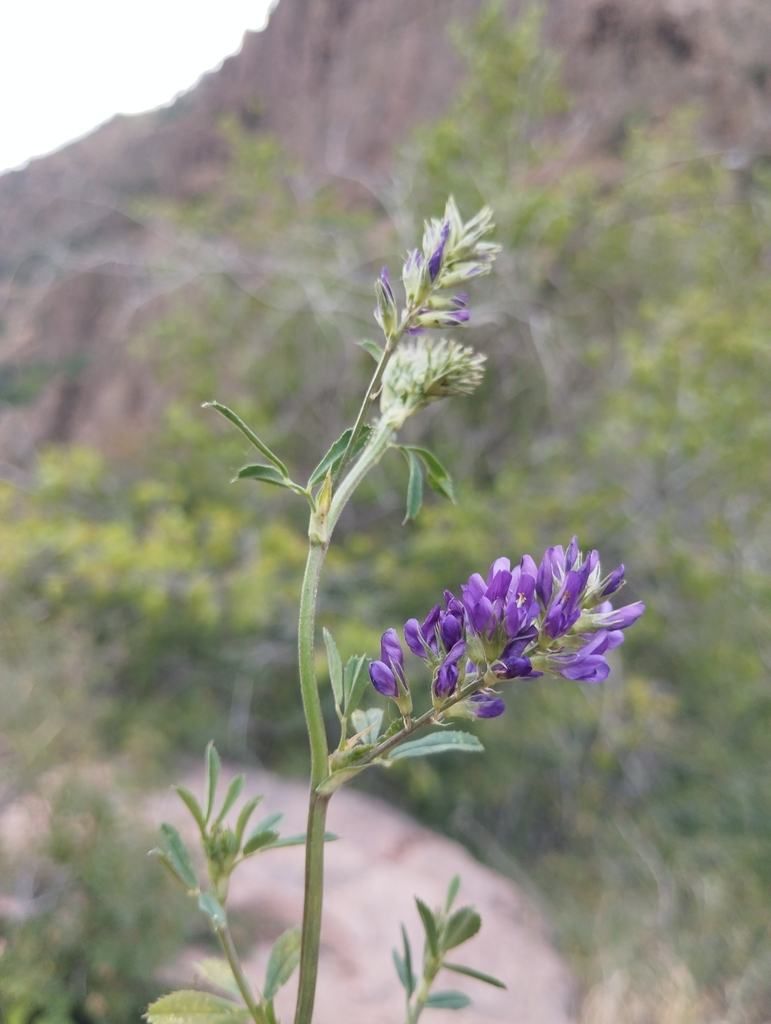
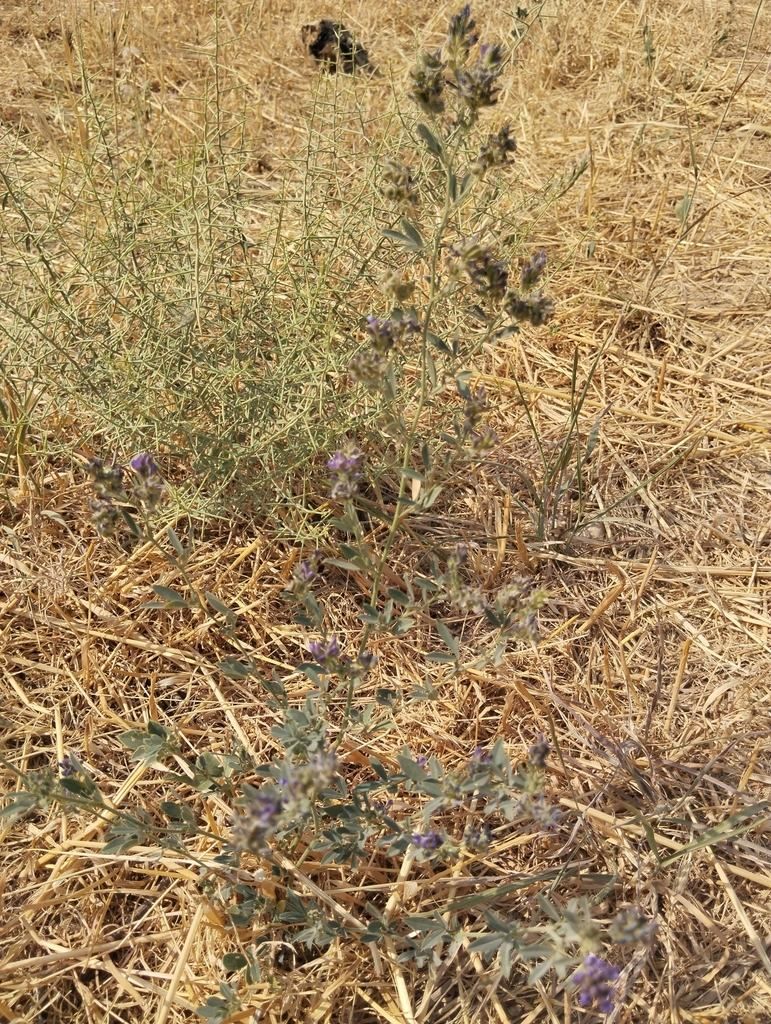
- Perennial; rhizome stout, penetrating deep into the soil; stems 4-angled, glabrous or in upper part hairy, profusely branched in upper part, 40-80 cm long, forming an upright or expanded bushy plant or decumbent; stipules united to one-third or half their length, the free portion triangular-lanceolate, taper-pointed, at base entire or mostly with 1 or 2 teeth, glabrous or sparingly appressed-hairy, with longitudinal veins; leaflets oblong-oval, ovate or linear, tapering toward base, crenate above the middle, mostly retuse and mucronate, (5) 10–25(45)mm long and 3-10 mm broad, glabrate or appressed-hairy, paler green beneath; corolla 6–15mm long, ranging in color from pale yellow to blue and blackish violet; calyx tubular-infundibular, the linear-subulate teeth longer than tube, mostly appressed-hairy; pedicels slender, shorter than or equaling calyx-tube; bracteoles whitish, linear-subulate, long-acuminate, mostly equaling the pedicel; inflorescence an abbreviated raceme,oval or round in outline, rarely somewhat elongated, 1–2.5cm long, 1–2 cm broad, 5–30(40)-flowered; peduncle slend. [Flora of the USSR (Tree of Life)]
- Habitat
- Fine-earth, gravelly, stony slopes, meadow, screes, valley of river, pebble beds, orchards, pasture, field, fallows, roadsides of road (feral), broadly is cultivated
- Altitudinal belts
- Plain, foothills, low mountains, mid-mountains
- Phenology
- Flowering and fruiting Jun–Aug
- Distribution
- Dzungarian Alatau, Tian Shan (Chu-Ili mountains: pass Kurday, ranges Trans-Ili, Kungey and Kyrgyz Alatau, Ketmentau; western), Pamir-Alai (ranges Alai, Turkestan)
- Uses
- forage, medicinal, melliferous
- Conservation
- IUCN LC; Red Data Book of Uzbekistan category 2