Species / Asteraceae
Lepidolopha komarowii
Asteraceae · Subshrub · Uzbek: Komarov lepidolofasi; Russian: Лепидолофа Комарова
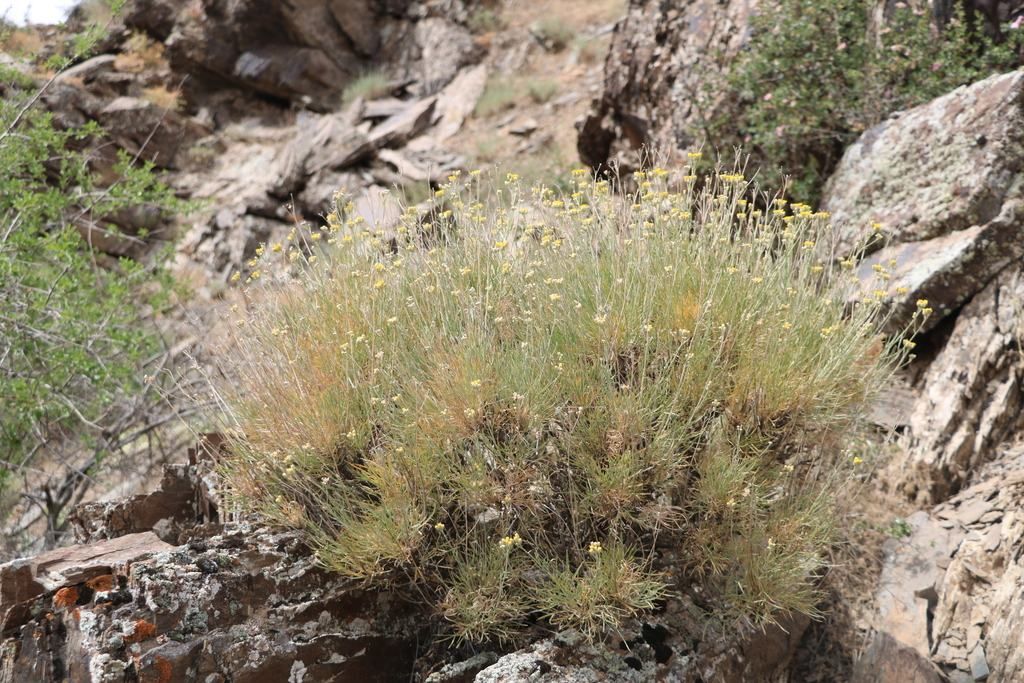
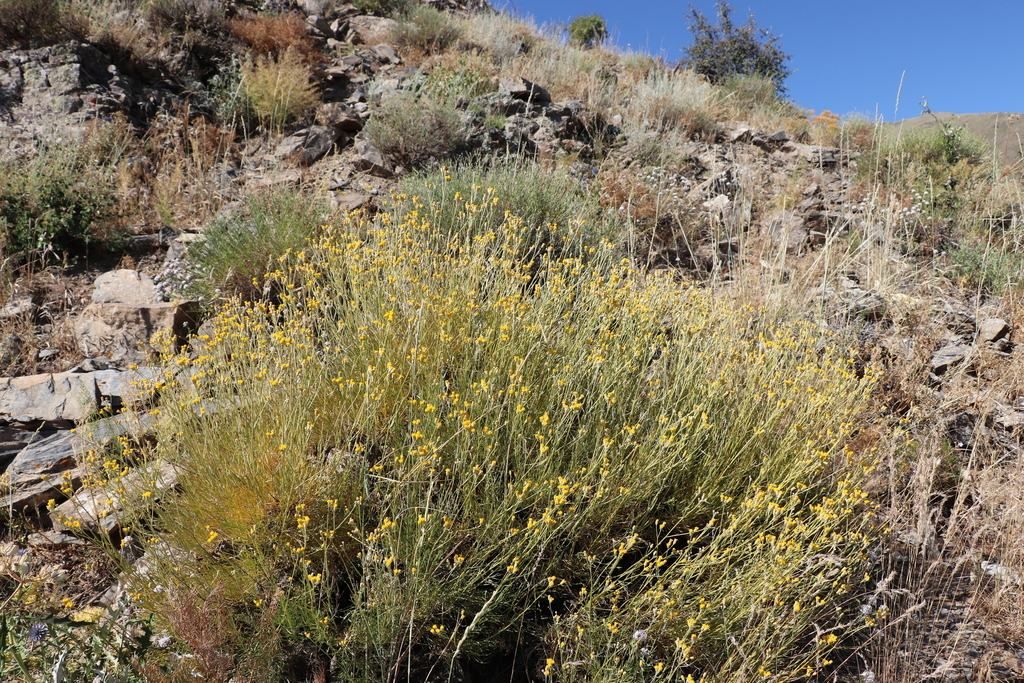
Restoration use by landscape
Nuratau Pilot score 72 · rank 69 of 80 shortlisted · rank 78 of 640 scored
- Succession role
- Pioneer (ground cover)
- Suited to
- Eroded slopes; Rocky slopes; Degraded juniper woodland; Degraded pistachio–almond woodland
- Establishment
- seed (protocol to confirm)
- Why this category
- Strong: drought tolerance; Weak: grazing tolerance; -> promising but propagation/supply or field performance not proven at scale: pilot plots
- Cautions
- protect from grazing for 3-5 yrs
- Local habitat
- Shrubland, Grassland, Rocky areas · Frequent
Criteria scores
Propagation
seed (protocol to confirm)
Planting material and suppliers
No commercial offer found in November 2026: material has to come from wild seed collection or contracted propagation. See Nurseries & supply.
Description
- Morphology
- Perennial. 15-35 cm high, branched semishrub, older branches covered with grayish bark, year-old stems erect, forked in middle and above, weakly pubescent, densely leafy in lower half. Leaves petiolate; lamina deeply divided, with linear or oblong lobes, 15-25 mm long, 2.5-4.5 mm wide, with prominent midrib; upper leaves entire; all leaves weakly pubescent. Capitula in corymbs on 5-10 mm long peduncle, cylindrical — 7 mm long, 3 mm in dia. Involucre many-rowed, finely pubescent; outer involucral bracts broadly ovate, obtuse, 3 mm long, mm wide; middle bracts 5 mm long, and 2 mm wide. Receptacle glabrous. Florets yellow at apex. Achenes pyramidal, 4.0-4.5 mm long; pappus coronate, 1.5-2.0 mm long, membranous, deeply divided, scales mostly entire, less often toothed. [Flora of the USSR (Tree of Life)]
- Habitat
- Stony, gravelly, fine-earth slopes, rocks
- Altitudinal belts
- Foothills, low mountains, mid-mountains
- Phenology
- Flowering Jun–Jul, fruiting Aug–Sep
- Distribution
- Tian Shan (ranges Ugam, Pskem, Chatkal, Karatau), Pamir-Alai (ranges Nuratau, Zarafshan, Hissar)
- Uses
- essential oil
- Conservation
- IUCN NE