Species / Amaranthaceae
Krascheninnikovia ceratoides
Amaranthaceae · Subshrub · Uzbek: kulrang teresken; Russian: Терескен серый
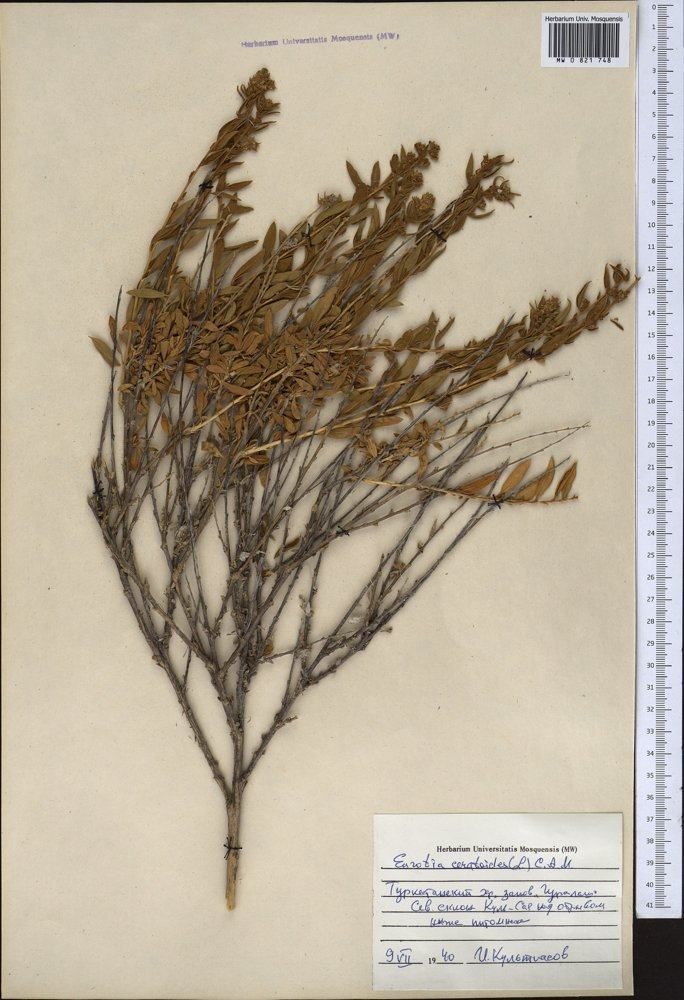
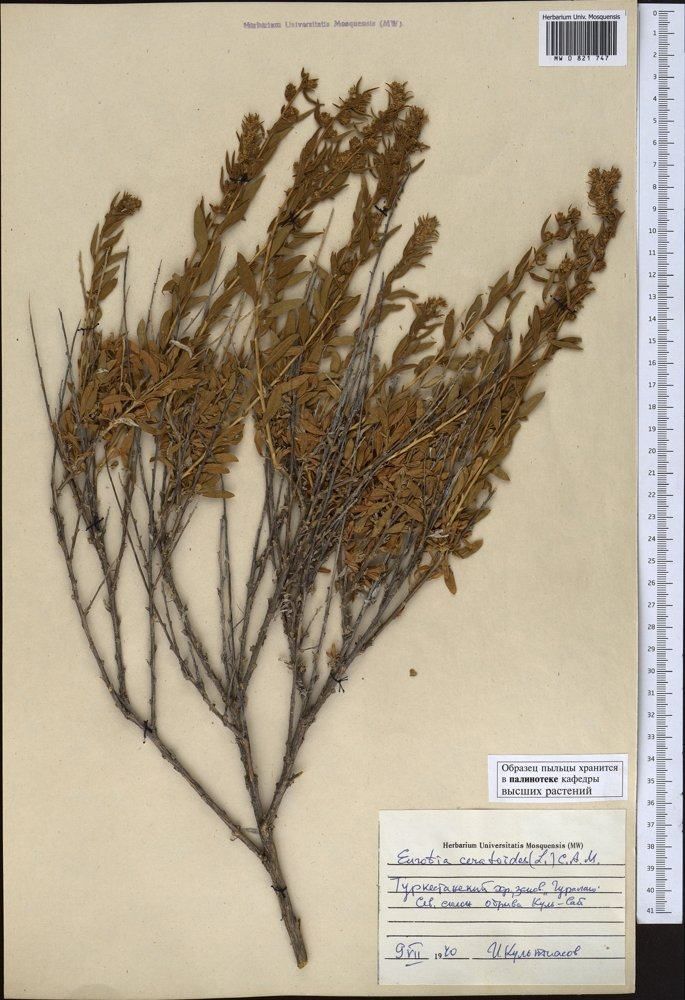
Restoration use by landscape
Nuratau Immediate score 76 · rank 29 of 80 shortlisted · rank 32 of 640 scored
- Succession role
- Pioneer (ground cover)
- Suited to
- Eroded slopes; Rocky slopes; Overgrazed rangelands; Degraded juniper woodland; Degraded pistachio–almond woodland
- Establishment
- direct seeding; seed islands
- Why this category
- Strong: drought tolerance, climate resilience; Weak: ecological suitability; in documented forestry/nursery use (D1); -> routine propagation and available material: use now
- Local habitat
- Desert, Shrubland, Grassland, Rocky areas · Rare
Criteria scores
Kugitangtau Immediate score 77 · rank 19 of 100 shortlisted · rank 21 of 1 208 scored
- Succession role
- Pioneer (ground cover)
- Suited to
- Eroded slopes; Rocky slopes; Overgrazed rangelands; Degraded pistachio–almond woodland
- Establishment
- direct seeding; seed islands
- Why this category
- Strong: climate resilience; in documented forestry/nursery use (D1); -> routine propagation and available material: use now
- Local habitat
- Desert, Grassland, Rocky areas, Wetlands (inland) · Occasional
Criteria scores
Propagation
direct seeding; seed islands
Where it fits in the degradation matrix
- Kugitangtau: Eroded slopes (pioneer)
- Kugitangtau: Overgrazed rangelands (pioneer)
- Kugitangtau: Degraded pistachio–almond woodland (pioneer)
Planting combinations
- Nuratau: Foothill and low-mountain rangeland (Phase 2)
- Kugitangtau: Overgrazed rangeland (foothill and low-mountain pasture) (Phase 2)
Planting material and suppliers
Wild seed collection needed. No supplier confirmed in the landscapes Action: Collect seed in October–November and sow in the same winter; the seed does not keep
Rangeland use
- Grazing tolerance
- Medium to high
- Forage value
- High. Autumn and winter browse
- Recovery
- Medium. From seed; slow under continuous browsing
- Management
- Seed islands with 2–3 years of protection
Description
- Morphology
- Undershrub or small shrub, 40–100 cm high; leaves oval, oblong, ovate-lanceolate, or linear-lanceolate, with a very short petiole, obtuse to subacute, narrowed or rounded at base, entire, with slightly revolute margins, 1 -nerved; segments of staminate perianth rounded -ovate, obtusish, stellate -hairy; fruiting bracteoles united, covered on the free spreading tips with stellate hairs, elsewhere with long simple white or finally rufescent hairs; these surpassing the tips; ovary hairy; fruit obovoid, ca. 3 mm long, covered with simple appressed hairs and scattered stellate ones. July— September. (Plate II, Figure 12). * From Greek euros, mold, alluding to leaf color. [Flora of the USSR (Tree of Life)]
- Habitat
- Stony, gravelly, loess slopes, sandy-pebbly piedmont aprons, cones of outwash, sandy deserts
- Altitudinal belts
- Plain, foothills, low mountains, mid-mountains, high mountains
- Phenology
- Flowering and fruiting Jul–Sep
- Distribution
- Throughout Central Asia
- Uses
- forage, fuel
- Conservation
- IUCN NE