Species / Rosaceae
Crataegus pontica
Rosaceae · Tree · Uzbek: Pontik do‘lanasi, do‘lana; Russian: Боярышник понтийский
Restoration use by landscape
West Tian Shan Pilot score 68 · rank 72 of 79 shortlisted · rank 163 of 1 194 scored
- Succession role
- Climax / long-term (canopy)
- Suited to
- Eroded slopes; Gullies & drainage lines; Degraded walnut–fruit and broadleaf woodland (other)
- Establishment
- seed with long (12-18 mo) warm+cold stratification; nursery
- Why this category
- Strong: seed; Weak: grazing tolerance, nursery propagation feasibility, restoration cost-effectiveness; in documented forestry/nursery use (D1); -> promising but propagation/supply or field performance not proven at scale: pilot plots
- Cautions
- protect from grazing for 3-5 yrs; propagation protocol to develop
- Local habitat
- Grassland · Frequent
Criteria scores
Nuratau Pilot score 66 · rank 78 of 80 shortlisted · rank 153 of 640 scored
- Succession role
- Climax / long-term (canopy)
- Suited to
- Eroded slopes; Gullies & drainage lines; Degraded juniper woodland
- Establishment
- seed with long (12-18 mo) warm+cold stratification; nursery
- Why this category
- Strong: seed; Weak: grazing tolerance, nursery propagation feasibility, restoration cost-effectiveness; in documented forestry/nursery use (D1); -> promising but propagation/supply or field performance not proven at scale: pilot plots
- Cautions
- protect from grazing for 3-5 yrs; propagation protocol to develop
- Local habitat
- Forest, Shrubland, Grassland · Frequent
Criteria scores
Kugitangtau Research score 62 · rank 97 of 100 shortlisted · rank 323 of 1 208 scored
- Succession role
- Climax / long-term (canopy)
- Suited to
- Gullies & drainage lines; Riparian / sai (other); Degraded juniper woodland
- Establishment
- seed with long (12-18 mo) warm+cold stratification; nursery
- Why this category
- Weak: drought tolerance, grazing tolerance, nursery propagation feasibility, restoration cost-effectiveness; in documented forestry/nursery use (D1); -> key data gaps (propagation, seed, conservation): research/ex-situ trials first
- Cautions
- needs moist sites; protect from grazing for 3-5 yrs; propagation protocol to develop
- Local habitat
- Forest, Grassland, Rocky areas, Shrubland, Wetlands (inland) · Occasional
Criteria scores
Propagation
seed with long (12-18 mo) warm+cold stratification; nursery
Where it fits in the degradation matrix
- Nuratau: Degraded juniper woodland (long-term)
- Kugitangtau: Degraded juniper woodland (long-term)
- Kugitangtau: Riparian / sai (other) (long-term)
Planting material and suppliers
No commercial offer found in November 2026: material has to come from wild seed collection or contracted propagation. See Nurseries & supply.
Description
- Morphology
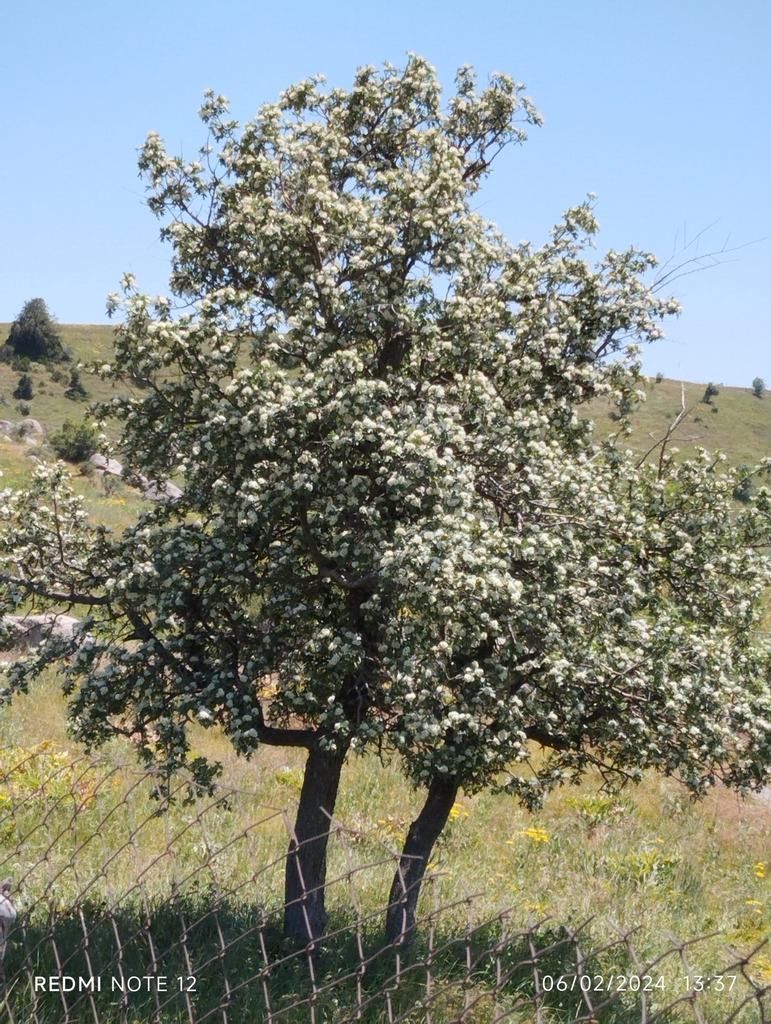
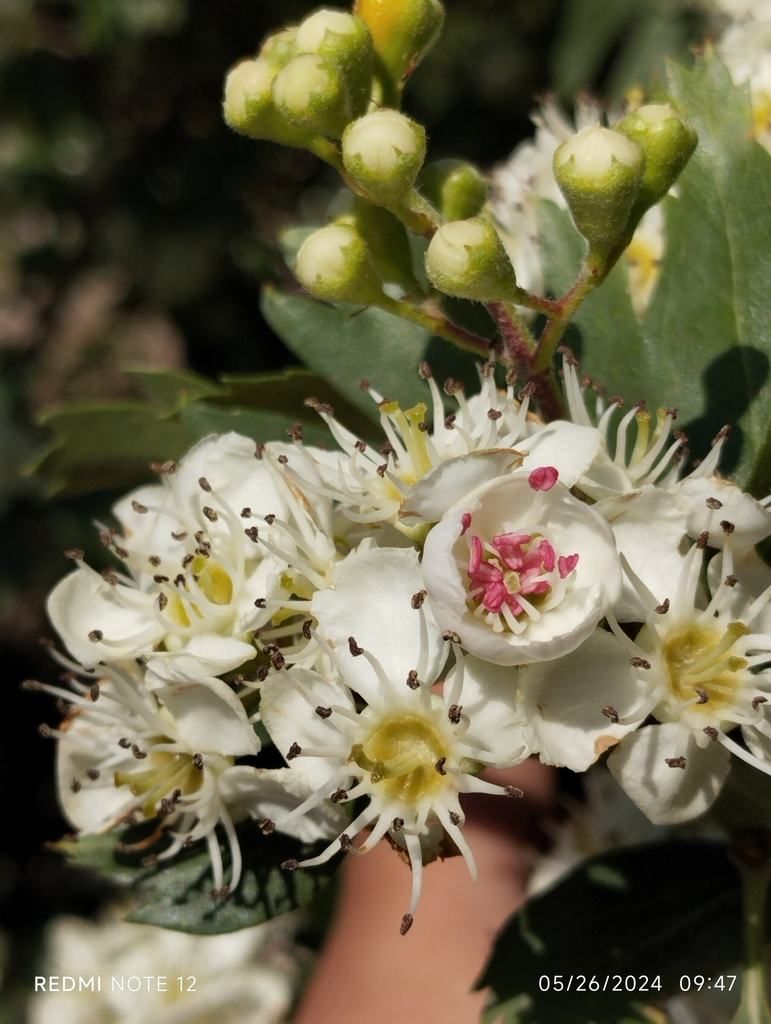
- Tree to 6–10 m high, with broad crown; shoots unarmed, thick, young and annotinous shoots pubescent-tomentose; leaves firm, glaucous-green on both sides, sparsely appressed-pubescent, more densely so above, sometimes subglabrous when adult; lower leaves on fruiting shoots obovate-cuneate, often oblong, decurrent along petioles, coarsely incised-dentate at the apex or trilobate; upper leaves (3)4.5–6.5 cm long and broad, the blade 3–6 times as long as the petiole, rhomboid or broadly obovate, broadly cuneate at base, deeply 5-fid, the middle lobe often trifid or 7-partite; lobes usually oblong, usually 3 times as long as broad (2.5–4:1), some entire, some with 1–4 large teeth at the apex; specimens with all their leaves broadly trilobate have been found exceptionally; inflorescences 3–5 cm in diameter, (6)8–14-flowered, hairy to tomentose; pedicels 3–7 cm long; sepals broadly triangular, acute or acuminate, recurved in fruit; corolla 15–20 mm in diameter; styles 2 or 3; fruits strongly flattened at the mm poles, 15–25(28) in diameter, yellow, from ferruginous-green to orangeyellow, of. [Flora of the USSR (Tree of Life)]
- Habitat
- Valley of river, fine-earth slopes, deciduous forest and shrubs
- Altitudinal belts
- Foothills, low mountains
- Phenology
- Flowering May–Jun, fruiting Sep–Oct
- Distribution
- Western Tian Shan (Karatau, mountains Kazy-kurt, Talas Alatau, Uzun-akhmat range, Karzhantau, Ugam, Pskem, Chatkal, Fergana and Kurama ranges, Mogoltau), Pamir-Alai (ranges Zarafshan, Hissar, Karategin, Peter the Great, southwestern spurs of Darvaz range, Kugitang), Kopet Dag (western and central)
- Uses
- forest amelioration / agroforestry, food, medicinal, melliferous, ornamental, technical
- Conservation
- IUCN LC