Species / Fabaceae
Cercis griffithii
Fabaceae · Tree, shrub · Uzbek: Griffit arg‘uvoni, binafsha gulli arg‘uvon; Russian: Багрянник Гриффита
Restoration use by landscape
West Tian Shan Research score 66 · rank 76 of 79 shortlisted · rank 212 of 1 194 scored
- Succession role
- Climax / long-term (canopy)
- Suited to
- Eroded slopes; Rocky slopes; Landslide-prone areas; Gullies & drainage lines; Degraded pistachio–almond woodland
- Establishment
- seed; nursery (protocol to confirm)
- Why this category
- Strong: erosion control potential; Weak: grazing tolerance, seed; Red Data Book of Uzbekistan cat. 2; G3 flag: nursery-raised material only; restricted wild collection; -> key data gaps (propagation, seed, conservation): research/ex-situ trials first
- Cautions
- protect from grazing for 3-5 yrs; use local provenance only; limit wild seed harvest
- Local habitat
- Rocky areas, Grassland · Occasional
Criteria scores
Propagation
seed; nursery (protocol to confirm)
Where it fits in the degradation matrix
- West Tian Shan: Landslide-prone areas (long-term)
- West Tian Shan: Degraded pistachio–almond woodland (long-term)
Planting material and suppliers
No commercial offer found in November 2026: material has to come from wild seed collection or contracted propagation. See Nurseries & supply.
Description
- Morphology
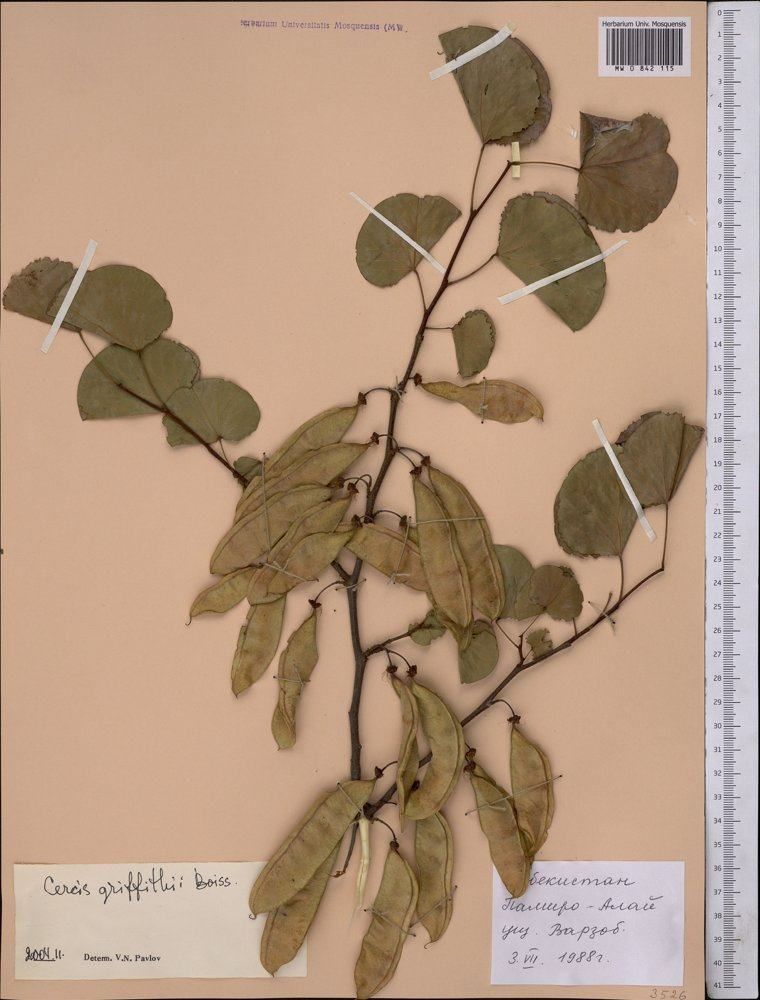
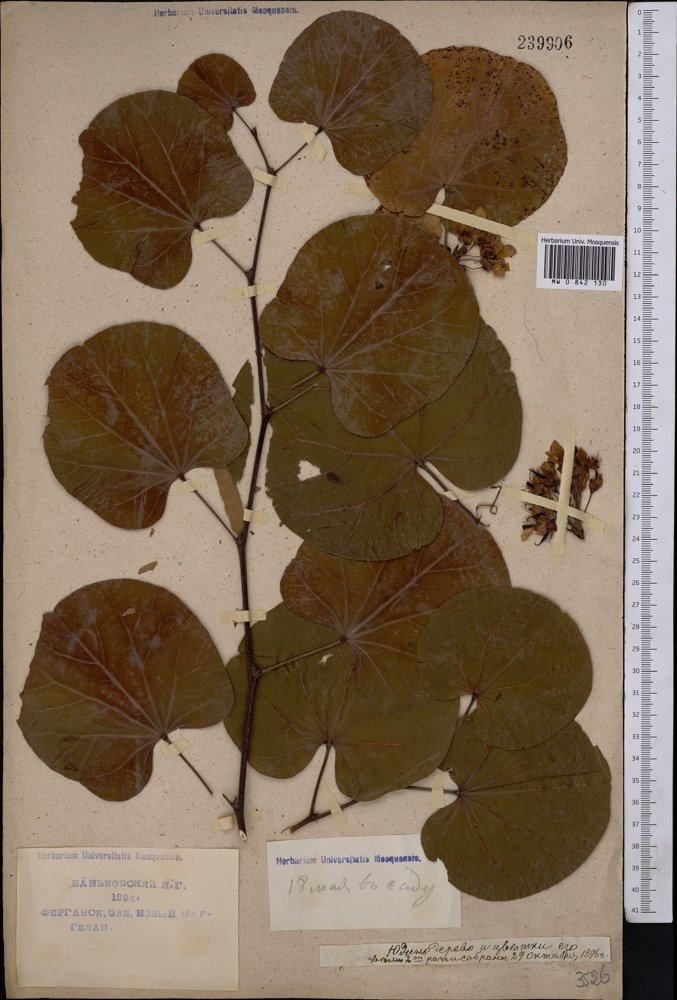
- A much branched shrub or tree 1–4 (lO)m high; branches forming a wide top; bark reddish brown at first, becoming dark brown; leaves rounded-reniform, broadly cordate at base, muticous, bright green above, bluish glaucous beneath; flowers in short clusters; pedicels 8–11mm long; calyx inflated, with short teeth; pod elongate, truncate at upper margin, coriaceous, with numerous prominent transversal nerves, the upper suture broadly wing-margined, the wing up to 3–5 mm mm broad; seeds few, oval, ca. 5–6.5 long and ca. 4–4.5mm broad, glabrous, dark brown. May (Plate I, Figure 2a). [Flora of the USSR (Tree of Life)]
- Habitat
- Fine-earth, gravelly, stony slopes, rocks, pebble beds, dry watercourse bed (wild), is cultivated in towns
- Altitudinal belts
- Low mountains, mid-mountains
- Phenology
- Flowering Apr–May, fruiting May–Aug
- Distribution
- Western Tian Shan (ranges Ugam, Kurama, Chatkal), Pamir-Alai (ranges Hissar, Karategin, Darvaz, Vakhsh, foothills of southern Tajikistan, Babatag), Kopet Dag
- Uses
- forest amelioration / agroforestry, melliferous, ornamental
- Conservation
- IUCN DD; Red Data Book of Uzbekistan, category 2; Red Data Book of Uzbekistan category 2