Species / Fabaceae
Caragana halodendron
Fabaceae · Shrub · Uzbek: kumushrang ching‘il, qizqon; Russian: Чемыш серебристый
Restoration use by landscape
Nuratau Pilot score 73 · rank 54 of 80 shortlisted · rank 61 of 640 scored
- Succession role
- Nurse / intermediate shrub
- Suited to
- Gullies & drainage lines; Riparian / sai (other); Degraded pistachio–almond woodland
- Establishment
- scarified seed, direct sowing or nursery
- Why this category
- Strong: erosion control potential, climate resilience; Weak: ecological suitability, drought tolerance; -> promising but propagation/supply or field performance not proven at scale: pilot plots
- Cautions
- needs moist sites
- Local habitat
- Wetlands (inland), Artificial aquatic, Artificial terrestrial · Occasional
Criteria scores
Kugitangtau Immediate score 83 · rank 3 of 100 shortlisted · rank 3 of 1 208 scored
- Succession role
- Nurse / intermediate shrub
- Suited to
- Eroded slopes; Landslide-prone areas; Gullies & drainage lines; Overgrazed rangelands; Riparian / sai (other); Degraded juniper woodland; Degraded pistachio–almond woodland
- Establishment
- scarified seed, direct sowing or nursery
- Why this category
- Strong: erosion control potential, climate resilience; -> routine propagation and available material: use now
- Local habitat
- Artificial terrestrial, Desert, Grassland, Rocky areas, Wetlands (inland) · Frequent
Criteria scores
Propagation
scarified seed, direct sowing or nursery
Where it fits in the degradation matrix
- Nuratau: Riparian / sai (other) (nurse)
- Kugitangtau: Eroded slopes (nurse)
- Kugitangtau: Landslide-prone areas (nurse)
- Kugitangtau: Gullies & drainage lines (nurse)
- Kugitangtau: Overgrazed rangelands (nurse)
- Kugitangtau: Degraded juniper woodland (nurse)
- Kugitangtau: Degraded pistachio–almond woodland (nurse)
- Kugitangtau: Riparian / sai (other) (nurse)
Planting combinations
- Nuratau: Gullies, sai and drainage lines (Phase 2)
- Kugitangtau: Eroded, rocky and landslide-prone slopes (Phase 2)
Planting material and suppliers
Seed collection and nursery propagation needed. No supplier found Action: Collect seed in summer 2027; direct sowing of scarified or stratified seed, or nursery stock from 2028
Description
- Morphology
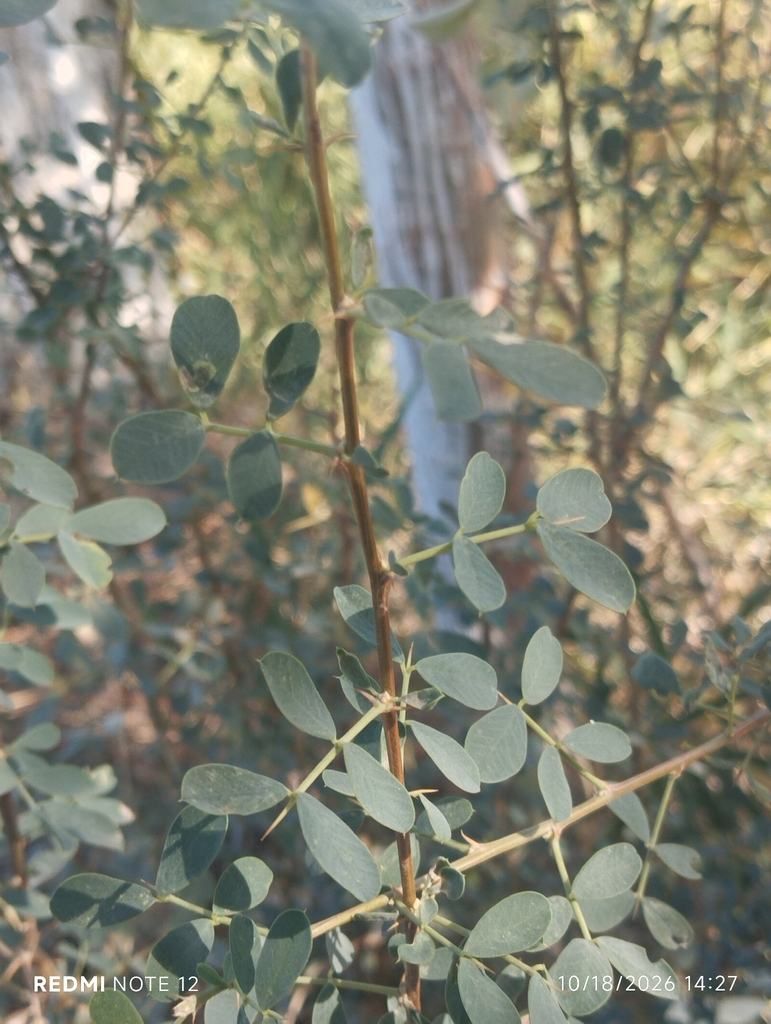
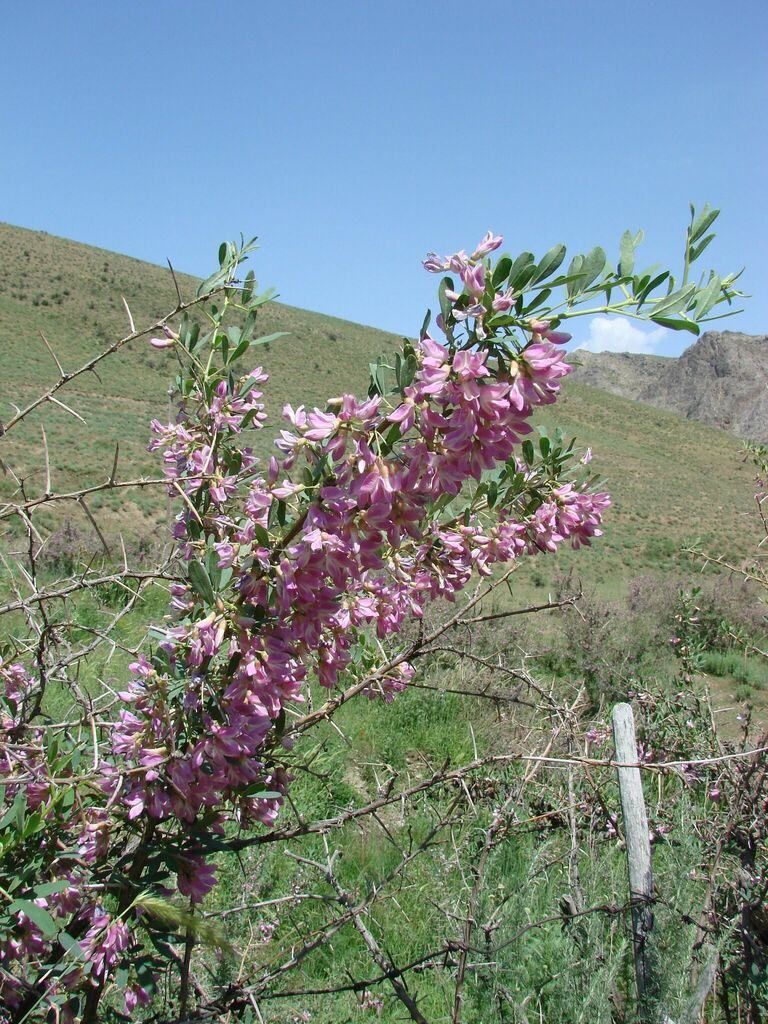
- Shrub, 0.5-2m high, with fuscous-brown bark, covered with short silky canescent-silvery appressed hairs (var.vulgare DC.) or glabrous (var. subvirescens DC.); spines 2–6cm long; leaves paripinnate, 3-3.5cem long, with 1–5 pairs of leaflets and a terminal spine 1–3mm long; stipules 2, subulate or triangular, 1–2 mm long, spinescent; leaflets obcuneate or oblong-obovate, 1.5-—3.5cm long and 2.5-—11 mm broad, emarginate, with a mucro 0.5-1mm long; flowers pedicellate, in twos or threes; racemes 3–4.5cm long and 3–4cm broad,on axillary peduncles; calyx 3-6mm long and 3-5 mm broad, the teeth broadly triangular; bracteoles paired, at base of calyx or on upper part of pedicel, 0.5mm long; corolla violet or almost white; standard 1.5cm long and 1.3mm broad, mostly retuse, with a short cuneate claw, about equaling wings and longer than claw; wings with an oblong-linear auricle 2–5mm long; keel incurved; pod glabrous, rugose, * From Greek hals — saline,and dendron — tree, “« Treatment by S.G. Gorshkova. ~ PLATE XXII. 1—Colutea buhsei (Boiss.) Shap., pod, leaf, flower; 2 -C.armena Boiss. [Flora of the USSR (Tree of Life)]
- Habitat
- Solonchaks, loess hills, outcrops of variegated rocks, tugais, bank of water bodies, pebble beds
- Altitudinal belts
- Plain, foothills, low mountains
- Phenology
- Flowering Apr–Aug, fruiting Jun–Sep
- Distribution
- Throughout Central Asia with the exception of eastern Pamir
- Uses
- forest amelioration / agroforestry, dye, forage, melliferous, ornamental
- Conservation
- IUCN NE